This website uses cookies
We use cookies to personalise content and ads, to provide social media features and to analyse our traffic. We also share information about your use of our site with our social media, advertising and analytics partners who may combine it with other information that you’ve provided to them or that they’ve collected from your use of their services.
Consent Selection
Details
  • Necessary cookies help make a website usable by enabling basic functions like page navigation and access to secure areas of the website. The website cannot function properly without these cookies.
  • Preference cookies enable a website to remember information that changes the way the website behaves or looks, like your preferred language or the region that you are in.
    • We do not use cookies of this type.

  • Statistic cookies help website owners to understand how visitors interact with websites by collecting and reporting information anonymously.
    • We do not use cookies of this type.

  • Marketing cookies are used to track visitors across websites. The intention is to display ads that are relevant and engaging for the individual user and thereby more valuable for publishers and third party advertisers.
    • We do not use cookies of this type.

  • Unclassified cookies are cookies that we are in the process of classifying, together with the providers of individual cookies.
    • __emg_sidPending
      Maximum Storage Duration: 1 dayType: HTTP Cookie
      __emg_vidPending
      Maximum Storage Duration: 1 yearType: HTTP Cookie
      nl-read-countPending
      Maximum Storage Duration: PersistentType: HTML Local Storage
Cookie declaration last updated on 8/12/26 by Cookiebot
[#IABV2_TITLE#]
[#IABV2_BODY_INTRO#]
[#IABV2_BODY_LEGITIMATE_INTEREST_INTRO#]
[#IABV2_BODY_PREFERENCE_INTRO#]
[#IABV2_BODY_PURPOSES_INTRO#]
[#IABV2_BODY_PURPOSES#]
[#IABV2_BODY_FEATURES_INTRO#]
[#IABV2_BODY_FEATURES#]
[#IABV2_BODY_PARTNERS_INTRO#]
[#IABV2_BODY_PARTNERS#]
About
Cookies are small text files that can be used by websites to make a user's experience more efficient.

The law states that we can store cookies on your device if they are strictly necessary for the operation of this site. For all other types of cookies we need your permission.

This site uses different types of cookies. Some cookies are placed by third party services that appear on our pages.

You can at any time change or withdraw your consent from the Cookie Declaration on our website.

Learn more about who we are, how you can contact us and how we process personal data in our Privacy Policy.

Please state your consent ID and date when you contact us regarding your consent.
NewsLayer.com
NewsLayer PulseLIVEBTC$77,786+1.31%ETH$2,477+2.58%SOL$94.9+1.36%XRP$1.49+0.65%DOGE$0.0915-0.74%ADA$0.2205-0.41%Total Cap$2.75T+1.24%Layer Index64 Greed

Eine neue Zutat für das Quantencomputing: Kryptongas

Eine neue Zutat für das Quantencomputing: Kryptongas Cornell Chronicle

Cornell Chronicle

Publisher

Aug 17, 2026 at 7:54 PM UTC · Updated vor 6 Tagen · 4 Min. Lesezeit

Eine neue Zutat für das Quantencomputing: Kryptongas
NewsLayer editorial artwork

Um das Quantencomputing zu kommerzialisieren, benötigen Hersteller hochwertige supraleitende Materialien für Mikrochips, aber sie brauchen auch einen zuverlässigen, nachhaltigen Nanofabrikationsprozess.

Tantal ist ein korrosionsbeständiges Metall, das das erste Kriterium erfüllt, aber nicht das zweite. Das liegt daran, dass es bei Temperaturen auf ein Substrat abgeschieden werden muss, die normalerweise 400 Grad Celsius überschreiten – zu heiß für viele aktuelle Werkzeuge von Halbleiter-Foundries.

Cornell-Forscher haben eine Methode entwickelt, die Kryptongas verwendet, um diese Abscheidetemperatur auf 200 Grad zu senken, während auf Silizium, ein standardmäßiges hochwertiges Substrat, abgeschieden wird. Der Prozess führte zu dünnen Schichten, die zudem eine wesentlich höhere elektronische Leitfähigkeit aufweisen.

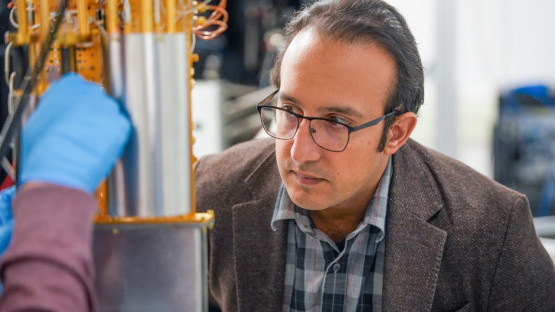
„Tantal als Material hat sich aus der Perspektive der Geräteleistung als sehr spannend erwiesen, aber seine Herstellbarkeit war aufgrund von Integrationsherausforderungen wie den erforderlichen Prozesstemperaturen mit einigen Fragezeichen versehen“, sagte Valla Fatemi, Assistenzprofessor und Aref and Manon Lahham Faculty Fellow am Cornell Duffield College of Engineering, der das Projekt leitete. „Wir haben eine relativ einfache Änderung herausgefunden, indem wir einige physikalische und materialwissenschaftliche Erkenntnisse genutzt haben, um diese Temperatur in einen Bereich zu senken, der auf Nanofabrikationssysteme in der Industrie übertragbar ist, während wir gleichzeitig gezeigt haben, dass wir in unserem akademischen Kontext eine Spitzenleistung dieser Geräte erzielen können.“

Article Intelligence

Topics

Sponsored

Ad

House — Advertise on NewsLayer
NewsLayerLearn more

NewsLayer Premium

Unlock deeper intelligence.

Ad-free reading, exclusive research, and real-time onchain insights.

Go Premium