

A new invention could significantly improve electron microscopy by integrating a small quantum computer directly into the microscope.
A Quantum Computer Could Make Electron Microscopes Far More Powerful
SciTechDaily reports that quantum computers could significantly enhance the capabilities of electron microscopes. The approach may enable more powerful analysis and imaging at microscopic scales.
SciTechDaily
Publisher
Sep 14, 2026 at 11:48 PM UTC · Updated 몇 초 전 · 5 분 소요
번역 중…
핵심 요약
- Quantum computing could improve electron microscope performance.
- The development focuses on making microscopy tools more powerful.
- The report suggests potential advances in microscopic-scale analysis and imaging.
For delicate samples such as individual proteins, electron microscopy faces a fundamental tradeoff. Producing a clearer image generally requires sending more electrons through the specimen, but increasing the dose also raises the risk of damaging the very material researchers are trying to observe.
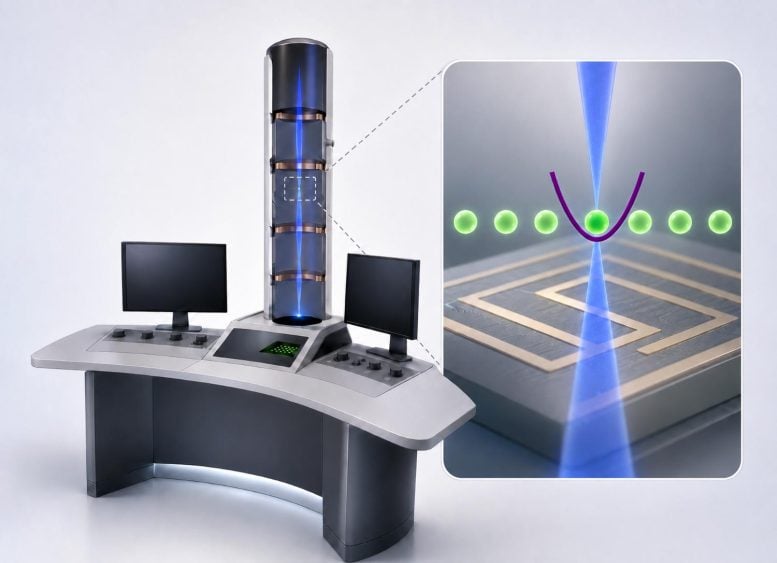
Researchers in Austria have proposed a way around that limitation by coupling an electron microscope to a quantum computer. Rather than using electrons only to form an image and discarding the additional quantum information they carry, the system would preserve and process that information. In principle, this could strengthen signals without requiring as many electrons to pass through a fragile sample.
“Today, we can image tiny details on the atomic scale,” says Philipp Haslinger from the Institute of Atomic and Subatomic Physics at TU Wien. “However, this requires a large number of electrons. And not every sample can be exposed to so many electrons without being damaged. This is often a problem, particularly when imaging biological samples such as individual proteins.”
Article Intelligence
Topics
Sponsored
Ad
NewsLayerLearn more
NewsLayer Premium
Unlock deeper intelligence.
Ad-free reading, exclusive research, and real-time onchain insights.
Go Premium