
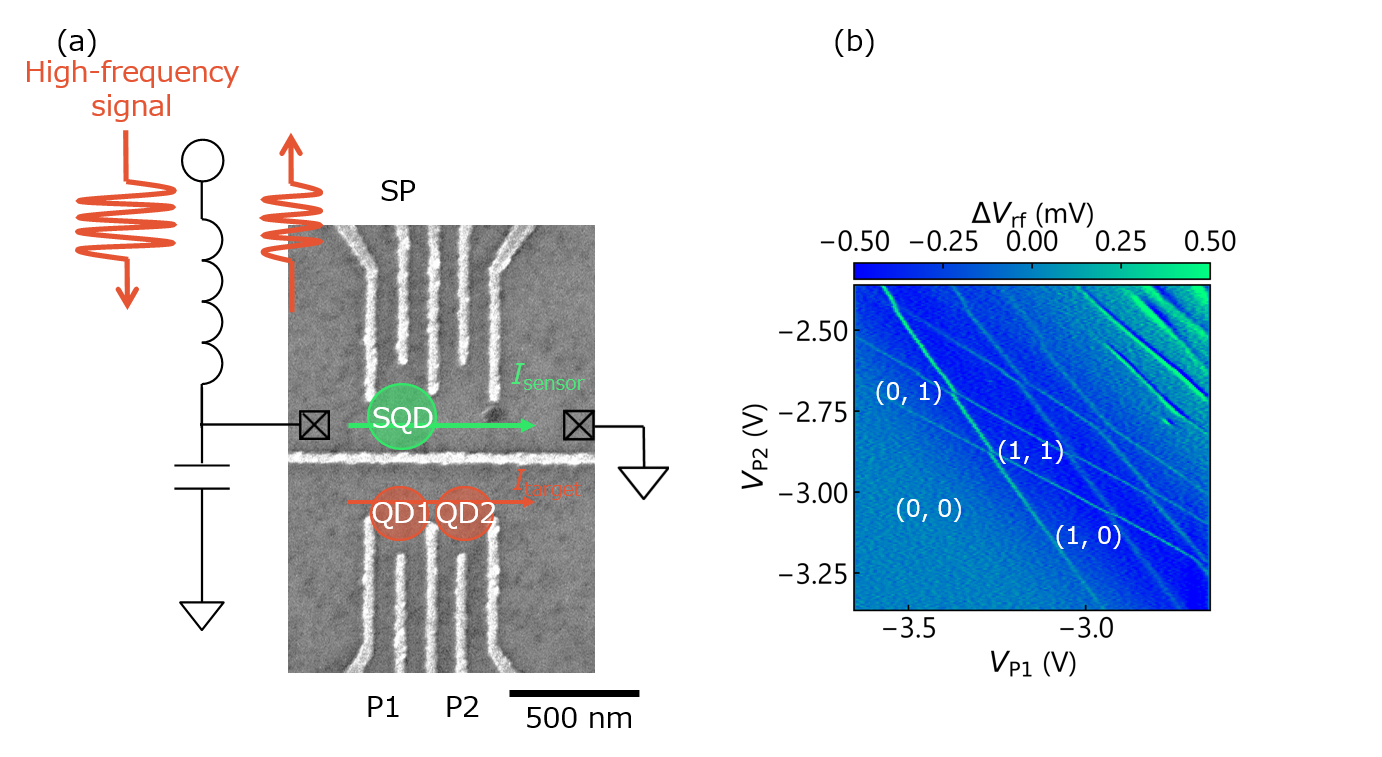
Researchers at Tohoku University, in collaboration with the National Institute for Materials Science (NIMS) and the University of Tokyo, have taken an important step toward semiconductor quantum computing using zinc oxide (ZnO). The team successfully demonstrated charge sensing, high-frequency reflectometry, and the formation of a few-electron double quantum dot in a ZnO device - three key technologies for developing and evaluating spin qubits.
Advancing Quantum Computing with Zinc Oxide Quantum Dots
Researchers at Tohoku University, in collaboration with the National Institute for Materials Science (NIMS) and the University of Tokyo, have taken an important step toward semiconductor quantum computing using zinc oxide (ZnO). The…
Asia Research News |
Publisher
Sep 30, 2026 at 8:17 AM UTC · 2 min de leitura
Traduzindo…
Semiconductor quantum dots are promising building blocks for scalable quantum computers because they can confine individual electrons and use their spins to store quantum information. Silicon and gallium arsenide have been extensively studied for this purpose, while ZnO has emerged as an alternative material with attractive properties, including a low nuclear spin environment that may help preserve electron spin states and a direct bandgap for possible optical coupling.
However, rapidly and accurately detecting the charge state of electrons in ZnO quantum dots has remained a challenge. To address this, the researchers fabricated a ZnO device containing two target quantum dots (QD1 and QD2) alongside a sensor quantum dot (SQD), which acts as a sensitive electrometer. By integrating the sensor with a radio-frequency resonant circuit, they achieved high-frequency reflectometry, enabling much faster detection of changes in electron charge.
Article Intelligence
Related Coverage
 QuantumResearchers Link Defects To Loss Of Qubit Coherencehá 2 horas · 4 min read
 QuantumResearchers Learn Quantum System With Single Qubit Readouthá 7 horas · 5 min read
 QuantumResearchers Build Fast Qubit Reader Using Spiking Netshá 8 horas · 3 min read
Sponsored
Ad
NewsLayerLearn more
NewsLayer Premium
Unlock deeper intelligence.
Ad-free reading, exclusive research, and real-time onchain insights.
Go Premium