

Artificial intelligence-enabled clinical phenotyping of human brown fat
This retrospective case–control study followed institutional guidelines and was approved by the Institutional Review Board of Memorial Sloan Kettering Cancer Center (MSK), protocol number 17-581. The requirement for informed consent was…
Nature
Publisher
Oct 14, 2026 at 5:59 PM UTC · Updated 1日前 · 17 分で読める
翻訳中…
This retrospective case–control study followed institutional guidelines and was approved by the Institutional Review Board of Memorial Sloan Kettering Cancer Center (MSK), protocol number 17-581. The requirement for informed consent was waived because the study involved secondary analysis of previously acquired PET–CT imaging and clinical data, posed no more than minimal risk to participants and could not be conducted practically with individual informed consent. All patient data were deidentified before use.
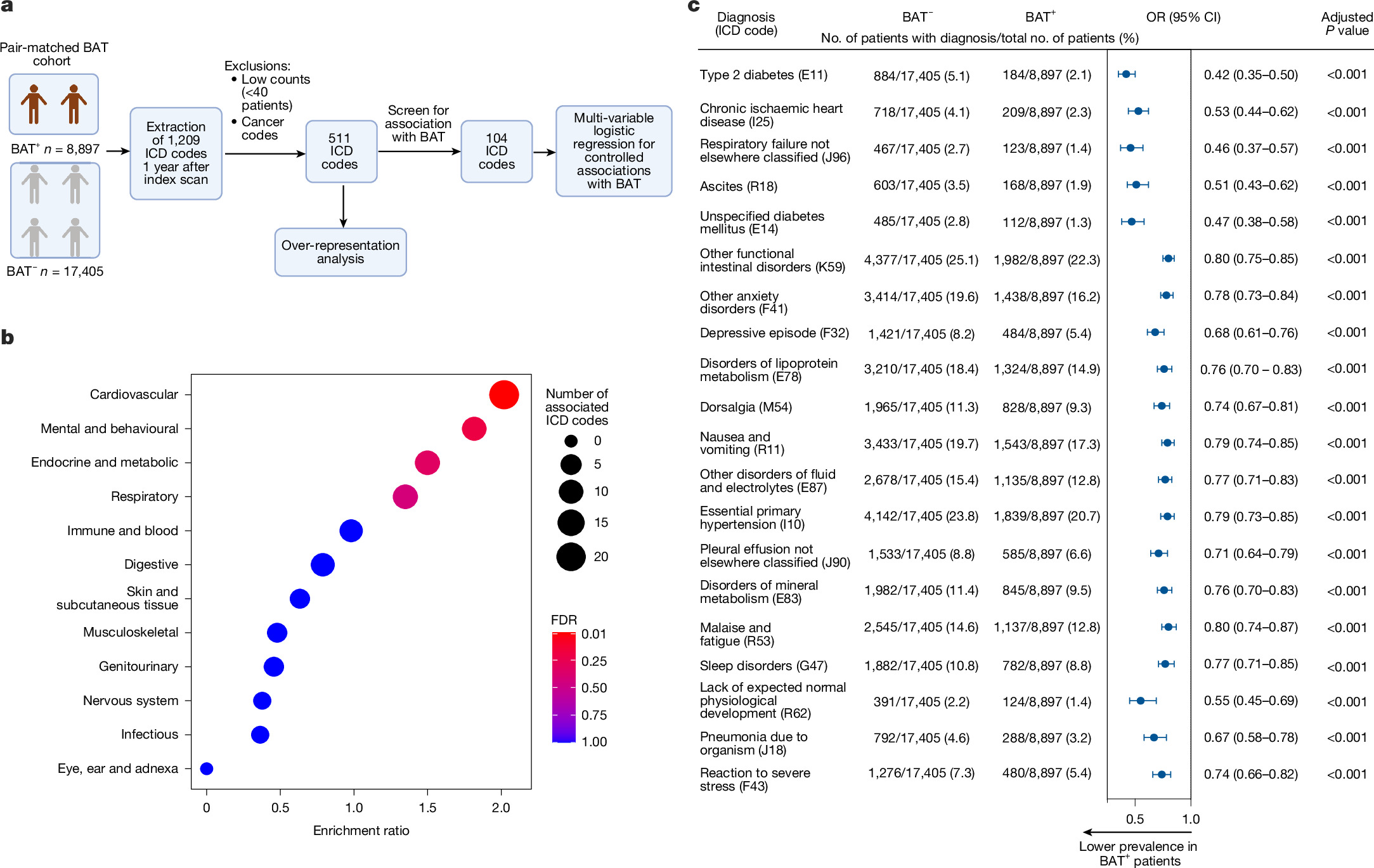
We previously established a cohort of patients with BAT by analysing 18F-FDG-PET–CT scans performed at MSK from June 2009 through March 20184. Patients who were positive for BAT in at least one scan were termed BAT+, whereas the remaining patients were grouped as BAT−. To expand this cohort, we established a new Extension BAT Cohort by following a similar strategy. We reviewed all 18F-FDG-PET–CT scans performed at MSK from patients aged 18 years and above from April 2018 through July 2024. People who were positive for BAT on at least one scan were termed BAT+, whereas the remaining patients were grouped as BAT− (Extended Data Fig. 1a and Supplementary Fig. 2). For each patient in both groups, an index scan was designated: in patients with BAT reported on at least one 18F-FDG-PET–CT scan, the first scan that reported BAT was defined as the index scan. In patients without BAT on any scan, the first 18F-FDG-PET–CT scan served as the index scan. We collected demographic, BMI, outside temperature data and pertinent ICD-9 and ICD-10 codes corresponding to cardiometabolic diseases4 (1 year after the index scan) (Supplementary Table 8) from the institutional EHR. Average outdoor temperatures in New York City were obtained from the US National Weather Service. An initial logistic regression analysis was performed on patients in the BAT+ versus BAT− groups who belonged exclusively to the Extension BAT Cohort to establish associations between BAT presence and cardiometabolic diseases. As the association of BAT presence with reduced prevalence of cardiometabolic disease was confirmed in the Extension BAT Cohort (Extended Data Fig. 1b), we proceeded to merge the Established BAT Cohort with the Extension BAT Cohort to create an Expanded BAT Cohort (Extended Data Fig. 1a). If a patient was present in both cohorts, data from the Established BAT Cohort were used.
Article Intelligence
Topics
Sponsored
Ad
NewsLayerLearn more
NewsLayer Premium
Unlock deeper intelligence.
Ad-free reading, exclusive research, and real-time onchain insights.
Go Premium