This website uses cookies
We use cookies to personalise content and ads, to provide social media features and to analyse our traffic. We also share information about your use of our site with our social media, advertising and analytics partners who may combine it with other information that you’ve provided to them or that they’ve collected from your use of their services.
Consent Selection
Details
  • Necessary cookies help make a website usable by enabling basic functions like page navigation and access to secure areas of the website. The website cannot function properly without these cookies.
  • Preference cookies enable a website to remember information that changes the way the website behaves or looks, like your preferred language or the region that you are in.
    • We do not use cookies of this type.

  • Statistic cookies help website owners to understand how visitors interact with websites by collecting and reporting information anonymously.
    • We do not use cookies of this type.

  • Marketing cookies are used to track visitors across websites. The intention is to display ads that are relevant and engaging for the individual user and thereby more valuable for publishers and third party advertisers.
    • We do not use cookies of this type.

  • Unclassified cookies are cookies that we are in the process of classifying, together with the providers of individual cookies.
    • __emg_sidPending
      Maximum Storage Duration: 1 dayType: HTTP Cookie
      __emg_vidPending
      Maximum Storage Duration: 1 yearType: HTTP Cookie
      nl-read-countPending
      Maximum Storage Duration: PersistentType: HTML Local Storage
Cookie declaration last updated on 8/12/26 by Cookiebot
[#IABV2_TITLE#]
[#IABV2_BODY_INTRO#]
[#IABV2_BODY_LEGITIMATE_INTEREST_INTRO#]
[#IABV2_BODY_PREFERENCE_INTRO#]
[#IABV2_BODY_PURPOSES_INTRO#]
[#IABV2_BODY_PURPOSES#]
[#IABV2_BODY_FEATURES_INTRO#]
[#IABV2_BODY_FEATURES#]
[#IABV2_BODY_PARTNERS_INTRO#]
[#IABV2_BODY_PARTNERS#]
About
Cookies are small text files that can be used by websites to make a user's experience more efficient.

The law states that we can store cookies on your device if they are strictly necessary for the operation of this site. For all other types of cookies we need your permission.

This site uses different types of cookies. Some cookies are placed by third party services that appear on our pages.

You can at any time change or withdraw your consent from the Cookie Declaration on our website.

Learn more about who we are, how you can contact us and how we process personal data in our Privacy Policy.

Please state your consent ID and date when you contact us regarding your consent.
NewsLayer.com
NewsLayer PulseLIVEBTC$64,678+1.36%ETH$1,911+0.17%SOL$76.82+1.21%XRP$1-0.29%DOGE$0.07-0.43%ADA$0.1755+0.68%Total Cap$2.31T+1.22%Layer Index48 Neutral
External ReportingPublished 20 hours ago

Artificial Intelligence helps Munson health care provider focus more on patients, less on screens

FORT LEAVENWORTH, Kansas — For Mikaela Altis, a physician assistant in Munson Army Health Center’s Department of Primary Care, adopting ambient listening technology has meant more eye contact with patients, more time for follow-up…

Artificial Intelligence helps Munson health care provider focus more on patients, less on screens
Publisher DVIDS 4 min read
Image via DVIDS

Layer Index

48

↑ 4 pts in 24h

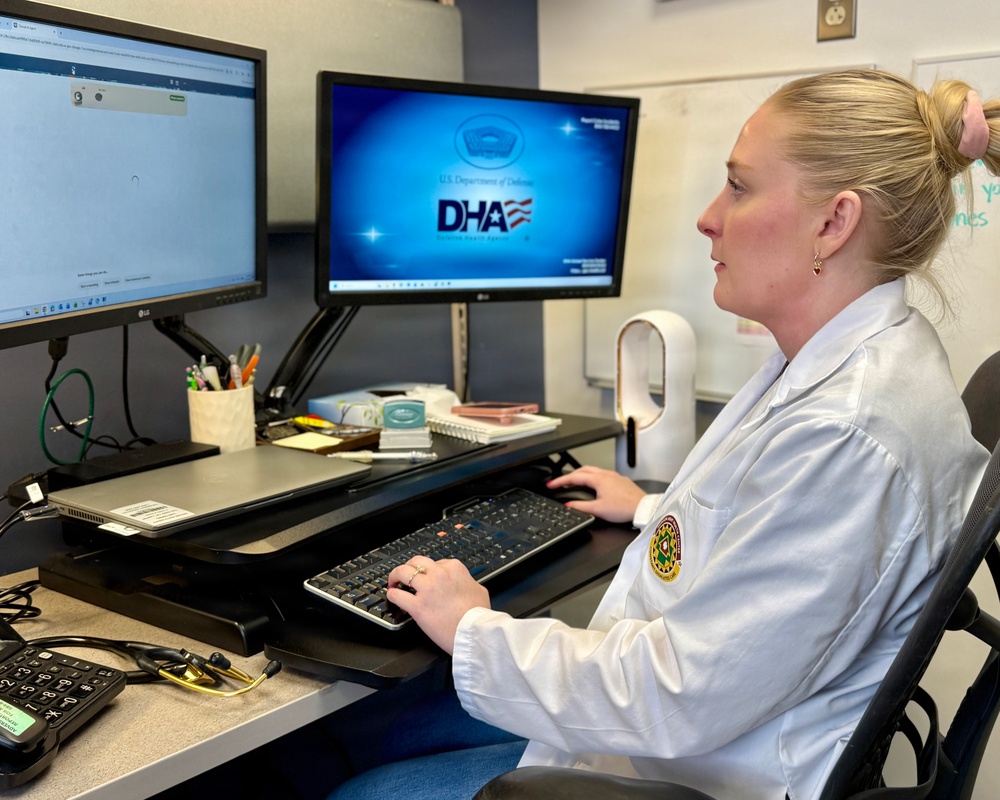
FORT LEAVENWORTH, Kansas — For Mikaela Altis, a physician assistant in Munson Army Health Center’s Department of Primary Care, adopting ambient listening technology has meant more eye contact with patients, more time for follow-up questions and fewer hours spent completing clinical notes after the workday ends.

Ambient Listening is a safe and secure artificial intelligence-enabled documentation tool that captures the conversation between a patient and provider during a medical appointment and uses the medically relevant information to generate a draft clinical note.

“It really lets us focus more on the patient during the visit,” Altis said. “A lot of times, you go into the room, and the provider is staring at the screen because they’re taking notes and clicking on things. With the ambient listening tool taking notes for us, it lets me sit, face the patient and make eye contact.”

Use of technology is voluntary for patients. Before activating it, the provider explains the tool and asks the patient for permission. If the patient declines, the recording is not started, and the appointment proceeds normally.

“It is definitely the patient’s choice,” Altis said. “If they say yes, we start the recording. If they say no, we don’t, and we complete the visit as usual.”

The system includes safeguards to protect patient information. Providers access it through their individual accounts using their unique military credentials. A recording is associated with the provider’s schedule and can only be accessed through that provider’s login. The recording automatically deletes after 24 hours.

The tool also separates medically relevant information from casual conversation. Altis said she initially wondered whether personal exchanges that help providers build rapport with patients—such as asking about their families, pets or recent moves—would appear in the medical record.

“It is very good at not pulling in the private conversation,” she said. “It only pulls in the medical conversation.”

Ambient listening does not diagnose conditions, recommend treatment or make healthcare decisions. It documents what was discussed and creates a draft for the provider to review. The provider remains responsible for evaluating the patient, determining the plan of care, correcting the note as needed and signing it.

“The thinking is still completely mine,” Altis said. “It is not adding things to the note that I didn’t say, and it is not trying to dictate what medical care I should give.”

That distinction may help reassure those who are hesitant to use artificial intelligence in a clinical setting. Altis considers ambient listening another tool available to providers, similar to standardized documentation templates. She uses it when it is appropriate for the type and complexity of the appointment.

Altis said that the technology has been especially helpful during visits involving multiple medical concerns. She estimated it can reduce her documentation time by about half for more complex appointments.

“When I’m addressing five or six things during a visit, it is saving me a ton of time,” she said. “When I’m done, I read through the note, make any corrections I need to make and sign it, rather than trying to type out the five or six things we just discussed.”

By reducing the time Altis spends documenting visits, ambient listening gives her more time to complete other patient-care responsibilities.

“I’m able to get back to patient messages sooner for urgent refills, or I may have a couple more minutes to call a patient about a test result rather than having them wait to schedule an appointment,” she said. “It is freeing up my time, which is still being used for patient care, just for some of the other things that have to be done every day.”

The technology can also improve the accuracy and timeliness of documentation when providers are unable to complete a note immediately after an appointment. Instead of trying to recall a detailed conversation several hours later, the provider can review the information captured during the visit.

“I can go back to finish a chart later and it helps me more accurately complete it rather than trying to recall what a patient said six hours earlier,” Altis said. “I can see what we talked about and what I said for the plan of care. It makes me feel like I’m giving the patient the care they deserve.”

Altis said the system was easy to learn, requiring about a day for her to become comfortable with it. She now uses ambient listening during approximately 75 to 80 percent of her appointments, depending on the type of visit.

For Altis, the benefits extend beyond documentation. Completing charts more efficiently helps her finish the workday on time and reduces the stress associated with carrying unfinished notes into the evening.

“It has helped me feel like I’m providing better care because I can be present with the patient, accurately capture what we discussed and have more time to take care of the other patients who need us,” she said.

At Munson, ambient listening is supporting healthcare delivery by giving providers more time to do what technology cannot—listen with empathy, exercise clinical judgment and connect with the person sitting across from them.

Breaking News

Never miss a breaking story

Advertisement

House — Advertise on NewsLayer
NewsLayerAd

Sourced by

Originally reported by DVIDS

NewsLayer coverage based on externally reported material.

The Daily Brief

The onchain economy, before your day starts.

Curated markets, onchain insights, and key headlines — delivered every weekday morning.

Weekdays · Free · ~5 minute read

More from Artificial Intelligence