
Insider Brief
Fermilab and CERN Begin Installation Work on DUNE Neutrino Experiment
Insider Brief PRESS RELEASE — Installation crews with the U.S. Department of Energy’s (DOE) Fermi National Accelerator Laboratory (Fermilab) and CERN, the European Organization for Particle Physics, are working alongside the Sanford…
Mohib Ur Rehman
Publisher The Quantum Insider
Nov 10, 2026 at 6:31 PM UTC · Updated 15시간 전 · 5 분 소요
Key Signal
1,300 km Neutrino beam distance
Last Updated
15시간 전
번역 중…
- Fermilab, CERN and the Sanford Underground Research Facility have begun installing the steel structures for the two massive cryostats that will house the Deep Underground Neutrino Experiment’s (DUNE) far detectors.
- Each cryostat will hold approximately 17,000 tons of liquid argon, with the experiment designed to study neutrinos sent 1,300 kilometres from Fermilab to detectors nearly a mile underground in South Dakota.
- The underground facility is expected to be completed by 2029, with detector installation scheduled for 2030 and the long-distance neutrino beam expected to begin operating by 2031.
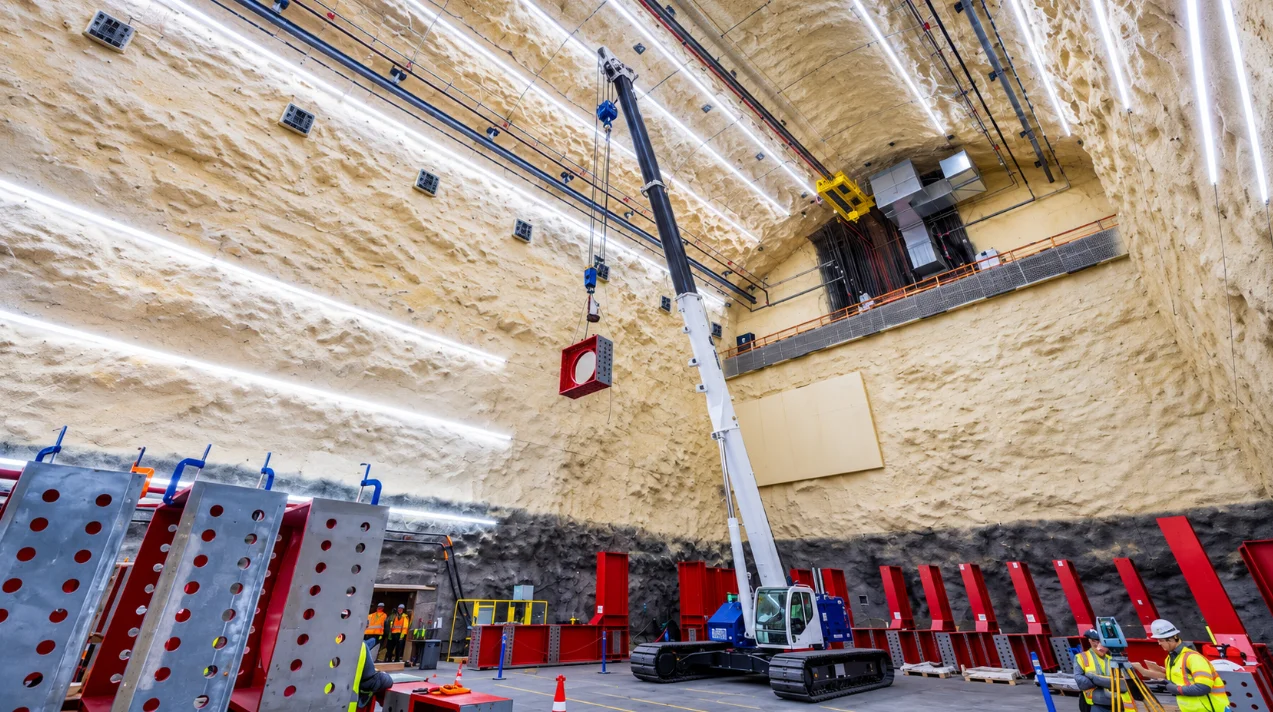
PRESS RELEASE — Installation crews with the U.S. Department of Energy’s (DOE) Fermi National Accelerator Laboratory (Fermilab) and CERN, the European Organization for Particle Physics, are working alongside the Sanford Underground Research Facility (SURF) to begin building massive cryostats, giant insulated containers designed to hold liquid argon at an extremely cold temperature, for the leading-edge Deep Underground Neutrino Experiment (DUNE).
The work is happening nearly a mile underground at SURF in Lead, South Dakota, where thousands of red steel beams were meticulously transported, one by one, from the surface down to the assembly area. Once installed, the beams will form the outer structures of the experiment’s two detector module cryostats. Each will house approximately 17,000 tons of liquid argon maintained at approximately minus 300 degrees Fahrenheit.
Article Intelligence
Topics
Related Coverage
View all related
Sponsored
Ad
NewsLayerLearn more
NewsLayer Premium
Unlock deeper intelligence.
Ad-free reading, exclusive research, and real-time onchain insights.
Go Premium