

The first US spot Bitcoin ETF is shutting down.
Hashdex Asset Management announced on August 4 that it will close and liquidate the Hashdex Bitcoin ETF (NYSE Arca: DEFI), ending a two-year effort to compete in a market now dominated by funds that are thousands of times larger. The decision makes DEFI the first spot Bitcoin exchange-traded fund in the United States to be liquidated.
As of July 30, 2026, the fund held approximately $14.7 million in assets under management, equivalent to roughly 225 BTC. Its peak was approximately $17.54 million in May 2025. That number never came close to the scale needed to cover operating costs in a category where the leading fund manages more than 3,200 times as much capital.

How the Wind-Down Works
Hashdex laid out a fixed liquidation schedule in its SEC filing.
- August 17, 2026 is DEFI’s final trading day on NYSE Arca. Investors can sell shares through their brokerage up to this date under normal conditions.
- After August 17, the fund will stop accepting new creation orders from authorized participants and will be delisted from the exchange.
- Hashdex will then sell the fund’s remaining Bitcoin holdings on the open market and settle any outstanding obligations.
- A cash liquidating distribution is expected on or around August 28, 2026, based on the fund’s net asset value at the time of liquidation, minus closing costs.
Hashdex warned that the final payout could shift significantly depending on Bitcoin’s price movements during the wind-down period. Investors who sell before August 17 will receive the market price; those who hold through liquidation receive whatever the NAV works out to after the BTC is sold and costs are deducted.
Why DEFI Never Gained Traction
DEFI has an unusual backstory. It launched in September 2022 as the Hashdex Bitcoin Futures ETF, built in partnership with Teucrium Trading and Victory Capital. It was registered under the Securities Act of 1933, making it the first Bitcoin futures ETF structured that way.
When the SEC approved spot Bitcoin ETFs in January 2024, a wave of billion-dollar products hit the market immediately. BlackRock’s iShares Bitcoin Trust (IBIT) launched on day one alongside offerings from Fidelity, Ark Invest, Bitwise, and others. Hashdex converted DEFI from a futures product to a spot fund on March 27, 2024, nearly three months later.
That delay mattered. By the time DEFI began trading as a spot product, IBIT had already accumulated billions in assets and established the liquidity and brand advantage that smaller funds couldn’t close.
Three factors worked against it:
- Late entry. DEFI arrived three months after the initial cohort. In ETF markets, first-mover advantage compounds rapidly through liquidity, tighter spreads, and institutional recognition.
- No fee advantage. At launch, DEFI charged a 0.25% expense ratio, matching what BlackRock and Fidelity charged. Without a discount, there was no economic incentive for investors to choose a smaller, less liquid product. By mid-2026, reports indicated the fee had risen to 0.94%, making it one of the most expensive options in the category.
- Scale economics. At $14.7 million in AUM, the fund’s annual fee revenue amounted to a negligible sum, nowhere near enough to sustain the compliance, custody, and infrastructure costs required to operate a regulated ETF.
Hashdex cited trading liquidity, operating costs, investor interest, and the fund’s fit within its broader product lineup as reasons for the closure.
A Market of One (and Everyone Else)
The closure of DEFI is a consolidation story, not a demand story.
The broader US spot Bitcoin ETF market holds $77.6 billion in total net assets, with lifetime cumulative net inflows totaling roughly $51.5 billion. Demand for Bitcoin exposure through regulated funds remains strong. But that demand has concentrated with striking severity.
Here’s the current landscape:
- BlackRock IBIT: $47.08 billion in net assets, $60.5 billion in cumulative net inflows
- Fidelity FBTC: approximately $9.95 billion in cumulative net inflows
- WisdomTree BTCW: $142.4 million in net assets (next-smallest after DEFI)
- Hashdex DEFI: $14.7 million in net assets (smallest, now closing)
IBIT accounts for roughly 61% of the entire category’s net assets and has absorbed the overwhelming majority of lifetime inflows. The gap between it and every other product is not narrowing.
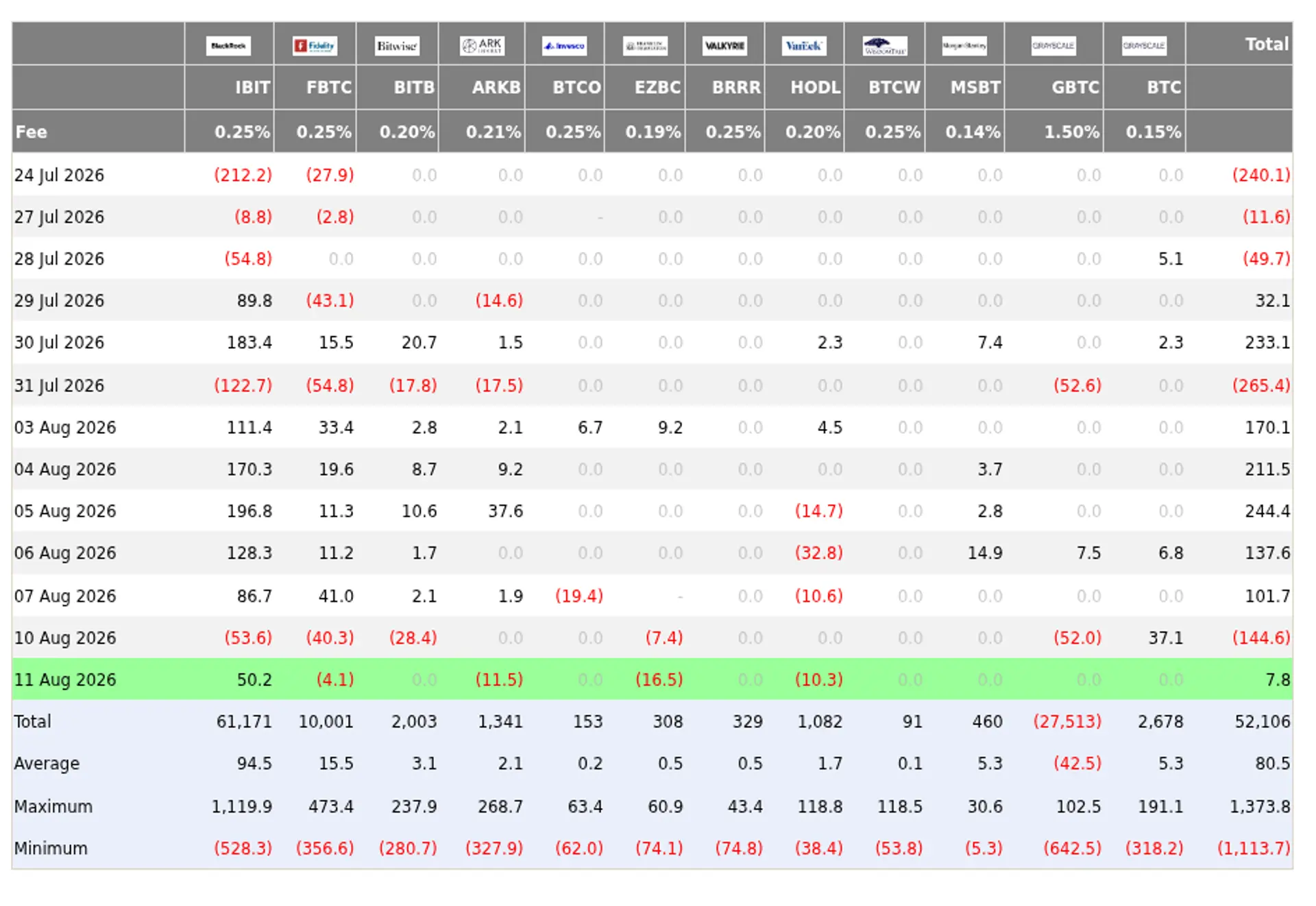
Recent flow data underscores the pattern. On August 4, US spot Bitcoin ETFs recorded $211.5 million in net inflows. BlackRock’s IBIT pulled in $170.35 million of that total, representing more than 80% of the day’s capital. Fidelity’s FBTC added $19.58 million, Ark’s ARKB contributed $9.17 million, and Bitwise’s BITB attracted $8.72 million. Morgan Stanley’s MSBT, a newer entrant, brought in $3.68 million. Invesco, Franklin Templeton, Valkyrie, VanEck, WisdomTree, and Grayscale products all recorded zero net inflows that day.