
A research team in Brazil has fabricated, operated, and characterized a flux-tunable superconducting transmon qubit coupled to a three-dimensional microwave cavity, demonstrating coherent control and quantitatively evaluating the mechanisms governing macroscopic quantum dissipation. Developed at the Quantum Device Physics Laboratory within the University of Campinas, the experimental circuit quantum electrodynamics system achieved a fundamental qubit transition frequency of 5.0122 gigahertz alongside an anharmonicity of minus 202.4 megahertz. In time-domain characterization, the device exhibited an energy relaxation time of 17.4 microseconds and a Ramsey dephasing time of 5.8 microseconds, operating within the dispersive regime. The investigation establishes an integrated workflow linking device design, microfabrication, sub-ten-millikelvin cryogenic measurement, and numerical master-equation modeling. By resolving spectroscopic signatures and temporal decay dynamics, the study provides a foundation for analyzing artificial atomic states interacting with structured electromagnetic environments.
Flux-Tunable Transmon Qubit in Three-Dimensional Cavity Reaches Seventeen Microsecond Coherence
A research team in Brazil has fabricated, operated, and characterized a flux-tunable superconducting transmon qubit coupled to a three-dimensional microwave cavity, demonstrating coherent control and quantitatively evaluating the…
Bioengineer.org
Publisher
Nov 23, 2026 at 3:28 PM UTC · 7 min read
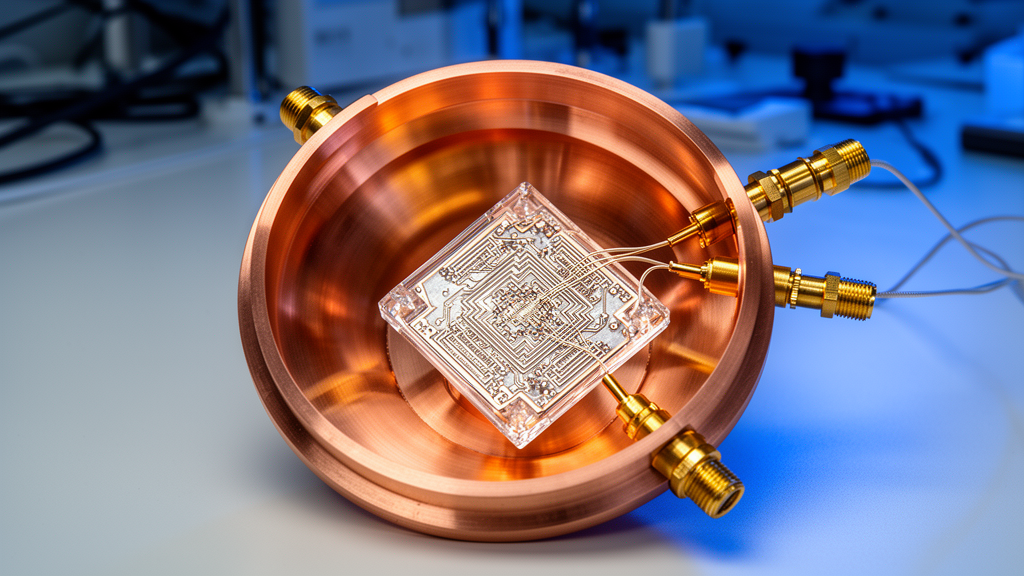
The foundational motivation for this research connects directly to the conceptual framework of macroscopic quantum tunneling and open-system dissipation formulated by Amir Caldeira and Anthony Leggett four decades ago. In their seminal work, dissipative environments were modeled as an infinite continuum of harmonic oscillators, establishing a microscopic description of how quantum superpositions lose phase coherence and decay toward thermal equilibrium when coupled to their surroundings. Superconducting circuits based on Josephson junctions realize these principles in solid-state devices where collective electromagnetic degrees of freedom exhibit quantized energy levels. Within circuit quantum electrodynamics, superconducting artificial atoms couple to discrete cavity modes, converting environmental interaction into an engineered tool for dispersive readout. The present study unites this theoretical background with modern laboratory practice, employing a Markovian Lindblad master equation to trace how physical loss channels govern relaxation and dephasing rates in a flux-tunable transmon system.
Article Intelligence
Sponsored
Ad
NewsLayer Premium
Unlock deeper intelligence.
Ad-free reading, exclusive research, and real-time onchain insights.
Go Premium