


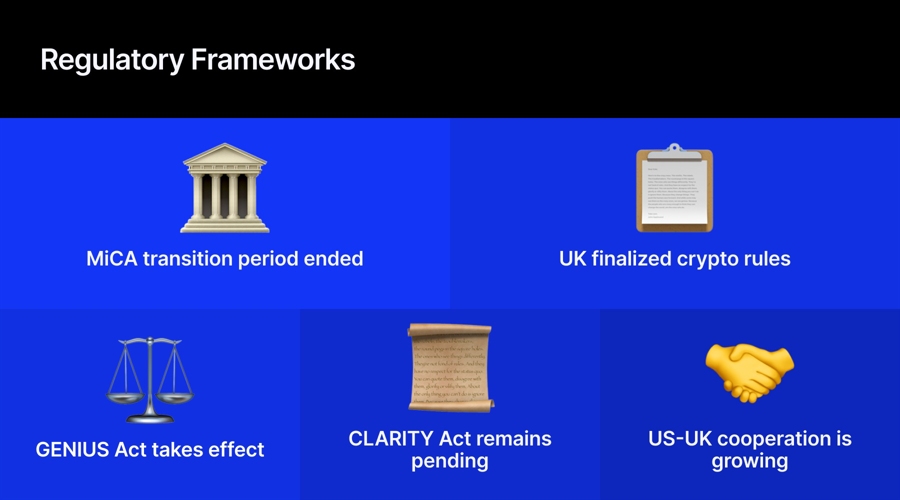
The central debate in digital asset policy used to be whether to regulate at all. That question is now settled. MiCA's transitional period ended July 1st, 2026; the UK finalized its cryptoasset rulebook on June 30th; the US celebrated the one-year anniversary of the GENIUS Act becoming law; and the SEC and CFTC issued joint guidance in mid-March that classified many digital assets as digital commodities.
From MiCA to GENIUS: Why Crypto's Next Regulatory Test Is Cross-Border Coordination
The central debate in digital asset policy used to be whether to regulate at all. That question is now settled. MiCA's transitional period ended July 1st, 2026; the UK finalized its cryptoasset rulebook on June 30th; the US celebrated…
Finance Magnates
Publisher
Aug 14, 2026 at 5:29 AM UTC · 13 phút đọc
Đang dịch…
What now keeps industry participants and policymakers up at night is whether rules written in Washington, London, and Brussels can interoperate and work alongside one another.
Where We Are
The end of MiCA's transitional period triggered a major shakeout in the European market. Of the more than 1,200 firms previously operating under national frameworks, only around 244 secured authorization. The UK's full regime goes live in October 2027, while in the US, perpetual futures were brought onshore in May 2026, the GENIUS Act takes effect in January 2027, and negotiators continue work to finalize and pass the CLARITY Act.
Recently, the Transatlantic Taskforce for Markets of the Future issued a joint US-UK statement affirming stablecoins as an important vehicle for innovation in digital money and committed to working together to develop clear, consistent regulatory pathways forward to enable stablecoins to flourish between the two jurisdictions.
Article Intelligence
Topics
Related Coverage
 CryptoStrategy’s Unrealized Bitcoin Loss Narrows to $4.77 Billion9 phút trước · 1 min read
 CryptoBitcoin Inches Towards $70,000 After Trump Calls For Passage Of Crypto Bill9 phút trước · 2 min read
 CryptoCrypto and payment services: key compliance updates (23 Jul – 19 Aug)10 phút trước · 1 min read
Sponsored
Ad
NewsLayerLearn more
NewsLayer Premium
Unlock deeper intelligence.
Ad-free reading, exclusive research, and real-time onchain insights.
Go Premium