

Guest Post by Ofir Joseph, Quantum Communication Researcher, University of Haifa, and Head of the Cybersecurity Program, Academic College of Tel Aviv–Yaffo
breaking
Guest Post: After DeepMind’s RSA Results, The Case For QKD on Critical Links
Guest Post by Ofir Joseph, Quantum Communication Researcher, University of Haifa, and Head of the Cybersecurity Program, Academic College of Tel Aviv–Yaffo Prof. Irit Hadar, Dean, Faculty of Computer and Information Science & Director,…
Matt Swayne
Publisher The Quantum Insider
Nov 25, 2026 at 12:27 PM UTC · Updated há 16 horas · 5 min de leitura
Traduzindo…
Prof. Irit Hadar, Dean, Faculty of Computer and Information Science & Director, Center for Cyber, Law and Policy, University of Haifa
Miriam Shtilman, Tal Ventures
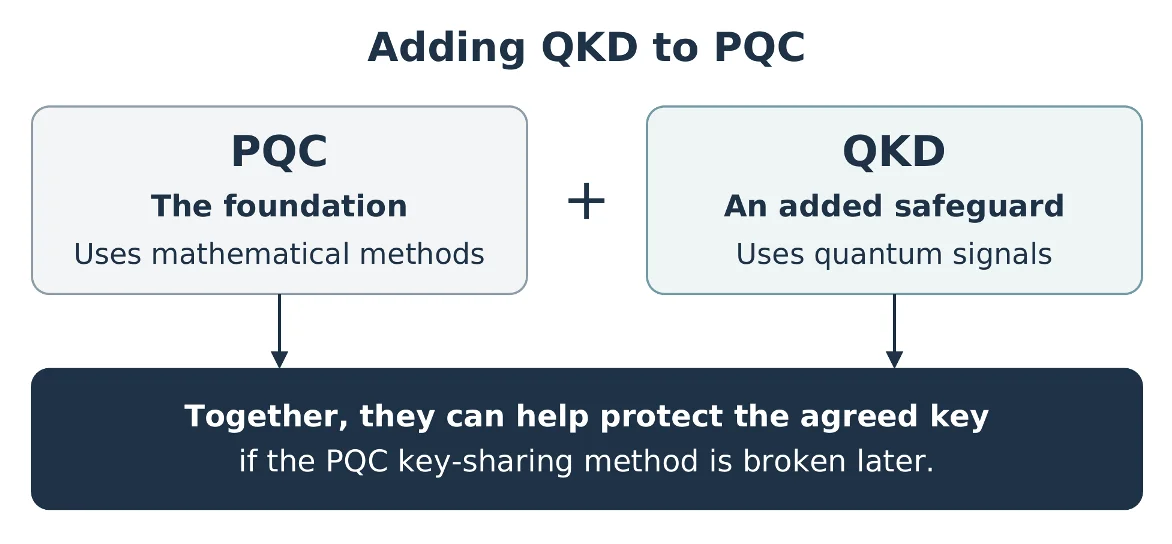
AI is helping researchers improve attacks on cryptography. Quantum key distribution can work alongside post-quantum cryptography to give selected critical connections extra protection against future attacks on how encryption keys are shared.
Google DeepMind’s November working papers show how AI can help researchers improve cryptographic attacks. One repeated a computation used in RSA-1024 signature attacks more efficiently, after billions of advance calls to a signing interface accepting chosen numerical inputs. It did not recover the private key. Another proposed theoretical savings when attacking many RSA keys of the same size through shared work; it has not been implemented. Neither demonstrated a practical break of deployed RSA-2048.
Peer-reviewed studies have also used AI to analyse simplified versions of encryption methods and exploit information leaking from particular devices. These results do not demonstrate a mathematical break of today’s standardised post-quantum algorithms.
Article Intelligence
Topics
Regulation Signal
in progressUpdated há 4 meses
SEC Crypto Asset Market Structure RulemakingRelated Coverage
 Artificial IntelligenceCompanies beefing up security to prevent AI agents from going roguehá 8 horas · 1 min read
 Artificial IntelligenceAI labs likely sitting on cryptography ‘bombshells,’ computer scientist sayshá 4 horas · 2 min read
 CryptoNvidia To Exit Investors' Crypto Chips Case For $290Mhá 8 horas · 1 min read
Sponsored
Ad
NewsLayerLearn more
NewsLayer Premium
Unlock deeper intelligence.
Ad-free reading, exclusive research, and real-time onchain insights.
Go Premium