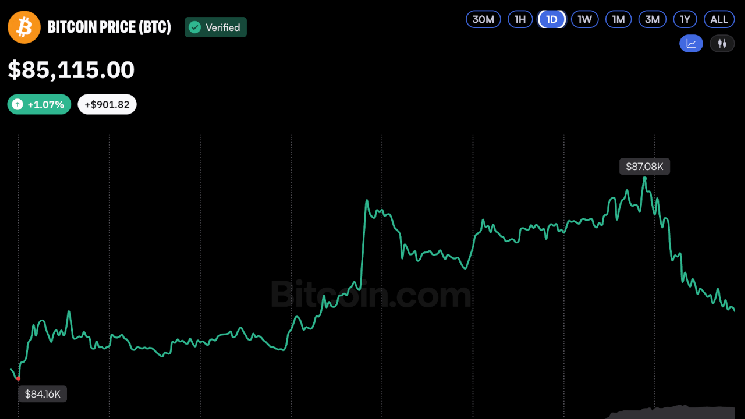

Responding to Inflation and Currency Pressures
Inflation has pushed many companies to rethink how they hold value. When cash reserves lose purchasing power, the question becomes how to offset that risk.
Bitcoin often enters that conversation because of its fixed supply. It is not subject to the same degree of expansion as fiat currencies. Some organizations have started exploring it as part of a broader response to economic uncertainty.
That does not remove volatility or risk. Treasury teams are now looking beyond traditional tools when planning for long-term stability. The discussion became more visible after periods of elevated inflation and rising interest rates placed pressure on idle corporate cash reserves that traditionally sat in low-yield accounts or short-duration instruments.
For companies in markets with volatile local currencies, the issue may be less about outperforming inflation and more about preserving optionality. A treasury team that receives revenue in a weakening currency may look at whether part of its surplus cash should remain in that currency, be converted into dollars or euros, or be placed into an alternative reserve asset. Bitcoin is sometimes considered within that mix, not because it removes macroeconomic risk, but because it introduces a different source of exposure than simply holding more local cash.
Where Bitcoin Fits in Cross-Border Treasury Operations
Managing funds across borders comes with its own set of challenges. Currency conversions, banking delays, and layered approvals can slow things down.
Bitcoin offers a more direct route in certain situations. Transfers can occur without the need for multiple intermediaries, thereby reducing both time and administrative effort. This can improve the flow of funds between locations for companies with international operations. The process has the ability to simplify specific aspects of a broader treasury system even without being a universal solution.
For example, a company that moves funds between international subsidiaries could otherwise face multiple banking fees, settlement delays, and foreign exchange conversions before the capital becomes available. Digital asset transfers can remove some of those operational layers, but are still subject to regulatory and compliance requirements.
This does not mean a treasury can simply send Bitcoin instead of using banks. In practice, the use case tends to be narrower. A company might use a digital asset transfer to move value between entities or counterparties more quickly, then convert back into fiat at the destination. Even then, the treasury would need clear policies around wallet controls, approved counterparties, sanctions screening, tax treatment, and documentation for auditors. The operational appeal is speed and fewer intermediaries, but the governance burden does not disappear.
Integrating Bitcoin Into Treasury Reporting and Controls
When companies start to hold digital assets, financial reporting becomes more complicated. Businesses should be aware that the valuation, accounting treatment, and disclosure are still developing.
So while the broader standards are still in the works, early adopters are creating their own internal standards. Important aspects include the frequency of valuation updates and how price changes are accounted for in the financial statements. In the longer term, these practices could be standardized, but for now, companies are developing frameworks that fit with their risk appetite and reporting requirements.
In practice, this may include such items as custody authority, storage of private keys, use of third-party custodians, and reporting of unrealized gains or losses in quarterly reports. These operational questions are as important as the investment thesis.
For treasury teams, this is where Bitcoin stops being just an asset-allocation question and becomes a controls question. Who is authorized to approve a purchase or sale? Who holds the private keys or controls the relationship with a custodian? How often is the position marked to market? What happens if the price falls by 20% in a week? Is the asset classified as a long-term reserve, a treasury investment or an operational liquidity tool? Each of those decisions affects internal reporting, board oversight and how finance leaders explain the position to auditors and investors.
Managing Volatility and Risk Exposure
Volatility remains a key consideration due to the fact that Bitcoin can move quickly, and those swings can affect short-term valuations.
That’s why most companies proceed with caution. Bitcoin is often held alongside more stable assets, as allocations are often limited. Also, organizations are looking more to hedging strategies to help reduce exposure in times of high volatility.
The goal isn’t to eliminate risk; it’s to manage it in a manner consistent with a broader financial plan. Some treasury teams also have internal thresholds that dictate when to rebalance, reduce, or temporarily pause positions during periods of heightened market volatility.
In practical terms, that can mean setting a maximum allocation, defining a minimum cash buffer that must stay in traditional accounts, or requiring treasury committee approval before increasing exposure. Some companies may also separate the decision to hold Bitcoin from the decision to use it operationally. Holding a reserve position is one type of risk. Using Bitcoin as part of payment flows or intercompany transfers introduces another, because timing, counterparty and settlement risks become more immediate.
Strategic Positioning and Market Perception
A company’s image can be affected if it holds Bitcoin. This choice can be seen as a willingness to engage with newer financial systems and technologies.
That perception could matter in sectors where innovation is key. For public companies in particular, the decision may also shape how shareholders, analysts and lenders interpret treasury discipline. Companies are holding Bitcoin for more than image; it’s often part of a bigger strategy that looks at the opportunities against the risks. In some sectors, particularly technology and fintech, digital asset exposure may also influence how investors interpret a company’s appetite for innovation, risk management, and long-term positioning within evolving financial infrastructure.
That perception can cut both ways. Supporters may view a Bitcoin allocation as a signal that management is willing to explore nontraditional reserve strategies. Critics may view it as introducing unnecessary balance-sheet volatility into a function that is supposed to be conservative. As a result, the strategic question is not only whether Bitcoin has a treasury use case, but whether management can explain that use case clearly to boards, investors and internal stakeholders.
The Long-Term Role in Corporate Finance
The interest in Bitcoin is driving a shift in how companies approach treasury management. More and more tools are becoming available, and digital assets are becoming part of that landscape.
The way companies use Bitcoin varies, as it can be treated as a reserve asset or used for payments or liquidity. How it fits within an overall strategy is what matters most to companies.
In the end, Bitcoin does not replace traditional treasury tools. It adds another option. And that extra flexibility may become more important for companies working in a global, always-on economy as financial systems change. Bitcoin is not seen as a complete replacement for traditional treasury models. Instead, it is viewed as one part of a broader corporate liquidity strategy that balances accessibility, risk, inflation, and operational flexibility.
For that reason, the most useful treasury question is often narrower than “Should a company buy Bitcoin?” It is whether a digital asset can serve a defined treasury objective better than the alternatives available. That objective might be diversification of strategic reserves, faster movement of value across borders, access to round-the-clock liquidity or a hedge against specific currency risks. If the answer is yes, Bitcoin may earn a place in a limited portion of the treasury toolkit. If not, it remains an asset to monitor rather than hold.
Investing involves risk, and your investment may lose value. Past performance gives no indication of future results. These statements do not constitute and cannot replace investment advice.
The information provided in this article is for general informational and educational purposes only. It is not intended as legal, financial, medical, or professional advice. Readers should not rely solely on the content of this article and are encouraged to seek professional advice tailored to their specific circumstances. We disclaim any liability for any loss or damage arising directly or indirectly from the use of, or reliance on, the information presented.