
Improving the robustness of binary classifiers in cryptocurrency exchange rate forecasts
The source is the public Binance Data Vision archive for USDS-M perpetual-futures trades. The reconstruction used March–May 2025 files and 28,157,374 trades in total: 6,809,556 MLNUSDT, 6,289,933 PLUMEUSDT, and 15,057,885 SIRENUSDT…
Nature
Publisher
Sep 21, 2026 at 1:55 PM UTC · 3 min read
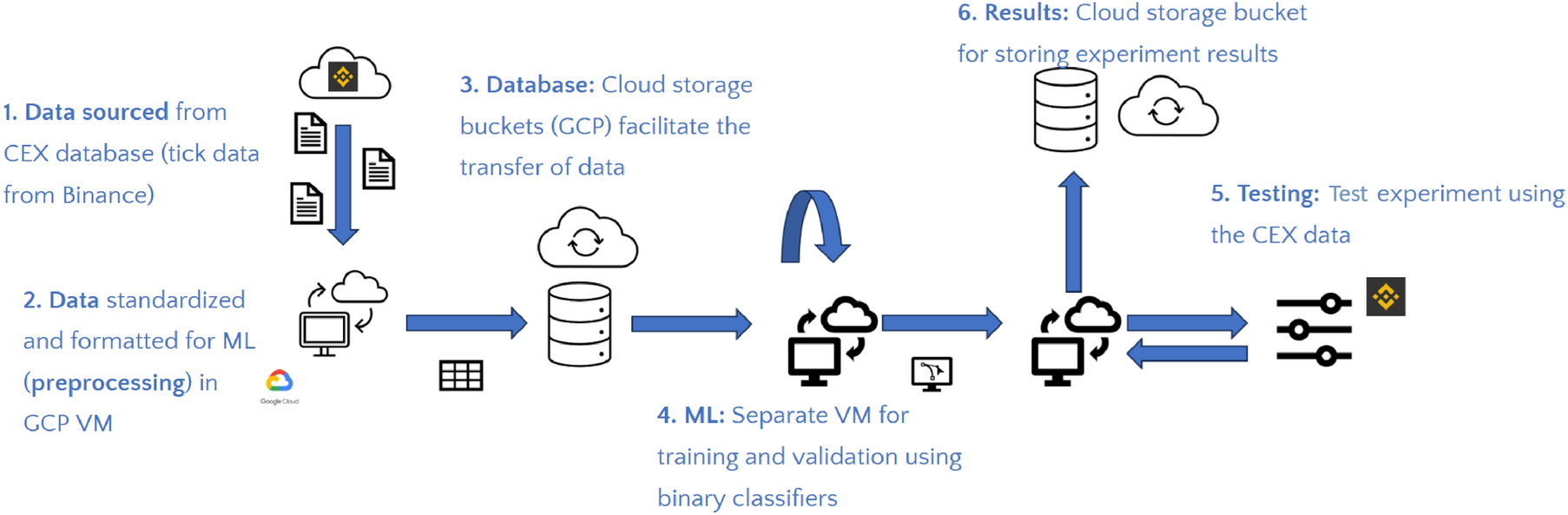
The source is the public Binance Data Vision archive for USDS-M perpetual-futures trades. The reconstruction used March–May 2025 files and 28,157,374 trades in total: 6,809,556 MLNUSDT, 6,289,933 PLUMEUSDT, and 15,057,885 SIRENUSDT observations. The first archived observations occur at 13:00:25 UTC on 21 March for PLUMEUSDT, 09:00:13 UTC on 22 March for SIRENUSDT, and 08:45:08 UTC on 31 March for MLNUSDT. Consequently, every usable ratio history is shorter than the nominal three-month window. Table 1 makes this listing bias explicit.
Trades are sorted by exchange timestamp and trade identifier. No duplicate rows were found. The archive contains 1,228 identifier-gap events (1,329 missing identifiers) for MLNUSDT, 500 (516) for PLUMEUSDT, and 1,684 (1,812) for SIRENUSDT. These are reported as diagnostics, not automatically labeled exchange outages. For each pair, the union of timestamps is formed; each leg’s most recently observed trade price is carried forward, and the ratio is emitted only after both legs have been observed. This deterministic as-of rule prevents look-ahead but can retain a stale leg, which is treated as a limitation rather than hidden by interpolation.
Article Intelligence
Sponsored
Ad
NewsLayerLearn more
NewsLayer Premium
Unlock deeper intelligence.
Ad-free reading, exclusive research, and real-time onchain insights.
Go Premium