

Liquidation Cascades Explained: How $19 Billion in Crypto Vanished in a Single Day
Most crypto speculation doesn’t happen in the spot market, where buyers own actual coins; rather, it happens in perpetual futures, derivative contracts that let a trader control, say, $100,000 of bitcoin exposure with $10,000 of margin.…
Bitcoin News
Publisher
Aug 15, 2026 at 11:37 AM UTC · 3 dk okuma

Entities
bitcoin
Last Updated
2 ay önce
Çevriliyor…
- Oct. 10, 2025 saw $19B liquidated from 1.6M traders, crypto’s largest forced sell-off on record.
- Feb. 1, 2026’s ‘Black Sunday II’ erased $2.2B in 24 hours, with ethereum longs alone losing $961M.
- Data shows leverage rebuilt after each 2026 flush, leaving the next cascade one headline away.
The Machine Behind the Margin Call
Most crypto speculation doesn’t happen in the spot market, where buyers own actual coins; rather, it happens in perpetual futures, derivative contracts that let a trader control, say, $100,000 of bitcoin exposure with $10,000 of margin. When the price moves against the position far enough that the collateral can no longer cover potential losses, the position is automatically sold into the open market.
That automatic sale is where cascades begin, as each forced sell pushes the price down a little more, which pushes the next trader’s position below its maintenance threshold, triggering another forced sell. In a market with billions of dollars of open interest (the total value of outstanding derivative contracts) stacked at similar price levels, one sharp move can knock positions over like dominoes for hours.
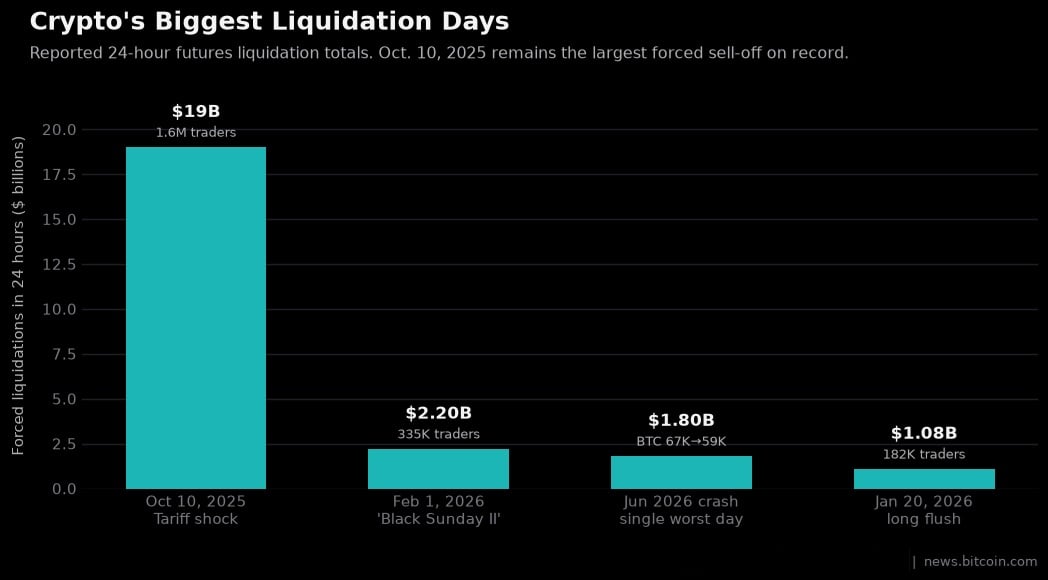
And while exchanges do have shock absorbers, they come with their own sharp edges. To elaborate, every major derivatives venue runs an insurance fund meant to cover positions that go underwater faster than they can be closed. When the fund can’t keep up, platforms resort to auto-deleveraging, forcibly closing the positions of profitable traders on the other side of the trade to balance the books.
Market Context
Bitcoin
BTC
$80,319
-0.25% (24H)
Market Cap
$1.61T
24H Volume
$14.8B
24H High
$80,919
Article Intelligence
Key Entities
Hyperliquidbitcoin
Topics
Related Coverage
 CryptoBitcoin Faces Potential Second Consecutive Red Octoberbir saat önce · 1 min read
 CryptoElectrum Patches Flaw That Let Rogue Servers Hijack Bitcoin Fee Bumps2 saat önce · 1 min read
 CryptoSygnum and Debifi Launch MultiSYG: Bank-Backed, Multisig Bitcoin Loans with Client Control8 saat önce · 1 min read
Sponsored
Ad
NewsLayerLearn more
NewsLayer Premium
Unlock deeper intelligence.
Ad-free reading, exclusive research, and real-time onchain insights.
Go Premium