
Perfect Quantum Information Transfer
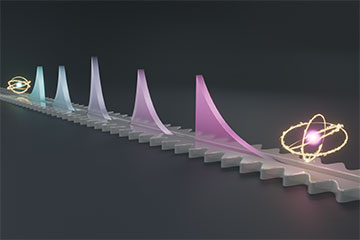
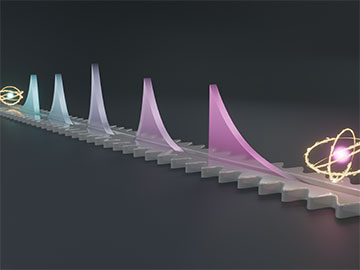
The photon changes shape during propagation. [Image: Oliver Diekmann / TU Wien]
Optics & Photonics News
Publisher
Sep 23, 2026 at 2:26 PM UTC · 2 dk okuma
Çevriliyor…
The photon changes shape during propagation. [Image: Oliver Diekmann / TU Wien]
Quantum networks that facilitate the transmission of information in the form of qubits are the basis of modern quantum technologies. Photons are used to transfer an excitation from one qubit to another, distant qubit—but with conventional methods, the second qubit can only absorb the photon pulse about 54% of the time.
To boost absorption efficiency, researchers at TU Wien in Austria propose a dispersion-engineered waveguide that reshapes the photon pulse into its time-reversed counterpart (Phys. Rev. Lett., doi: 10.1103/m2md-rxkv). The theoretical work may open the door to more efficient and simpler architectures for quantum communication and quantum computation.
“This allows the second qubit to perfectly absorb the photon and therefore enables perfect quantum information transfer,” said study author Zeyu Kuang., a postdoctoral researcher at TU Wien’s Institute of Theoretical Physics. “What makes our approach different from traditional methods is that it is entirely passive.”
Time-reversal symmetry
Quantum information is transferred between two qubits when one qubit spontaneously decays to its ground state and emits a photon pulse. The photon pulse then travels through a waveguide to a second qubit, which absorbs the photon pulse and jumps to an excited state.
Article Intelligence
Topics
Sponsored
Ad
NewsLayerLearn more
NewsLayer Premium
Unlock deeper intelligence.
Ad-free reading, exclusive research, and real-time onchain insights.
Go Premium