
Quantum computers promise to solve problems that would stump even the most powerful supercomputers on Earth, from designing better batteries and cleaner industrial catalysts to simulating molecules and materials too complex for conventional machines. But the same quantum properties that give these devices their extraordinary potential also make them extraordinarily fragile. Now, researchers from Rutgers University, IBM and a network of collaborating institutions have demonstrated a critical capability on the road to practical quantum computing: a quantum computer that can repeatedly check what is happening inside it and respond while it is running, resetting parts of the system to bring chaotic behavior under control. The experiment, published in Nature Physics, is among the largest demonstrations to date of real-time quantum feedback control, a capability widely considered essential for the fault-tolerant quantum computers of the future.
Quantum Computer Learns to Police Itself in Landmark Error-Control Experiment
Quantum computers promise to solve problems that would stump even the most powerful supercomputers on Earth, from designing better batteries and cleaner industrial catalysts to simulating molecules and materials too complex for…
Bioengineer.org
Publisher
Oct 9, 2026 at 9:58 PM UTC · 6 dk okuma
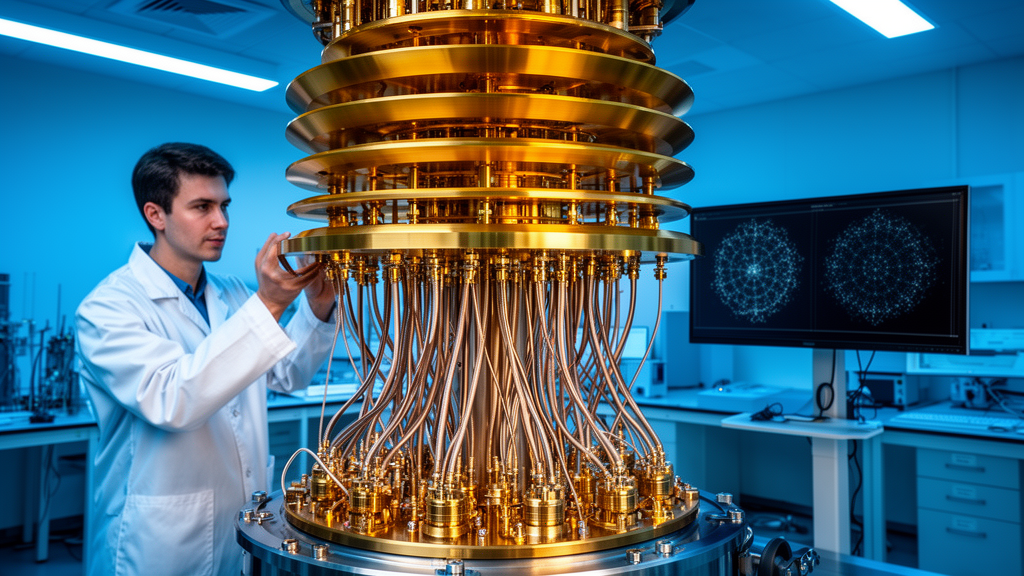
To understand why this matters, it helps to consider how quantum computers differ from the machines on our desks. Conventional computers store information in bits, each of which is either a 0 or a 1. Quantum computers use qubits, which can exist in a superposition, meaning they hold multiple possibilities between 0 and 1 until they are measured, at which point each produces one result or the other. This strange property, governed by the unusual rules that govern atoms and other extremely small particles, is what gives quantum computers their potential power. It is also what makes the information they carry so sensitive. Heat, stray electromagnetic signals, imperfect control pulses and tiny flaws in the hardware can all alter a qubit’s state, and over time the resulting errors can accumulate until a calculation can no longer be trusted.
Article Intelligence
Topics
Sponsored
Ad
NewsLayer Premium
Unlock deeper intelligence.
Ad-free reading, exclusive research, and real-time onchain insights.
Go Premium