
Insider Brief
Quantum Computers Need 100,000-Fold Performance Gain For Scientific Utility, Study Finds
Insider Brief A new benchmark could give researchers and buyers a more practical way to compare quantum computers by measuring how much computation they can complete successfully and how quickly they can do it. The new benchmark also…
Matt Swayne
Publisher The Quantum Insider
Sep 15, 2026 at 8:27 AM UTC · Updated 11시간 전 · 8 분 소요
번역 중…
- The QUOPS benchmark measures how much computation a quantum computer can complete successfully and how quickly it can perform the work.
- Tests found that Quantinuum’s Helios handled larger circuits, while Google’s Willow and IBM’s Boston completed operations at higher rates.
- The study estimates that current quantum computing capability must increase about 100,000-fold to reach the scientific workloads examined.
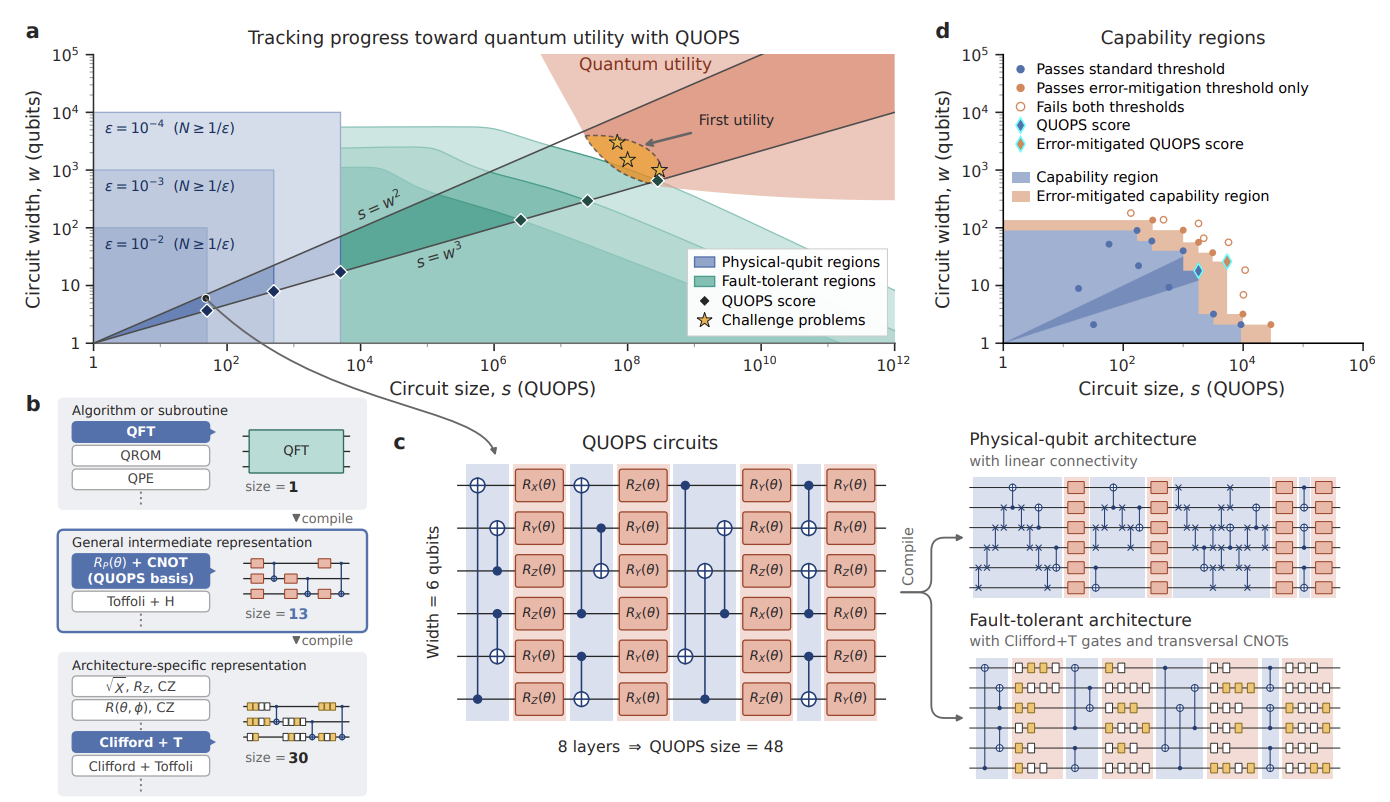
A new benchmark could give researchers and buyers a more practical way to compare quantum computers by measuring how much computation they can complete successfully and how quickly they can do it.
The new benchmark also indicates that future quantum computers will need a significant performance boost — in the 100,000-fold range — to tackle high-value scientific problems.
The Quantum Universal Operations Performance System, or QUOPS, measures the largest useful-sized test circuit a quantum computer can run above a set accuracy threshold. It also records the rate at which the machine performs those operations.
Researchers tested the benchmark on processors from Quantinuum, Google and IBM, according to a study posted on the preprint server arXiv. They also applied it to a small fault-tolerant processor built with up to eight logical qubits on Quantinuum’s Helios-1 system.
Article Intelligence
Related Coverage
 QuantumMagnets could help quantum computers talk to each other, says researcher한 시간 전 · 1 min read
 ResearchFujitsu Releases Open Quantum Application Research Package as Open Source14시간 전 · 5 min read
Sponsored
Ad
NewsLayerLearn more
NewsLayer Premium
Unlock deeper intelligence.
Ad-free reading, exclusive research, and real-time onchain insights.
Go Premium