
Insider Brief
Researchers Explore Quantum Inspired AI Repair
Insider Brief Researchers have developed a method that repairs repetitive reasoning in small language models by changing selected internal weights, with a separate quantum hardware experiment testing a possible route for future work.…
Matt Swayne
Publisher The Quantum Insider
Nov 11, 2026 at 3:48 PM UTC · Updated an hour ago · 3 min read
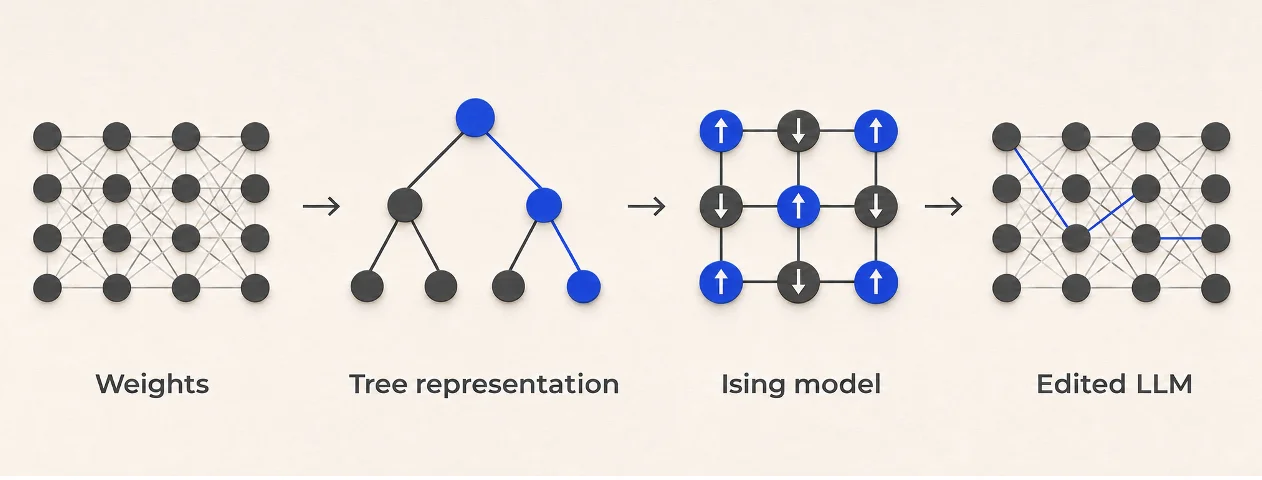
- Researchers from QDeep and ITMO University developed Tree-Ising, a method that repairs repetitive reasoning in small language models through targeted changes to their internal weights.
- Running on conventional GPUs, the method achieved 55.1% accuracy on MATH-500 for one model and increased another model’s GSM8K accuracy from 21.6% to 69.4% under specific test conditions.
- The team executed an eight-variable repair subproblem on an IBM quantum processor as a proof of concept, without demonstrating a quantum advantage or a complete model repair on quantum hardware.
Researchers have developed a method that repairs repetitive reasoning in small language models by changing selected internal weights, with a separate quantum hardware experiment testing a possible route for future work.
The study, by Hadi Salloum of QDeep in Riyadh, Saudi Arabia, and Ammar Ali of ITMO University’s Lab for Efficient AI and Data, introduces Tree-Ising, a system for turning model repairs into mathematical optimization problems. The researchers describe the method in a preprint posted to arXiv.
The main repairs ran on conventional graphics processors. One solver uses simulated bifurcation, a quantum-inspired computing method that runs on classical hardware. The quantum experiment addressed only a small part of a repair problem and did not demonstrate a quantum advantage.
Article Intelligence
Topics
Related Coverage
 Artificial IntelligenceConductor and Elevate Quantum Partner on Training and Quantum Component Testing4 hours ago · 1 min read
 ResearchOpenAI’s quarterly revenue reportedly crosses $10B for the first time2 hours ago · 1 min read
 Artificial IntelligenceTallinn Digital Summit’s first afternoon finds Europe slow where AI agents are fast3 hours ago · 1 min read
Sponsored
Ad
NewsLayerLearn more
NewsLayer Premium
Unlock deeper intelligence.
Ad-free reading, exclusive research, and real-time onchain insights.
Go Premium