
Insider Brief
Scientists Find Structural Guide to Unusual Magnetism in Quantum Materials
Insider Brief Researchers in Japan have identified a structural measurement that could help scientists predict magnetic behavior in complex alloys, offering a more reliable way to search for materials with unusual quantum properties.…
Matt Swayne
Publisher The Quantum Insider
Oct 1, 2026 at 7:56 AM UTC · Updated 42 minutes ago · 3 min read
- Researchers in Japan found that a crystal’s structural dimensions classified magnetic states more consistently than electron concentration across a family of complex alloys.
- The compounds exhibited distinct magnetic states at different lattice sizes, providing a guide for designing materials with targeted magnetic properties.
- The findings could help quantum researchers systematically explore unconventional magnetism and investigate how atomic structure influences collective behavior.
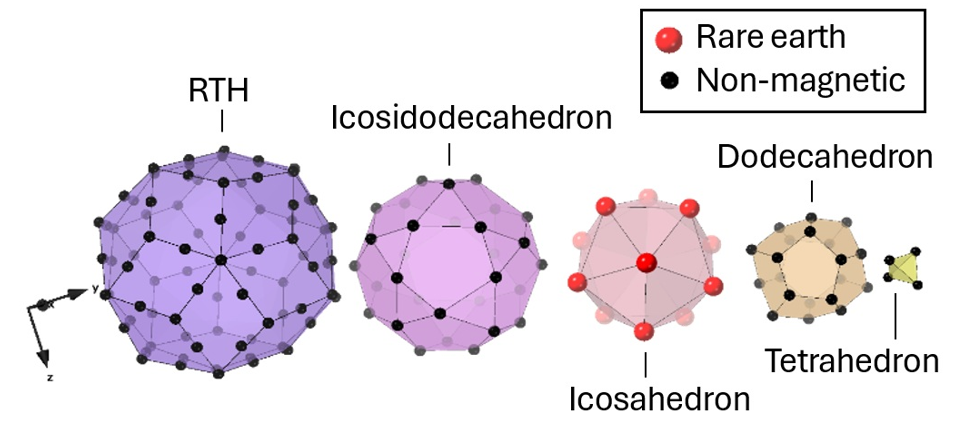
- Image: A Tsai-type cluster consists of nested atomic shells, including the rhombic triacontahedron, icosidodecahedron, icosahedron, dodecahedron, and inner tetrahedron. Rare-earth atoms occupy the icosahedral shell and provide the magnetic moments responsible for the magnetic response in these compounds. (Tokyo University)
Researchers in Japan have identified a structural measurement that could help scientists predict magnetic behavior in complex alloys, offering a more reliable way to search for materials with unusual quantum properties.
The finding gives researchers studying quasicrystals and related materials a practical guide to selecting compounds for further investigation. These materials have intricate atomic arrangements that can support unconventional magnetism, making them useful subjects for exploring how atomic structure shapes collective behavior.
Article Intelligence
Topics
Sponsored
Ad
NewsLayerLearn more
NewsLayer Premium
Unlock deeper intelligence.
Ad-free reading, exclusive research, and real-time onchain insights.
Go Premium