This website uses cookies
We use cookies to personalise content and ads, to provide social media features and to analyse our traffic. We also share information about your use of our site with our social media, advertising and analytics partners who may combine it with other information that you’ve provided to them or that they’ve collected from your use of their services.
Consent Selection
Details
  • Necessary cookies help make a website usable by enabling basic functions like page navigation and access to secure areas of the website. The website cannot function properly without these cookies.
  • Preference cookies enable a website to remember information that changes the way the website behaves or looks, like your preferred language or the region that you are in.
    • We do not use cookies of this type.

  • Statistic cookies help website owners to understand how visitors interact with websites by collecting and reporting information anonymously.
    • We do not use cookies of this type.

  • Marketing cookies are used to track visitors across websites. The intention is to display ads that are relevant and engaging for the individual user and thereby more valuable for publishers and third party advertisers.
    • We do not use cookies of this type.

  • Unclassified cookies are cookies that we are in the process of classifying, together with the providers of individual cookies.
    • __emg_sidPending
      Maximum Storage Duration: 1 dayType: HTTP Cookie
      __emg_vidPending
      Maximum Storage Duration: 1 yearType: HTTP Cookie
      nl-read-countPending
      Maximum Storage Duration: PersistentType: HTML Local Storage
Cookie declaration last updated on 8/12/26 by Cookiebot
[#IABV2_TITLE#]
[#IABV2_BODY_INTRO#]
[#IABV2_BODY_LEGITIMATE_INTEREST_INTRO#]
[#IABV2_BODY_PREFERENCE_INTRO#]
[#IABV2_BODY_PURPOSES_INTRO#]
[#IABV2_BODY_PURPOSES#]
[#IABV2_BODY_FEATURES_INTRO#]
[#IABV2_BODY_FEATURES#]
[#IABV2_BODY_PARTNERS_INTRO#]
[#IABV2_BODY_PARTNERS#]
About
Cookies are small text files that can be used by websites to make a user's experience more efficient.

The law states that we can store cookies on your device if they are strictly necessary for the operation of this site. For all other types of cookies we need your permission.

This site uses different types of cookies. Some cookies are placed by third party services that appear on our pages.

You can at any time change or withdraw your consent from the Cookie Declaration on our website.

Learn more about who we are, how you can contact us and how we process personal data in our Privacy Policy.

Please state your consent ID and date when you contact us regarding your consent.
NewsLayer

Install NewsLayer

Get the app experience — one tap from your home screen, instant loads and breaking-news alerts.

Enjoying NewsLayer?

Get breaking crypto stories the second they drop — join our Telegram channel.

NewsLayer.com
NewsLayer PulseLIVEBTC$63,351+0.69%ETH$1,895+0.88%SOL$75.32+0.11%XRP$0.9974-0.19%DOGE$0.0701+0.63%ADA$0.175-1.05%Total Cap$2.27T+0.37%Layer Index42 Neutral
BreakingExternal ReportingUpdated há um dia

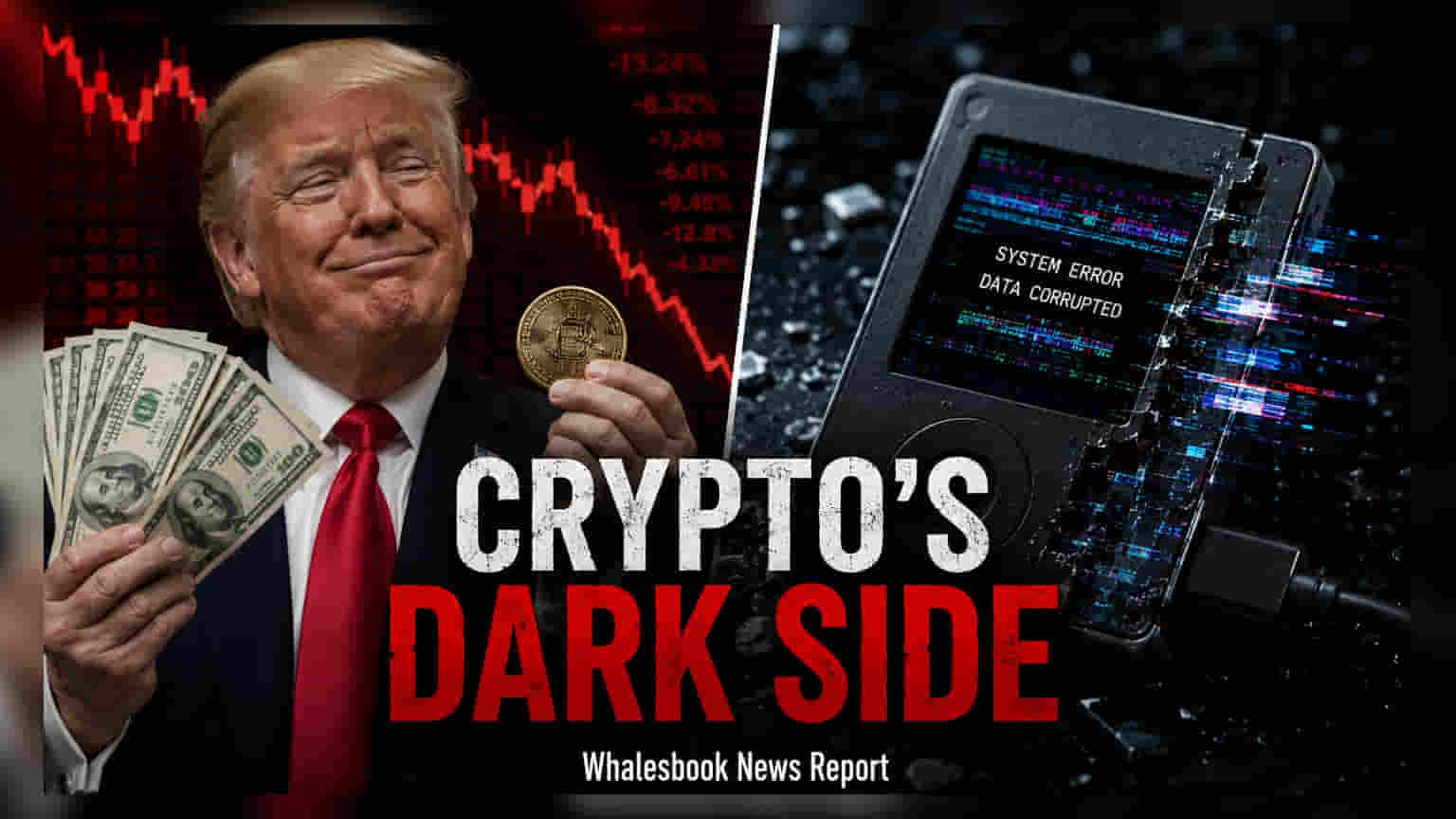
Trump’s $1.4B Crypto Income and Coldcard Hack Test Investor Trust

President Donald Trump reported $1.4 billion in crypto-related earnings for 2025, while a major security flaw in Coinkite’s Coldcard wallets led to over $150 million in losses. These events highlight the sharp contrast between the rapid…

Trump’s $1.4B Crypto Income and Coldcard Hack Test Investor Trust
Publisher Whalesbook 2 min de leitura
Image via Whalesbook

Layer Index

42

President Donald Trump reported $1.4 billion in crypto-related earnings for 2025, while a major security flaw in Coinkite’s Coldcard wallets led to over $150 million in losses. These events highlight the sharp contrast between the rapid growth of crypto ventures and the severe security risks facing retail investors.

The cryptocurrency landscape is facing intense scrutiny following two distinct, high-impact events that have raised alarms for millions of retail participants, including an estimated 40 million investors in India. While U.S. President Donald Trump’s financial disclosures revealed massive personal earnings from the sector, a critical security failure in hardware wallets has simultaneously exposed the fragility of self-custody solutions.

Trump’s Crypto Ventures and Regulatory Questions

Financial disclosures for 2025 show that President Trump earned over $1.4 billion from cryptocurrency ventures. A significant portion of this income is tied to his involvement with World Liberty Financial, an entity that recently received conditional approval for a national trust bank charter from the Office of the Comptroller of the Currency on August 14, 2026.

This level of personal financial integration between a sitting President and the crypto market has sparked debate among ethics experts and regulators. While the venture aims to build institutional-grade crypto services, the intersection of political influence and private financial interests creates a complex environment for market regulation. For investors, the situation highlights a reliance on opaque ventures where the line between policy support and private profit remains a point of contention.

The $150 Million Coldcard Exploit

While the market watches developments in institutional crypto, retail users are grappling with a severe security crisis. Coinkite’s Coldcard hardware wallets, widely regarded as a secure tool for storing Bitcoin private keys offline, were found to have a critical firmware vulnerability. This bug, which dates back to 2021, allowed the device to generate predictable secret keys, effectively bypassing the hardware's random number generator.

Attackers exploited this flaw to drain thousands of wallets, resulting in losses exceeding $150 million by late July 2026. This incident has damaged confidence in the 'self-custody' model—the idea that individual users can secure their own assets better than exchanges. Because the issue was a fundamental software bug, simple firmware updates did not secure existing wallets; users were forced to generate entirely new, secure keys and migrate their funds to avoid further theft. For many, this has served as a painful reminder that even hardware solutions marketed as 'impenetrable' carry significant, often invisible, risks.

Investor Trust in an Opaque Market

These two events together expose a trust deficit in the crypto ecosystem. In traditional finance, investors rely on audits, central bank oversight, and established legal frameworks. In the crypto sector, investors are often asked to place faith in code or the reputation of founders and manufacturers. When code fails, as seen in the Coldcard exploit, or when ventures involve complex conflicts of interest, retail investors often have little to no recourse.

Investors may monitor how regulators handle the dual challenge of protecting retail participants while encouraging innovation. The shift toward institutional-grade custody services, which often come with higher regulatory standards, may accelerate as users seek safer alternatives to manual, self-managed security. For now, the most critical step for those in the market remains verifying the security of their digital assets and staying informed about ongoing regulatory decisions regarding ventures like World Liberty Financial.

Última Hora

Não perca nenhuma notícia de última hora

Advertisement

House — Advertise on NewsLayer
NewsLayerAd

Sourced by

Originally reported by Whalesbook

NewsLayer coverage based on externally reported material.

The Daily Brief

The onchain economy, before your day starts.

Curated markets, onchain insights, and key headlines — delivered every weekday morning.

Weekdays · Free · ~5 minute read

Notícias Relacionadas