

University of Pennsylvania Demonstrates Single-Gate Parallel Entanglement on Room-Temperature Diamond Quantum Register
Researchers at the University of Pennsylvania reported demonstrating parallel entanglement using a single gate on a room-temperature diamond quantum register. The result, highlighted by Quantum Computing Report, points to an approach…
Quantum Computing Report
Publisher
Sep 19, 2026 at 11:53 PM UTC · Updated há poucos segundos · 2 min de leitura
Traduzindo…
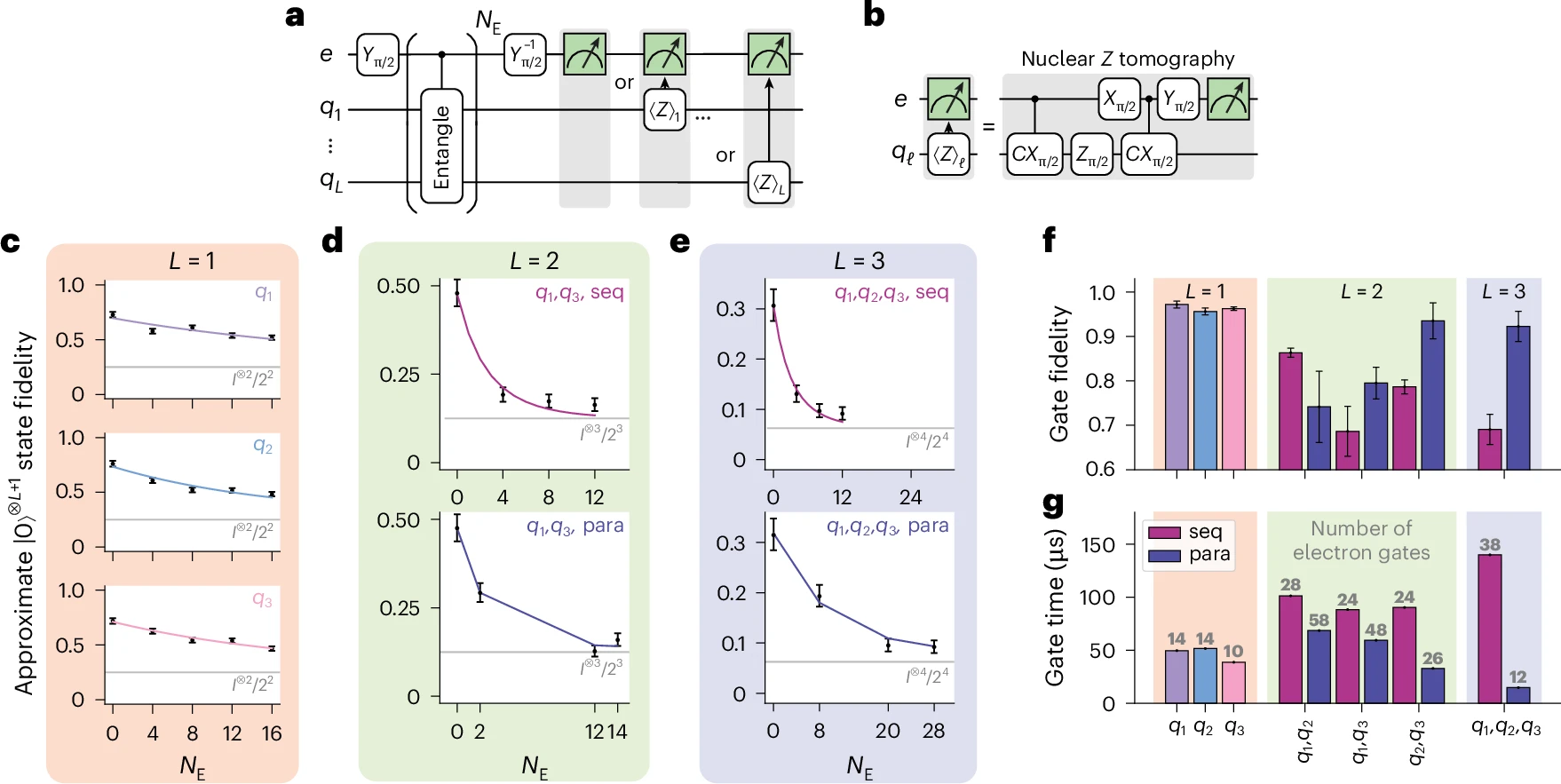
Quantum researchers at the University of Pennsylvania have demonstrated single-gate, parallelized multipartite entanglement on a solid-state quantum register operating under ambient room-temperature conditions. Detailed in a study published in Nature Nanotechnology, the team generated a four-qubit Greenberger–Horne–Zeilinger (GHZ) state—entangling the central electron spin of a nitrogen-vacancy (NV) center in diamond with three surrounding 13C nuclear spin memory qubits—in 14.8 microseconds using a single dynamical decoupling (DD) control sequence.
Traditional solid-state central spin registers rely on sequential, pairwise two-qubit gates to entangle the central electron with individual nuclear memory qubits. This sequential approach incurs significant gate latency and introduces unwanted phase crosstalk on non-targeted nuclear spins. The UPenn framework harnesses this inherent crosstalk, tuning the unit-pulse timing (t) and repeat count (N) of an XY8 dynamical decoupling sequence to execute conditional rotations across multiple weakly coupled nuclear qubits simultaneously. The resulting 14.8 μs gate duration represents a 10-fold speedup over sequential gate protocols and operates near the physical interaction limit dictated by the perpendicular hyperfine coupling frequencies (A⊥ ≈ 60 kHz).
Article Intelligence
Related Coverage
 QuantumMitsubishi Electric Selected for Two NEDO R&D Projects to Scale Quantum Hardware Platformshá 21 horas · 1 min read
 QuantumGlobalFoundries Finalizes $375 Million CHIPS Act Award for Onshore Quantum Semiconductor Fabricationhá 18 horas · 1 min read
 QuantumDiraq and Dell Technologies Partner to Integrate Silicon QPUs with High-Performance Classical Computinghá 18 horas · 1 min read
Sponsored
Ad
NewsLayerLearn more
NewsLayer Premium
Unlock deeper intelligence.
Ad-free reading, exclusive research, and real-time onchain insights.
Go Premium