Last week, I went to Kyrenia looking for cryptocurrency.
I found something considerably more interesting: a parallel financial system operating almost in plain sight.
Shaffaf Exclusive
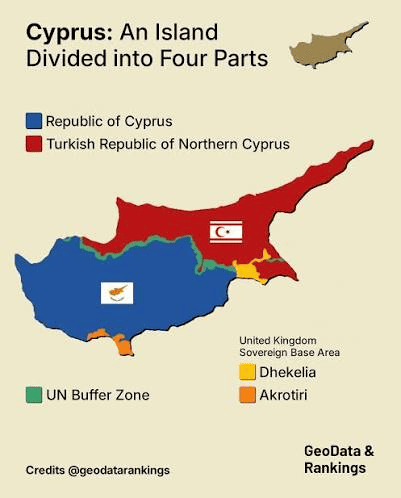
Kyrenia — Keryneia to Greek Cypriots, Girne in Turkish — is a beautiful Mediterranean town of hotels, restaurants, casinos and an old harbour that could easily persuade a visitor to forget the politics surrounding it. But history is impossible to separate from the place.
Turkey launched its military intervention in Cyprus on July 20, 1974, five days after a Greek-junta-backed coup overthrew President Archbishop Makarios. Turkey maintains that its intervention was necessary to protect the Turkish Cypriot community and argues that the Cyprus problem predates 1974. The Republic of Cyprus describes what followed as an invasion and continuing military occupation. Turkish forces captured Kyrenia during the opening phase of the conflict, and the island has effectively remained divided ever since.
In 1983, the Turkish Cypriot administration declared the “Turkish Republic of Northern Cyprus”. The United Nations Security Council declared the attempt to create the state legally invalid and called on countries not to recognise it. To this day, Turkey is the only country that recognises the TRNC as an independent state.
That international isolation has had consequences far beyond diplomacy.
I had travelled there because I had repeatedly heard about cryptocurrency moving through northern Cyprus. In particular, I wanted to understand the cash-to-crypto business: shops where physical dollars can apparently be converted into USDT, the dollar-linked stablecoin that has become enormously useful for moving value across borders.
I had also encountered information in my wider research suggesting cryptocurrency flows from the region were reaching wallets in Lebanon, including wallets of concern in investigations involving Hezbollah and Hamas-linked financial networks.
What I could investigate myself was much simpler.
Could somebody walk into these shops with a very large amount of physical cash and turn it into USDT?
So I went to find out.
Nothing prepared me for how easy it appeared to be.
Crypto shops seemed to be everywhere. You would pass one, turn a corner, walk or drive another two hundred metres and encounter another.
This was particularly strange because I wasn’t walking around some futuristic crypto economy. I wasn’t paying for my coffee in USDT. Restaurants weren’t quoting dinner in Tether. Taxi drivers weren’t asking me to scan a wallet.
Yet the infrastructure for converting cash into crypto was remarkably visible.
It raises an obvious question: who needs this many cash-to-crypto shops, and what are they being used for?
As Much As You Want
I asked our taxi driver to stop at the first shop.
I walked inside and played the part I have become rather good at over seven years of investigating the cash economy: the slightly confused blonde tourist who has money but doesn’t entirely understand what she is doing.
Could I bring cash and buy USDT?
Of course.
“What is the fee?”
“1.5 per cent.”
Plus $10 for the transfer.
Then came the important question.
“How much can I deposit?”
“As much as you want.”
I decided to test that statement.
“I have $250,000. Can I go back to my hotel and bring it?”
No problem, she told me.
Apparently they had cash-counting machines.
In fact, judging by what I could see, they had plenty of them.
Then I asked the question that should normally follow a stranger appearing with a quarter of a million dollars in physical currency:
“Do you need my passport? KYC?”
She looked confused.
“KFC?”
For a moment we had entered completely different regulatory universes.
She explained that there wasn’t a KFC nearby and that I would need a taxi to reach one.
At that point, KFC may genuinely have been easier to locate than KYC.
I wasn’t looking for fried chicken. I was asking about Know Your Customer – the basic process financial institutions use to establish who their customer is and, particularly with large transactions, understand the source and purpose of funds.
But the misunderstanding almost perfectly captured the absurdity of the situation.
I had just told a crypto dealer that I wanted to arrive with $250,000 in cash. She had told me that was fine. And we were now discussing where I could find a bucket of chicken.
I instinctively reached for my phone to film the shop and then noticed the cameras.
There were cameras everywhere.
And there was a man sitting inside watching me who looked considerably less amused by my questions than I was.
I decided my investigative journalism had achieved enough for one shop.
Back in the taxi, I asked my American friend — an experienced traveller — to photograph the storefront.
He had also noticed the cameras.
“No.”
So much for American courage.
I played the tourist and took a few photographs myself.
Then we drove off.
We barely had time to discuss what had happened before another crypto shop appeared.
The Second Shop
We stopped.
Same experiment.
“Can I deposit cash and buy USDT?”
No problem.
“How much?”
“As much as you want.”
“What do you need from me?”
Nothing.
Just the cash.
This time the commission was 1.5 per cent with no transfer fee.
I was delighted.
I had apparently negotiated a better money-laundering hypothetical simply by travelling 200 metres down the road.
Then I looked through towards an office.
Three men were standing around what appeared to be a large suitcase full of cash.
At this point the whole experience was becoming surreal.
The men were looking at me.
I was looking at the suitcase.
The suitcase, fortunately, had no opinion.
I left.
Another short drive and there was another shop, this one larger, with a conventional foreign-exchange business next door.
I changed $100 into Turkish lira and casually asked about crypto.
The man directed me next door.
This shop was busy.
So in walked the lost blonde tourist again, this time with a new story.