
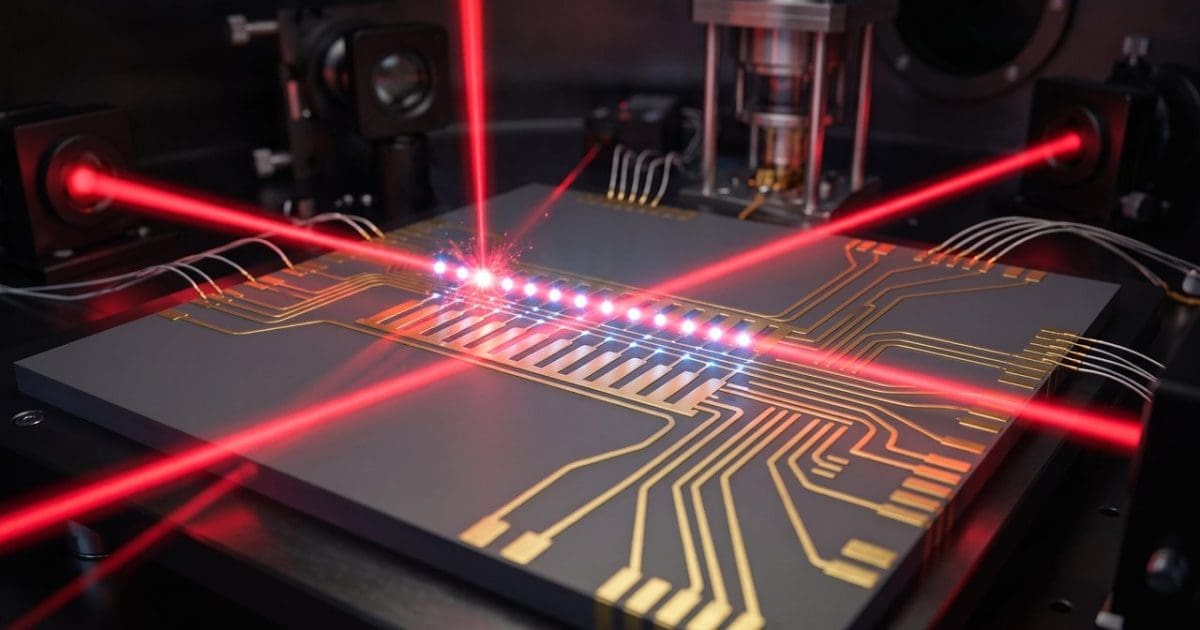
Researchers have demonstrated two-qubit operations in 125-135 ns using a new framework for quantum control. Qi Ding and colleagues designed gates with both frequency and amplitude modulation of microwave drives, enabling systematic analysis and design without requiring qubit frequency tunability. Using Floquet theory to analyze and design these drives, numerical simulations using typical transmon qubit parameters achieved a universal gate set, including X, Hadamard, phase and CZ gates, with control error well below 0.1% and gate times of 25-40 ns for single-qubit operations and 125-135 ns for two-qubit operations.
125 Nanosecond Two-Qubit Gates Advance Quantum Control
Researchers have demonstrated two-qubit operations in 125-135 ns using a new framework for quantum control. Qi Ding and colleagues designed gates with both frequency and amplitude modulation of microwave drives, enabling systematic…
Quantum Zeitgeist
Publisher
Sep 29, 2026 at 8:24 AM UTC · 7 Min. Lesezeit
Übersetzung…
They show an always-on CZ gate tailored for driven qubits, which has gate times of 80-90 ns. This approach offers a path to fast, high-fidelity gates in superconducting quantum processors while preserving reduced flux-noise sensitivity, and can help alleviate frequency-crowding constraints.
Frequency- and Amplitude-Modulation Enables Universal Quantum Control
1%, demonstrating high fidelity essential for complex quantum computations. This approach bypasses the need for tunable qubit frequencies by shifting the modulation to the microwave drives themselves, a design choice validated through the use of Floquet theory to analyze and design the drives.
Article Intelligence
Topics
Regulation Signal
in progressUpdated vor 2 Monaten
SEC Crypto Asset Market Structure RulemakingRelated Coverage
 PolicySibos 2026: The quantum tipping pointvor 3 Stunden · 1 min read
 QuantumA quantum computer operated in space for the first time: what it was used for and what problem it could solvevor 3 Stunden · 2 min read
 Artificial IntelligenceOpenAI CEO Sam Altman to skip congressional hearing on rogue AI agentsvor 41 Minuten · 1 min read
Sponsored
Ad
NewsLayerLearn more
NewsLayer Premium
Unlock deeper intelligence.
Ad-free reading, exclusive research, and real-time onchain insights.
Go Premium