A New Code Cuts Qubit Needs For Quantum Logic, Photonic Reports
has demonstrated a quantum low density parity check (
Quantum Zeitgeist
Publisher
Aug 25, 2026 at 7:13 PM UTC · 1 Min. Lesezeit
Photonic
has demonstrated a quantum low density parity check (
QLDPC
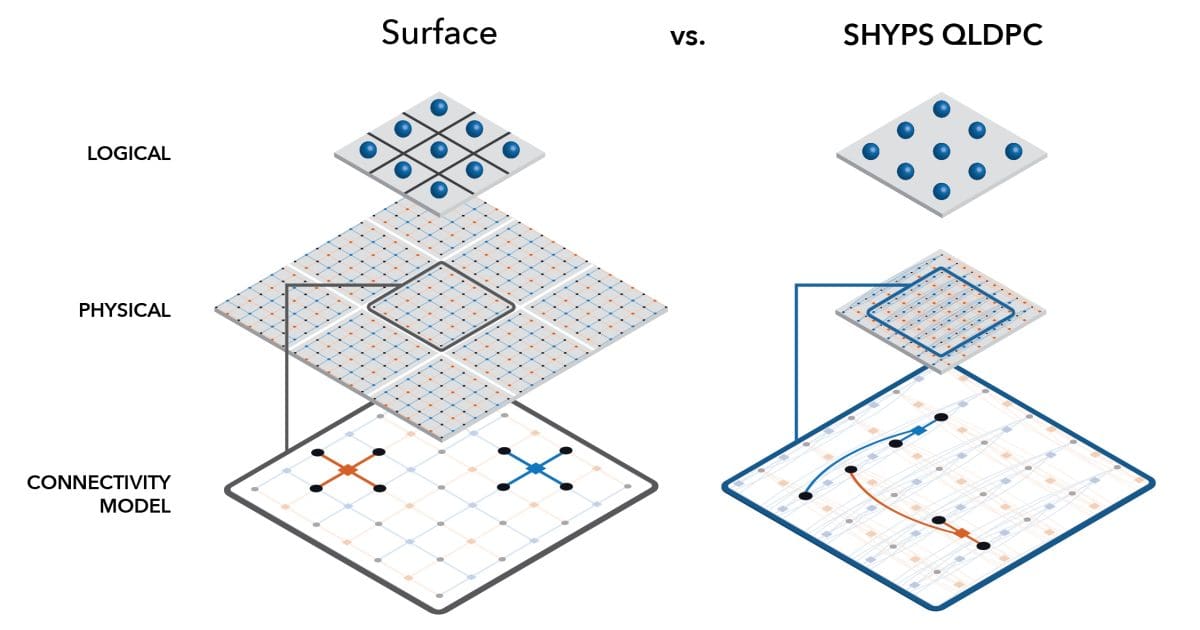
) code family capable of performing quantum computation while minimizing qubit use, a result detailed in a new Nature Communications paper, the company says. The company’s SHYPS codes efficiently manage both computation and error correction, requiring fewer physical qubits than existing surface codes; this advance is enabled by high-connectivity systems like
Photonic’s
Entanglement First architecture. “This paper introduced the first demonstrated QLDPC code family capable of performing logic efficiently—not just storing information, but computing with it, using a fraction of the qubits error correction has always demanded,” said Dr.
Stephanie Simmons
, Chief Quantum Officer at Photonic. “That distinction has changed the conversation across our industry: efficient QLDPC logic is no longer a theoretical promise, it’s a demonstrated result, with real implications for architectures and timelines.”
SHYPS Codes Enable Efficient Quantum Logic with Reduced Qubit Needs
The company’s Subsystem Hypergraph Product Simplex (SHYPS) codes achieve this efficiency by significantly reducing the number of physical qubits needed compared to surface codes at comparable code sizes. This reduction in qubit requirements accelerates the path toward building commercially viable quantum computers, addressing a longstanding challenge in the field. The efficiency of SHYPS codes is intrinsically linked to quantum systems with high connectivity, and Photonic’s Entanglement First architecture is designed to utilize these advances. These fast and lean SHYPS codes maintain competitive logical clock times and performance while requiring fewer qubits, marking a milestone for quantum error correction and opening avenues for further acceleration of quantum computing capabilities.
This paper introduced the first demonstrated QLDPC code family capable of performing logic efficiently – not just storing information, but computing with it, using a fraction of the qubits error correction has always demanded. Dr. Stephanie Simmons, Chief Quantum Officer at Photonic
Stay current
See today’s quantum computing news on Quantum Zeitgeist for the latest breakthroughs in qubits, hardware, algorithms, and industry deals.
Sourced by
Originally reported by Quantum Zeitgeist
NewsLayer coverage based on externally reported material.
The Daily Brief
The onchain economy, before your day starts.
Curated markets, onchain insights, and key headlines — delivered every weekday morning.
Weekdays · Free · ~5 minute read
0
Applause
Was this article helpful?
Article Intelligence
Related Coverage
 QuantumPrinceton to Lead $27.9M NSF Institute for Quantum Processor Manufacturingvor 2 Stunden · 5 min read
 QuantumRGTI vs IONQ: Which Quantum Computing Stock Led the Q2 Earnings Race?vor 5 Stunden · 1 min read
 ResearchU.S. SpaceForce’s SpaceWERX Awards Casimir Inc. STTR Phase I Awardvor 6 Stunden · 1 min read
Sponsored
Ad
NewsLayerLearn more
NewsLayer Premium
Unlock deeper intelligence.
Ad-free reading, exclusive research, and real-time onchain insights.
Go Premium