We use cookies to personalise content and ads, to provide social media features and to analyse our traffic. We also share information about your use of our site with our social media, advertising and analytics partners who may combine it with other information that you’ve provided to them or that they’ve collected from your use of their services.
Necessary cookies help make a website usable by enabling basic functions like page navigation and access to secure areas of the website. The website cannot function properly without these cookies.
_cfuvidThis cookie is a part of the services provided by Cloudflare - Including load-balancing, deliverance of website content and serving DNS connection for website operators.
Maximum Storage Duration: SessionType: HTTP Cookie
__cf_bm [x7]This cookie is used to distinguish between humans and bots. This is beneficial for the website, in order to make valid reports on the use of their website.
CookieConsentStores the user's cookie consent state for the current domain
Maximum Storage Duration: 1 yearType: HTTP Cookie
Preference cookies enable a website to remember information that changes the way the website behaves or looks, like your preferred language or the region that you are in.
We do not use cookies of this type.
Statistic cookies help website owners to understand how visitors interact with websites by collecting and reporting information anonymously.
We do not use cookies of this type.
Marketing cookies are used to track visitors across websites. The intention is to display ads that are relevant and engaging for the individual user and thereby more valuable for publishers and third party advertisers.
We do not use cookies of this type.
Unclassified cookies are cookies that we are in the process of classifying, together with the providers of individual cookies.
List of domains your consent applies to: [#BULK_CONSENT_DOMAINS#]
Cookie declaration last updated on 8/12/26 by Cookiebot
[#IABV2_TITLE#]
[#IABV2_BODY_INTRO#]
[#IABV2_BODY_LEGITIMATE_INTEREST_INTRO#]
[#IABV2_BODY_PREFERENCE_INTRO#]
[#IABV2_BODY_PURPOSES_INTRO#]
[#IABV2_BODY_PURPOSES#]
[#IABV2_BODY_FEATURES_INTRO#]
[#IABV2_BODY_FEATURES#]
[#IABV2_BODY_PARTNERS_INTRO#]
[#IABV2_BODY_PARTNERS#]
About
Cookies are small text files that can be used by websites to make a user's experience more efficient.
The law states that we can store cookies on your device if they are strictly necessary for the operation of this site. For all other types of cookies we need your permission.
This site uses different types of cookies. Some cookies are placed by third party services that appear on our pages.
You can at any time change or withdraw your consent from the Cookie Declaration on our website.
Learn more about who we are, how you can contact us and how we process personal data in our Privacy Policy.
Please state your consent ID and date when you contact us regarding your consent.
Install NewsLayer
Get the app experience — one tap from your home screen, instant loads and breaking-news alerts.
Bitcoin Just Took a $390 Million Hit: A JPMorgan Warning From April Explains Why
Bitcoin just absorbed a $390 million shock, and a warning JPMorgan issued back in April explains why. Institutions pulled that sum out of spot Bitcoin ETFs last week as oil spiked and the Strait of Hormuz stayed shut.
Bitcoin just absorbed a $390 million shock, and a warning JPMorgan issued back in April explains why. Institutions pulled that sum out of spot Bitcoin ETFs last week as oil spiked and the Strait of Hormuz stayed shut.
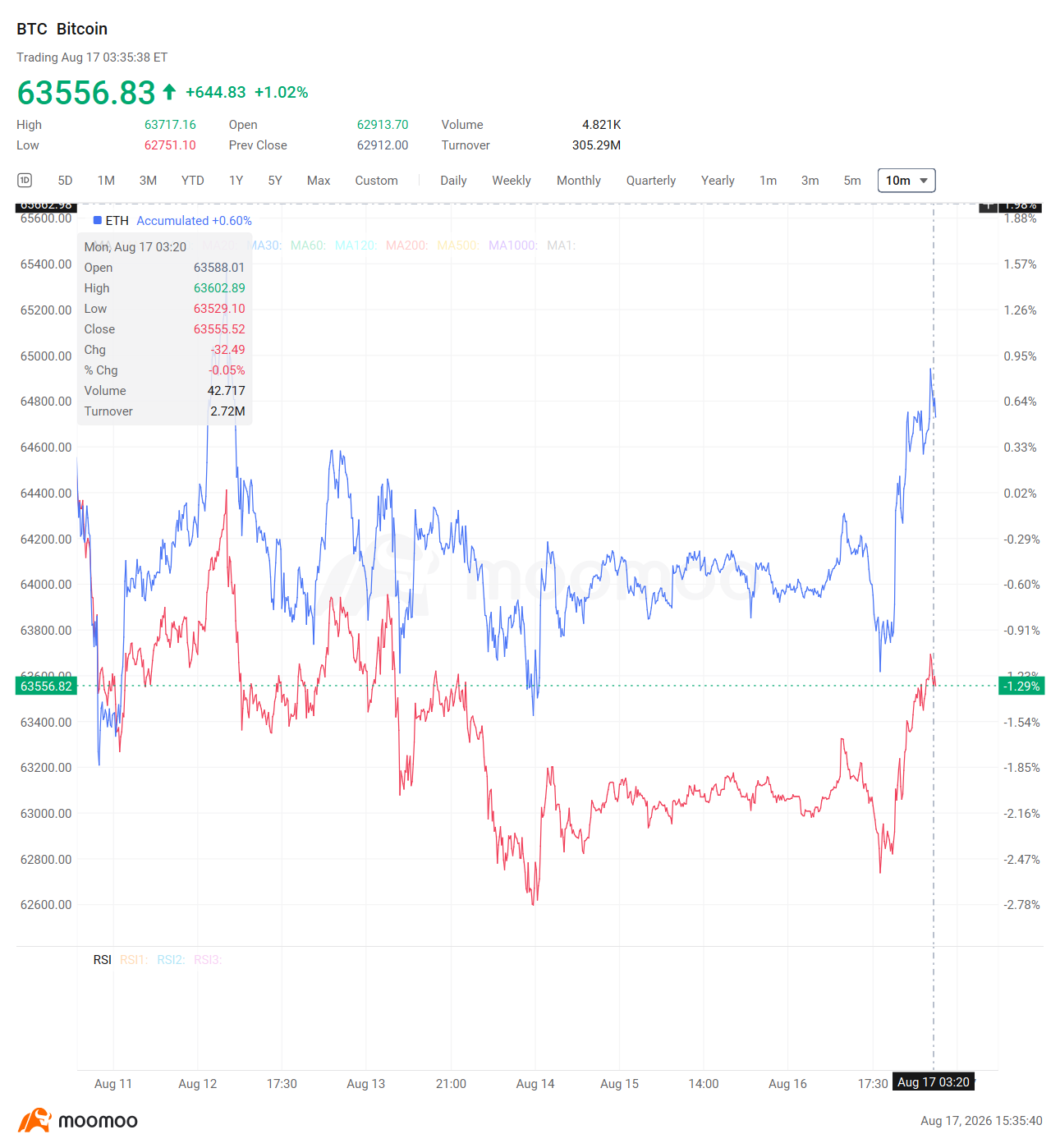
The Bitcoin price is holding near $63,500 despite the exit, yet the selling traces a clean line from a blocked shipping lane, through inflation, to crypto order books.
Why Is the Oil Shock Back, and Why Does Bitcoin Care?
Brent crude pushed back above $88 a barrel in the week to August 15, up more than 5%, after the US said its naval blockade of Iran could run indefinitely while talks to reopen the Strait of Hormuz stayed deadlocked.
The same blockage does more than lift crude. The Middle East ships close to a quarter of the world's urea through Hormuz, and JPMorgan flagged that nitrogen fertilizer benchmarks jumped 25 to 50% after the conflict began. With the World Bank's fertilizer index near its highest since 2022, the bank saw that ripple lifting global food inflation toward 4 to 5%.
Those prices have eased from the April peak in recent weeks, but they sit far above pre-war levels, and this week's oil surge alongside renewed Hormuz attacks threatens a second leg higher.
Fertilizer Is Cooling but Still Elevated: BeInCrypto
For Bitcoin, the connection comes down to one word, inflation.
Sticky energy and food costs give the Federal Reserve reason to keep rates high, and high rates drain the cheap liquidity that risk assets lean on.
How an Oil Shock Reaches Bitcoin: BeInCrypto
So a shock that begins in a shipping lane lands on crypto order books, and the collapse of the US-Iran ceasefire keeps that pressure building rather than fading.
Are Bitcoin Whales Selling Into the Inflation Fear?
The first traders to act on that logic were the whales. Reading the same macro signal, wallets holding 1,000+ BTC peaked near 1,963 on July 31, according to Glassnode, then thinned steadily through August as oil climbed.
Want more token insights like this? Sign up for Editor Harsh Notariya's Daily Crypto Newsletter here.
The trend is the entire story. The cohort's 30-day change turned net negative around August 10, the very week crude pushed higher, meaning the largest holders were cutting exposure as the inflation threat hardened.
BTC Whale Address Count: Glassnode
When the most informed money leaves first, the slower money usually follows. But the whales weren't the only ones.
Why Did $390 Million Leave Bitcoin ETFs?
Spot Bitcoin exchange-traded funds bled about $390 million in the week to August 14, just after the whales turned, their heaviest weekly outflow since early July and a sharp reversal from the $853 million they absorbed the week before.
That order is the whole point.
ETF Flows Weakening: SoSoValue
The macro fear hit whales first and funds second, so the selling flowed from Hormuz through inflation to Bitcoin in a matter of weeks.
Whales Blinked First, Funds Followed: BeInCrypto
Even so, the Bitcoin price has drifted near $63,500 rather than crashed, which reads as steady de-risking instead of panic.
How Has the Price Reacted to War Before?
If that chain sounds ominous, history offers a counterweight. When Russia invaded Ukraine in February 2022, Bitcoin fell about 9% in two days. It then rebounded roughly 15% within five weeks. The 2023 Israel-Hamas war barely moved it. Moreover, June 2025's Israel-Iran flare-up knocked BTC about 4% before a ceasefire sparked a recovery.
Bitcoin Reaction to War Shocks: BeInCrypto
So war itself has not stayed bearish for long. The first drop has repeatedly proven a shakeout that de-escalation reversed. This is the pattern our analysis of the Ukraine playbook traced in detail. If another de-escalation wave arrives, Bitcoin prices can again start showing strength. However, this time both whales and ETFs are not seeing an optimistic conclusion to the current scenario.
Analyst's View: From here, the story splits two ways. If the Gulf tension eases, or if whales and ETF buyers simply step back in, the dip likely repairs itself. Same way the past war scares did. Then the bottom talk fades as fast as it started. Experts watching the chains already describe an accumulation zone, even while admitting the floor is not yet in.
The other path is harder. If the Bitcoin ETFs keep bleeding through August, historically one of Bitcoin's weakest months, and whales keep selling rather than buying, the capitulation could deepen into the kind of floor that only forms once sellers are exhausted. In short, a real Bitcoin bottom may still be near. Yet, it forms only if the fear gets worse before it gets better.
Read the Original story Bitcoin Just Took a $390 Million Hit: A JPMorgan Warning From April Explains Why by Ananda Banerjee at beincrypto.com