
Researchers at Cornell University have developed a chip-based laser-cooling technique that brings trapped ions close to their quantum ground state in just 150 microseconds, potentially reducing a major time bottleneck in quantum computing.
Chip-based lasers cool trapped ions 3x faster for quantum computing
Researchers at Cornell University have developed a chip-based laser-cooling technique that brings trapped ions close to their quantum ground state in just 150 microseconds, potentially reducing a major time bottleneck in quantum computing.
Interesting Engineering
Publisher
Nov 13, 2026 at 3:28 AM UTC · Updated vor 2 Stunden · 2 Min. Lesezeit
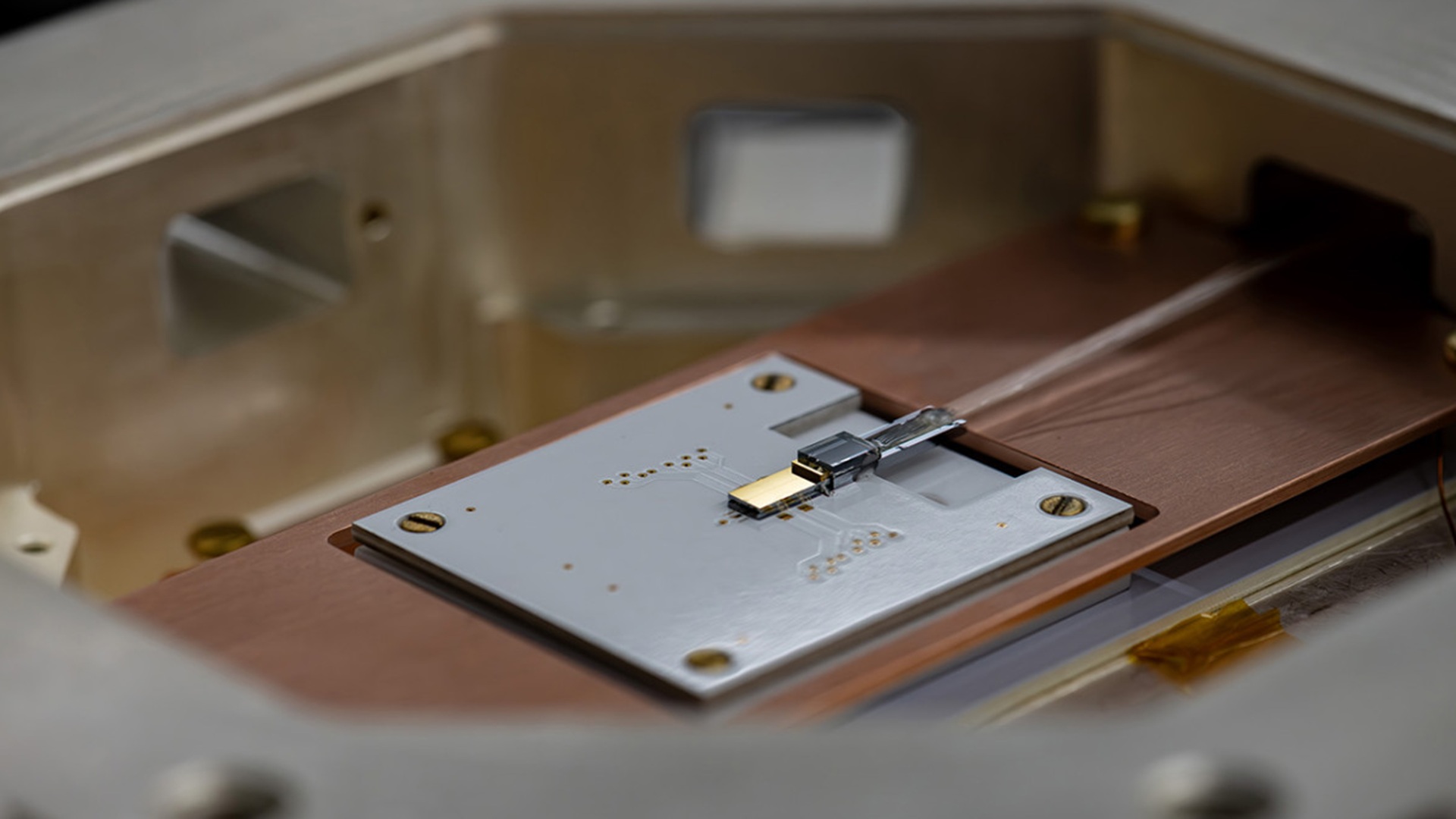
The method is around three times faster than a conventional laser arrangement, which takes approximately 500 microseconds. It also cools three different modes of an ion’s motion simultaneously, rather than requiring separate cooling operations for each mode.
The findings demonstrate how integrated photonics could improve the control of trapped ions as researchers work to build larger quantum computers.
The study was led by Karan Mehta, an assistant professor of electrical and computer engineering at Cornell’s Duffield College of Engineering.
Cooling slows quantum operations
Trapped-ion quantum computers use electrically charged atoms held in electromagnetic fields to store and process quantum information. Their precision makes them promising candidates for quantum computing, but unwanted atomic motion can interfere with operations.
Researchers must repeatedly use lasers to remove this motion and cool ions close to their lowest possible energy state. These cooling procedures can take up a substantial portion of a quantum computer’s operating time.
Article Intelligence
Topics
Sponsored
Ad
NewsLayerLearn more
NewsLayer Premium
Unlock deeper intelligence.
Ad-free reading, exclusive research, and real-time onchain insights.
Go Premium