
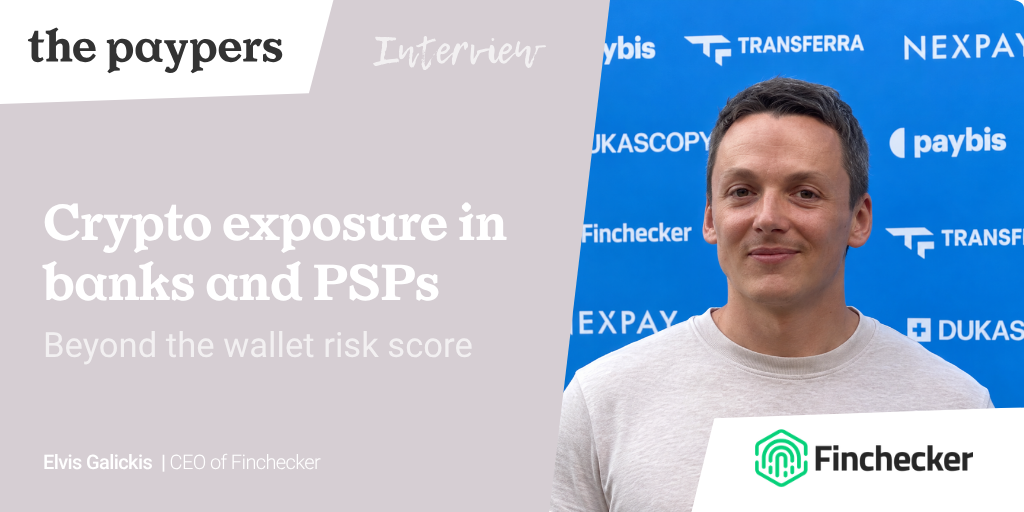
Elvis Galickis of Finchecker explains why crypto-linked payments require institutions to link wallet activity to customer identity and source of funds.
Crypto exposure in banks and PSPs: beyond the wallet risk score
Elvis Galickis of Finchecker explains why crypto-linked payments require institutions to link wallet activity to customer identity and source of funds.
The Paypers
Publisher
Oct 13, 2026 at 7:05 AM UTC · 6 Min. Lesezeit
Übersetzung…
He discusses the limits of analytics, AI's role in onboarding, and practical steps to prepare for the EU’s changing AML framework.
Many banks, merchants, and PSPs don't consider themselves crypto businesses, yet they already process transfers to exchanges or serve corporate clients with crypto-linked activity. Why is this small share of transactions attracting so much regulatory attention, and what is the real risk of treating it as an edge case?
The risk comes from the connection between two financial systems. A payment that begins in a bank account can become a crypto asset and move through several wallets or services. Understanding the original customer does not necessarily explain who ultimately receives the funds or why. That matters for investment scams, money laundering, and sanctions evasion. A legitimate customer can be a scam victim; a corporate client can have crypto activity that was never disclosed during onboarding.
Treating this as an edge case creates an operational gap. Who reviews payments to exchanges? What activity should trigger questions? What evidence would resolve those questions? If those responsibilities are unclear, a small transaction category can become a significant blind spot.
Article Intelligence
Topics
Related Coverage
 CryptoSaaScada and Zumo Launch Ready-Built Crypto Route for UK Banks and Wealth Managersvor 35 Minuten · 1 min read
 CryptoUS Government Holds $25.49 Billion in Seized Crypto as Bitcoin Transfers Draw Attentionvor einer Stunde · 2 min read
 CryptoU.K. High Court Says Chinese Law Will Decide Fate of 61,000 Seized Bitcoinvor einer Stunde · 1 min read
Sponsored
Ad
NewsLayerLearn more
NewsLayer Premium
Unlock deeper intelligence.
Ad-free reading, exclusive research, and real-time onchain insights.
Go Premium