Have Bitcoin whales stopped selling?
One of the most important changes currently taking place in the market is the behavior of the largest BTC holders. According to CoinShares data, whales have sold roughly $40 billion worth of Bitcoin since October 2025, creating one of the largest sources of selling pressure in the current cycle. That process, however, has started to fade. CoinShares points to three consecutive weeks of accumulation among the largest holders, a pattern that has historically appeared at similar stages of Bitcoin’s four-year cycles. If this shift proves sustainable, the market could be losing one of the key sources of supply that has weighed on prices in recent months.
Since October 2025, whales have sold around $40 billion worth of BTC. Bitcoin has now recorded three consecutive weeks of accumulation, and if the price begins to recover toward $70,000, the cyclical low may already be behind the market. This does not automatically mean the beginning of a new bull market. Until the autumn, consolidation and a potential test of the $80,000 area may be more likely, although a decline toward $50,000 or below also remains possible. This distinction is important: the end of a major selling wave removes a significant headwind, but does not by itself create enough demand to establish a sustainable uptrend. If fresh supply emerges, Bitcoin could deepen its losses and experience a percentage decline comparable with previous bear markets.
Capital is slowly returning to crypto funds
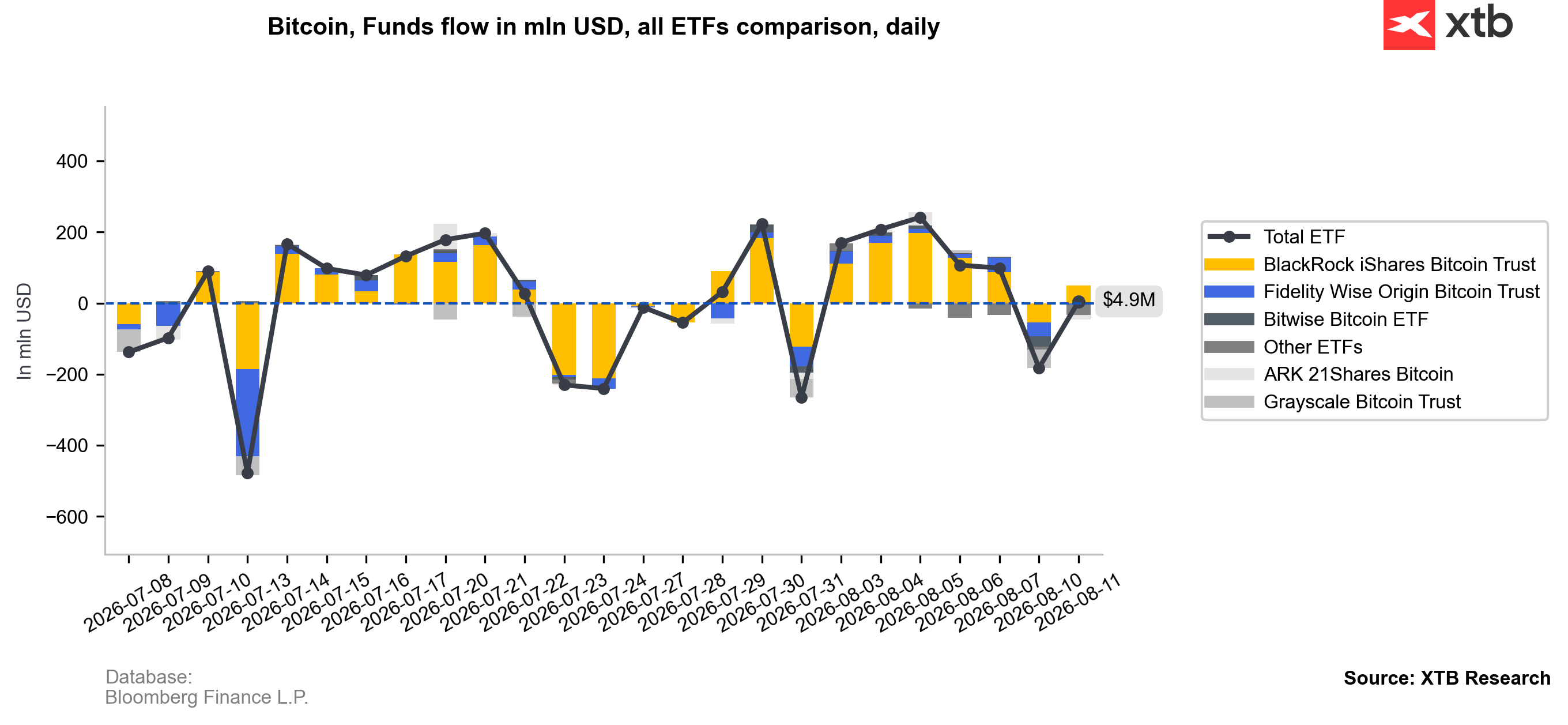
A more positive signal comes from capital flows. Digital asset investment products attracted approximately $1.05 billion in the week ended August 7, marking the fifth consecutive week of inflows. This looks particularly interesting against the preceding eight-week period, during which investors withdrew a record $8 billion. In a relatively short period, the market has therefore shifted from aggressive exposure reduction toward renewed accumulation.
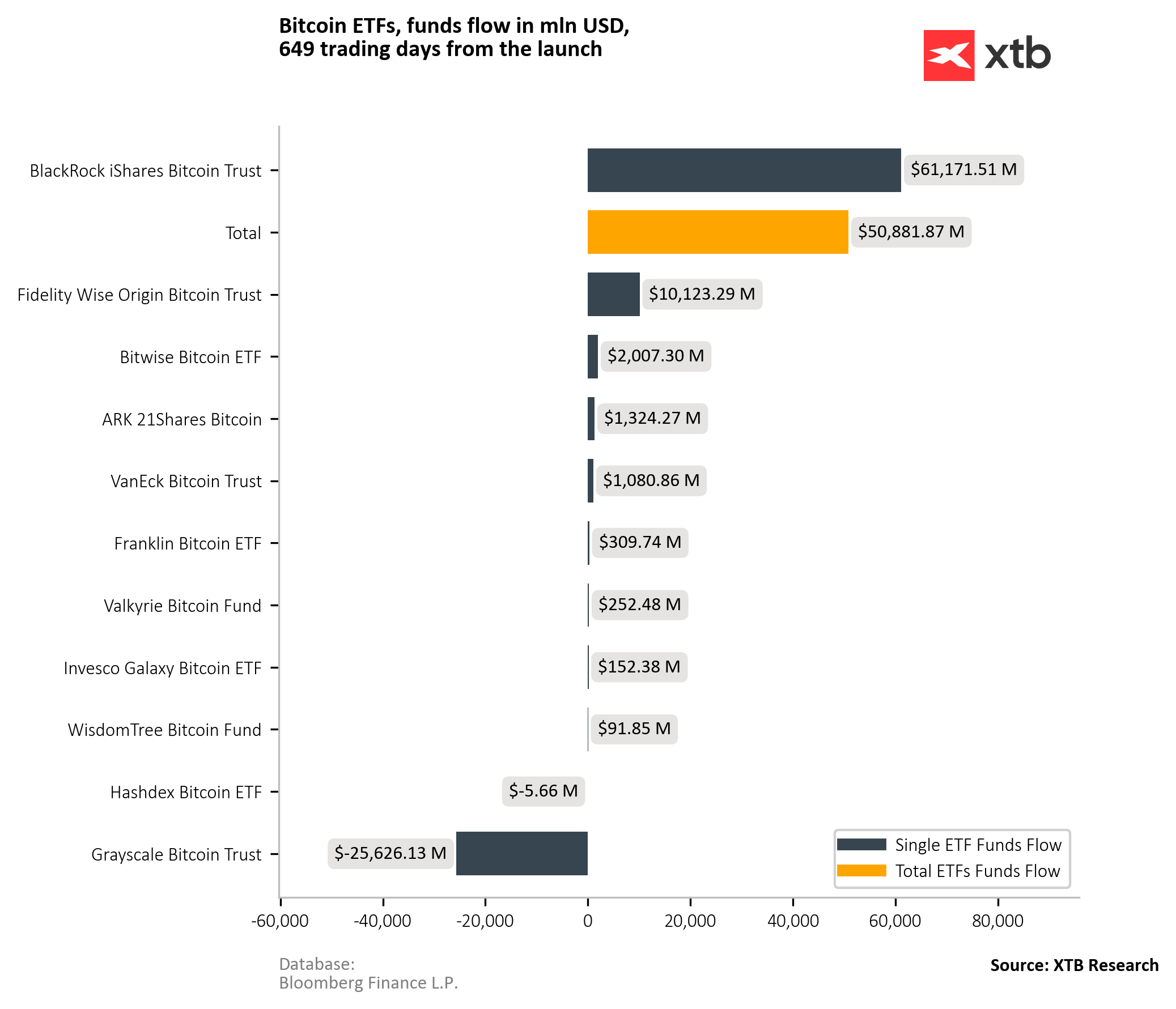
A similar picture can be seen in U.S. spot Bitcoin ETFs. They attracted around $853.5 million in the week ended August 7, the strongest result since mid-April. BlackRock’s iShares Bitcoin Trust alone accounted for roughly $700 million of those flows, while its net assets stood at approximately $48.5 billion. Combined with the fading selling pressure from whales, this creates a more constructive supply-demand setup than just a few weeks ago.
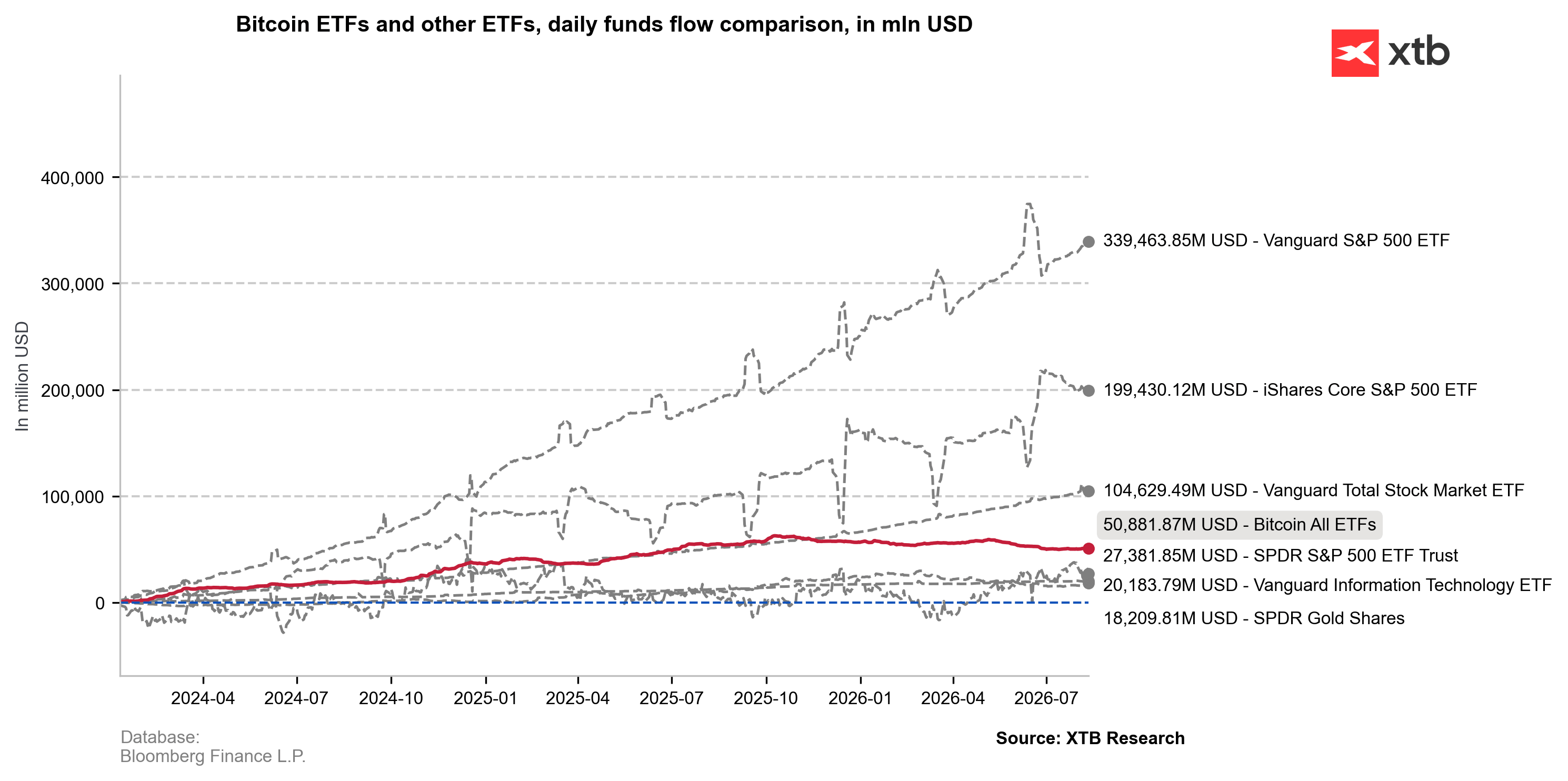
The largest holders are reducing the amount of BTC they bring to market just as institutional capital is beginning to return. However, investor interest in equities and equity funds remains clearly stronger than demand for Bitcoin and the broader crypto market.
The Fed remains key to a return toward $100,000
U.S. interest rates remain the most important macroeconomic catalyst for Bitcoin. Weaker labor market data have reduced expectations for further Fed rate hikes, helping BTC rebound from this year’s lows. According to the CoinShares scenario, however, simply scaling back rate-hike expectations may not be enough to trigger a much larger move. A return toward $100,000 would likely require clearer signs of deterioration in employment and a more pronounced shift in market expectations toward lower interest rates. The market therefore remains in an uncomfortable position.
The data are weak enough to ease concerns about further monetary tightening, but not yet weak enough to force the Fed into a decisively more dovish stance. The Jackson Hole symposium could provide more clues, although CoinShares does not expect an explicitly dovish message from the central bank. Oil remains another important variable. De-escalation around Iran could reduce energy prices and inflationary pressure, indirectly improving the macro environment for Bitcoin, while renewed escalation could quickly reverse this effect.
Bitcoin continues to lag Wall Street
This is the strongest argument against declaring the end of crypto weakness too early. Glassnode points out that Bitcoin has yet to regain relative strength against major equity indices. Over the past 90 days, BTC has fallen around 20%, while the S&P 500 has gained approximately 5%.
The divergence is even greater year-to-date. Bitcoin is down around 35% and altcoins have lost an average of 57%, while the Nasdaq and Russell 2000 are up approximately 38% and 31%, respectively. Some commodities have performed even better, with gold up around 60%, copper 66%, and silver 107%.
Glassnode describes the current setup as an equity-led market. In other words, improving flows and whale accumulation are constructive signals, but the real test will come when Bitcoin starts consistently outperforming the major stock indices.
July brought an important shift — what about regulation?
The first signs of such a change may have emerged in July. During a sharp correction in AI and semiconductor stocks, chip ETFs fell by more than 20% and the Nasdaq 100 declined almost 7%. Over the same month, Bitcoin gained around 9% and Ethereum rose 20%. Just a few months earlier, such divergence would have been much less likely because of BTC’s very strong correlation with technology stocks. Bitcoin’s 90-day correlation with the Nasdaq reached 0.89 in May, while K33 Research data showed that its 30-day correlation had fallen to 0.43 by late July.
BlackRock argues that Bitcoin’s declining dependence on equities increases its potential usefulness as a portfolio diversifier. This could become one of the more important trends to watch over the coming months. If Bitcoin can continue to perform relatively well during Nasdaq corrections, its narrative may gradually shift away from being perceived primarily as a “technology risk-on asset” and toward becoming a more independent asset class.
The weaker part of the picture remains U.S. regulation. The probability of the CLARITY Act passing this year has fallen to only around 15% on Polymarket. The Senate is not expected to vote on the crypto market-structure bill before the summer recess. CoinShares nevertheless believes that a delay would be more problematic for Ethereum and stablecoin-related projects than for Bitcoin itself. At the same time, the debate in Washington is increasingly shifting away from questions about crypto’s legitimacy or its place in the financial system and toward ethical concerns — particularly whether public officials should be allowed to issue and profit from their own tokens.
Has Bitcoin already built a bottom?
The market picture has become noticeably more constructive, but one element is still missing: confirmation from price action. On the one hand, the multibillion-dollar selling wave from the largest holders is fading, funds are attracting capital again, and the interest-rate environment is becoming less restrictive. On the other hand, Bitcoin remains one of the weakest major assets of 2026 and has yet to regain an advantage over equities.
The current setup therefore looks more like a bottoming process than the confirmed beginning of another bull-market leg. What is particularly interesting, however, is the changing market structure: lower supply from whales is meeting returning institutional demand at the same time as Bitcoin’s correlation with the Nasdaq begins to decline.
The next phase will largely depend on three factors: Fed policy, the behavior of the largest BTC holders, and whether inflows into ETFs and other investment products can be sustained. If these factors are accompanied by improving relative strength against Wall Street, the argument that Bitcoin remains trapped in an equity-dominated market will begin to weaken. Only then would there be much stronger evidence that the current cycle of Bitcoin weakness has genuinely come to an end.
Bitcoin chart (D1 interval)
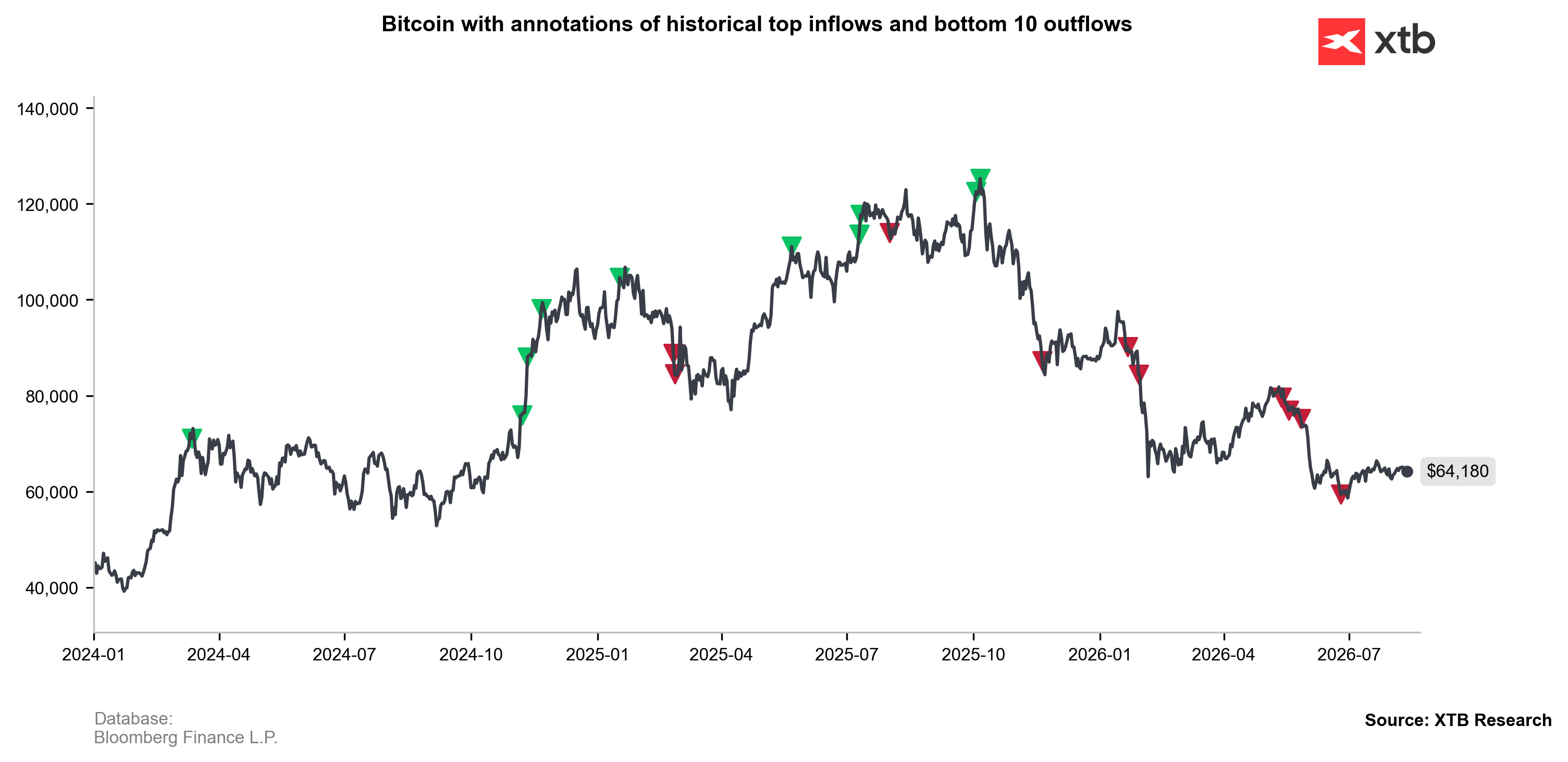
BTC remains well below the 23.6% Fibonacci retracement of the latest major downward move, located around $73,000. Bitcoin is clearly struggling to initiate a strong rebound from current levels and has twice encountered significant resistance around $65,000–66,000. The $60,000–62,000 area appears to be an important support zone, reinforced by previous price reactions. A break below $60,000 could point to another stronger bearish impulse and potentially new lows in the ongoing bear market.
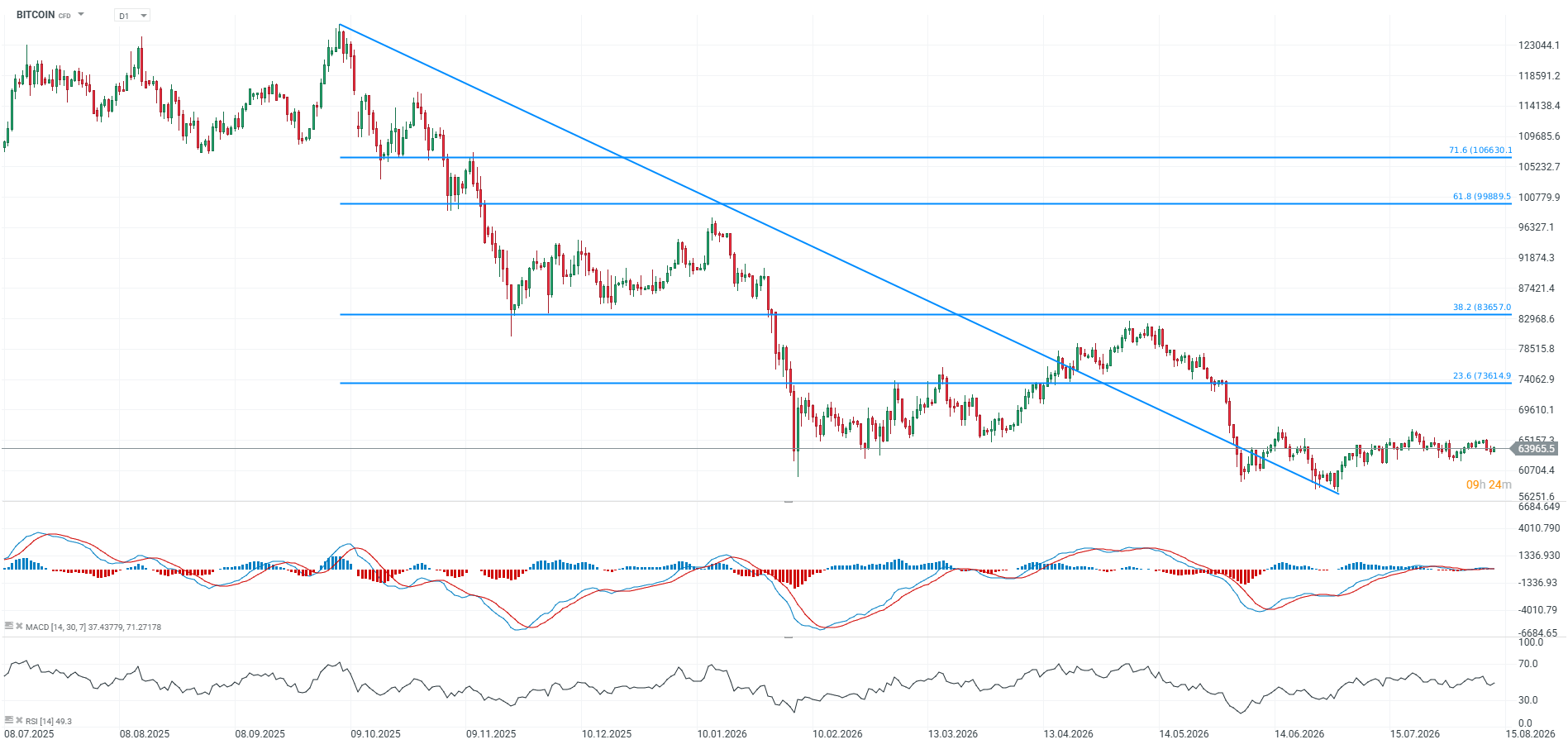
Source: xStation5