
This website uses cookies
We use cookies to personalise content and ads, to provide social media features and to analyse our traffic. We also share information about your use of our site with our social media, advertising and analytics partners who may combine it with other information that you’ve provided to them or that they’ve collected from your use of their services.
Consent Selection
Details
  • Necessary cookies help make a website usable by enabling basic functions like page navigation and access to secure areas of the website. The website cannot function properly without these cookies.
  • Preference cookies enable a website to remember information that changes the way the website behaves or looks, like your preferred language or the region that you are in.
    • We do not use cookies of this type.

  • Statistic cookies help website owners to understand how visitors interact with websites by collecting and reporting information anonymously.
    • We do not use cookies of this type.

  • Marketing cookies are used to track visitors across websites. The intention is to display ads that are relevant and engaging for the individual user and thereby more valuable for publishers and third party advertisers.
    • We do not use cookies of this type.

  • Unclassified cookies are cookies that we are in the process of classifying, together with the providers of individual cookies.
    • __emg_sidPending
      Maximum Storage Duration: 1 dayType: HTTP Cookie
      __emg_vidPending
      Maximum Storage Duration: 1 yearType: HTTP Cookie
      nl-read-countPending
      Maximum Storage Duration: PersistentType: HTML Local Storage
Cookie declaration last updated on 8/12/26 by Cookiebot
[#IABV2_TITLE#]
[#IABV2_BODY_INTRO#]
[#IABV2_BODY_LEGITIMATE_INTEREST_INTRO#]
[#IABV2_BODY_PREFERENCE_INTRO#]
[#IABV2_BODY_PURPOSES_INTRO#]
[#IABV2_BODY_PURPOSES#]
[#IABV2_BODY_FEATURES_INTRO#]
[#IABV2_BODY_FEATURES#]
[#IABV2_BODY_PARTNERS_INTRO#]
[#IABV2_BODY_PARTNERS#]
About
Cookies are small text files that can be used by websites to make a user's experience more efficient.

The law states that we can store cookies on your device if they are strictly necessary for the operation of this site. For all other types of cookies we need your permission.

This site uses different types of cookies. Some cookies are placed by third party services that appear on our pages.

You can at any time change or withdraw your consent from the Cookie Declaration on our website.

Learn more about who we are, how you can contact us and how we process personal data in our Privacy Policy.

Please state your consent ID and date when you contact us regarding your consent.
NewsLayer.com
NewsLayer PulseLIVEBTC$77,235-0.09%ETH$2,429+0.04%SOL$94.45+0.65%XRP$1.5-0.63%DOGE$0.0926+1.16%ADA$0.2249-0.36%Total Cap$2.74T+0.25%Layer Index54 Neutral

Engineers build world's first portable diamond-powered quantum computer — it works at room temperature and can be plugged into an outlet

A German startup has debuted the world's first diamond-based quantum computing system to exceed 10 qubits.

Live Science

Publisher

Aug 6, 2026 at 7:00 AM UTC · Updated vor 4 Tagen · 4 Min. Lesezeit
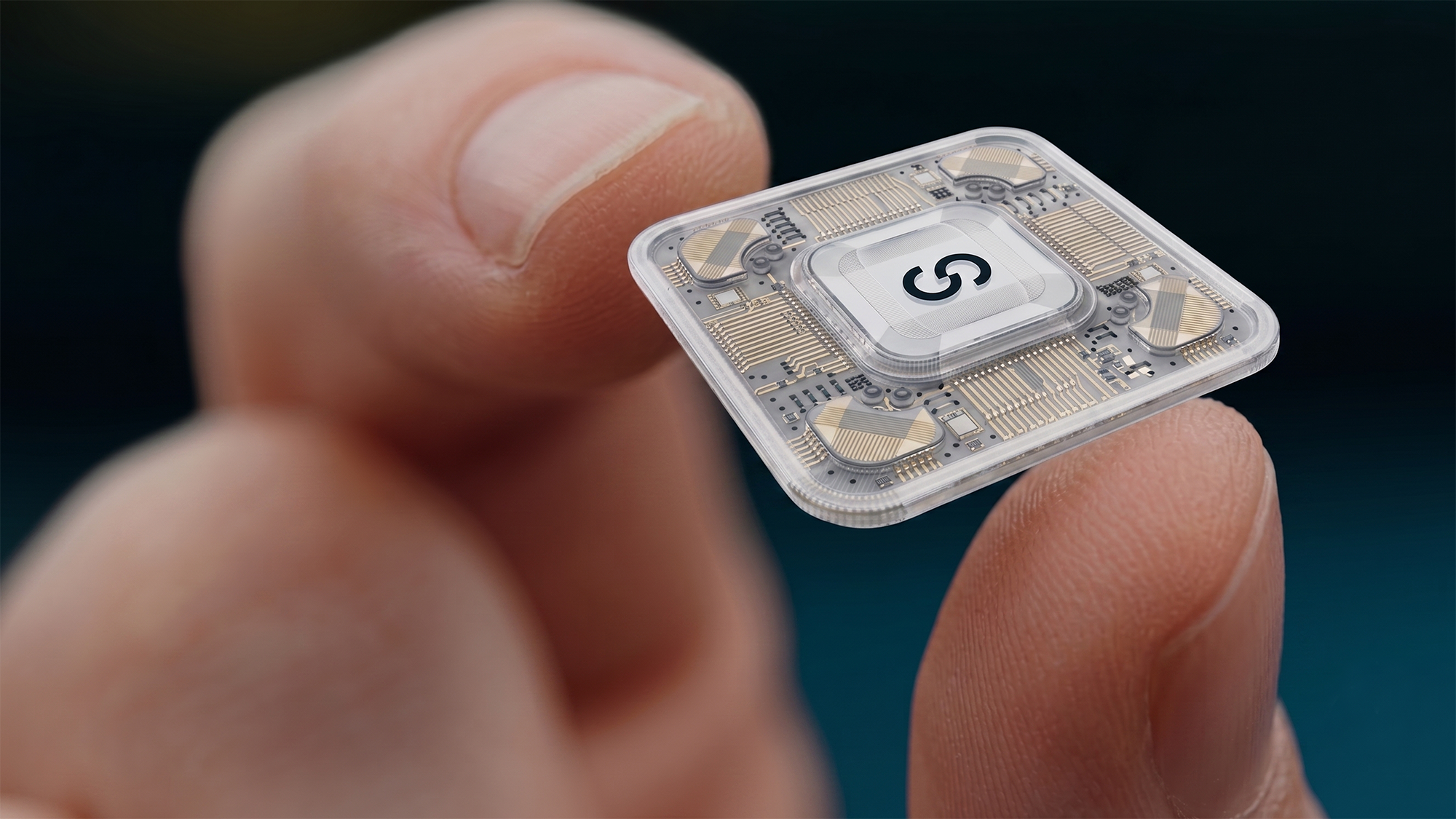
Engineers build world's first portable diamond-powered quantum computer — it works at room temperature and can be plugged into an outlet
Image via Live Science
Übersetzung…

A German startup has debuted the world's first diamond-based quantum computing system to exceed 10 qubits.

The machine, built by engineers at Saxon Q, is a nitrogen-vacancy (NV) quantum computer, meaning it uses defects in synthetic diamonds as quantum bits (qubits) to perform quantum operations. Qubits can be manipulated to represent the 0s and 1s of data, as well as quantum states that are superpositions of both the 0s and the 1s.

The hardware is currently available in rack-mounted systems featuring up to 128 qubits, with 512-qubit configurations available for delivery next year. According to the company's road map, the goal is to scale to 10,000 qubits and beyond after 2030.

Latest Videos FromLive Science

Although the technology existed before this debut, scientists have found it difficult to build systems beyond 10 qubits due to the difficulty of creating nitrogen vacancy qubits.

Although Live Science saw a technical white paper outlining how the technology works, there didn't appear to be any published research demonstrating a functional quantum computer based on the NV architecture operating with more than 10 qubits before this launch. It's still unclear exactly how well the firm's quantum computers stack up against other platforms.

Article Intelligence

Sponsored

Ad
House — Advertise on NewsLayer
NewsLayerLearn more

NewsLayer Premium

Unlock deeper intelligence.

Ad-free reading, exclusive research, and real-time onchain insights.

Go Premium
