

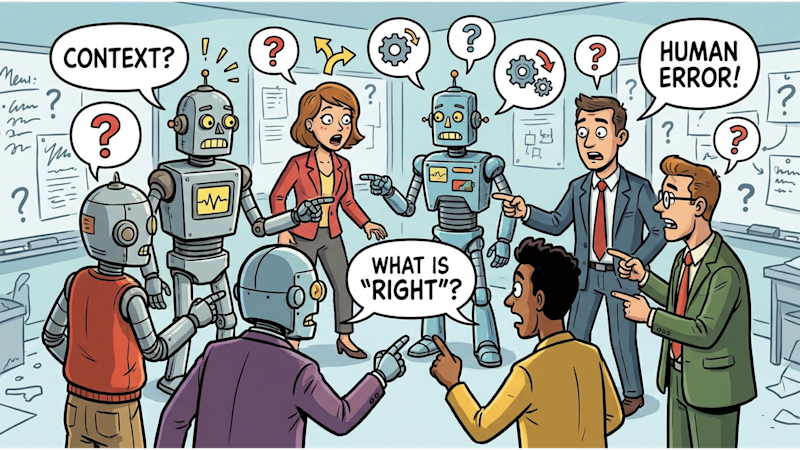
In the enterprise, a confidently wrong AI agent answer can come from something more basic than the model: the agent doesn't know what the business means by its own terms, like what counts as revenue or which customer record is current.
Few AI agents rely on semantic layers
In the enterprise, a confidently wrong AI agent answer can come from something more basic than the model: the agent doesn't know what the business means by its own terms, like what counts as revenue or which customer record is current.
VentureBeat
Publisher
Oct 6, 2026 at 5:57 PM UTC · Updated vor 3 Stunden · 4 Min. Lesezeit
Übersetzung…
The VB Pulse tracker has followed how enterprises are responding to that across three separate waves since June. Across all three waves, most respondents report running, piloting or building a governed semantic layer: 58% in June, 63% in July and 67% in August. But far fewer name that layer as their agents’ primary source of business context: 21%, 19% and 13%, respectively.
Context failures remain widespread. Sixty-four percent of August respondents traced a confidently wrong agent answer to missing or inconsistent business context in the past six months. July was 68%, and June was 57%.
Agents get context somewhere else
Respondents named several different primary sources of business context for their agents. Retrieval over documents was named by 32%. Direct queries to live systems, where an agent runs SQL or calls an API or an MCP server and reads whatever comes back, were named by 21%, up from 11% in July, a change large enough to call. The gap between retrieval and direct queries is too close to call. Long-context loading, pasting a large set of documents or records straight into the model's context window, was named by 19%. The governed semantic layer was named by 13%.
Article Intelligence
Topics
Sponsored
Ad
NewsLayerLearn more
NewsLayer Premium
Unlock deeper intelligence.
Ad-free reading, exclusive research, and real-time onchain insights.
Go Premium