

How Crypto Forensics is Dismantling the IRGC
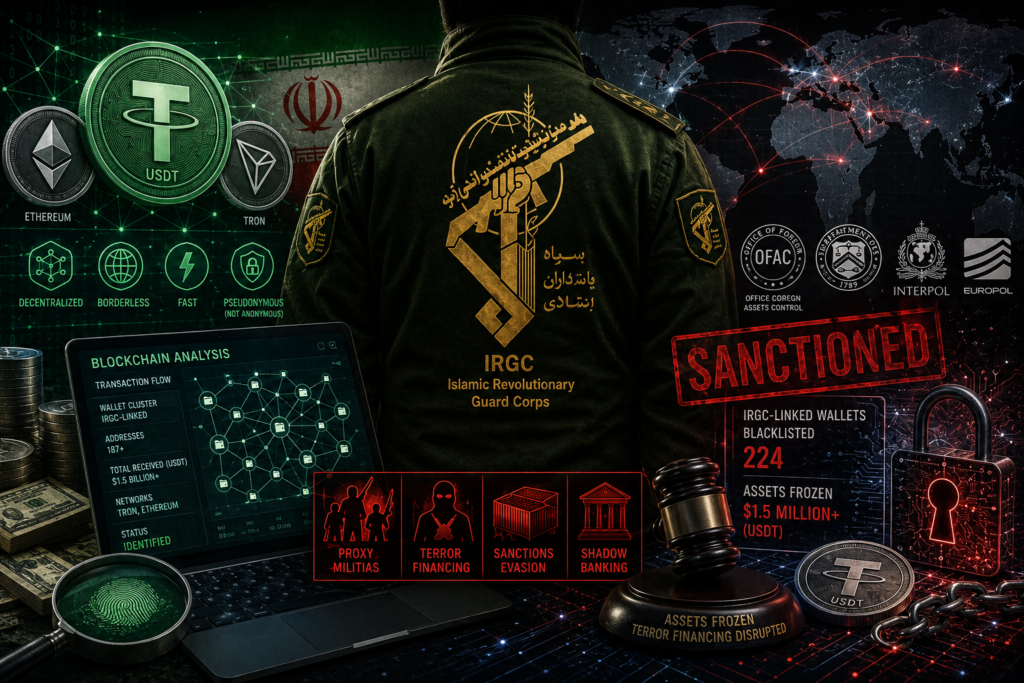
The article examines how cryptocurrency forensics may be used to investigate and disrupt financial activity linked to Iran’s Islamic Revolutionary Guard Corps (IRGC). It is published by the Jerusalem Center for Security and Foreign Affairs.
Jerusalem Center for Security and Foreign Affairs
Publisher
Aug 10, 2026 at 9:37 AM UTC · 11 Min. Lesezeit
Key Signal
187 wallets IRGC-linked wallets seized
Last Updated
vor 2 Monaten
Übersetzung…
Kernpunkte
- Crypto-forensics tools can trace and analyze blockchain-based transactions.
- The article focuses on potential investigations involving the IRGC.
- The piece comes from the Jerusalem Center for Security and Foreign Affairs.
Cryptocurrency provides sanctioned and terrorist organizations with new ways to transfer value, but public blockchains also create persistent records that investigators can analyze retrospectively. Crypto forensics can connect wallets, identify infrastructure, expose financial relationships, and support sanctions or asset freezes. Centralized stablecoin issuers and exchanges create particularly important intervention points where authorities may disrupt access to funds. As evasion techniques become more sophisticated, effective enforcement will increasingly combine blockchain analytics, AI, conventional investigative methods, legal powers, and international cooperation.
Key Takeaways
- Blockchain transparency can work against illicit finance. Public, immutable transaction records allow investigators to trace historical activity, connect related wallets, and uncover financial networks that might be harder to reconstruct through traditional banking systems.
- Enforcement increasingly targets entire financial ecosystems. Wallet freezes, exchange sanctions, stablecoin blacklisting, and investigations of brokers and infrastructure providers can disrupt the gateways that connect digital assets with real-world money and resources.
- Crypto forensics is becoming a strategic counterterrorism capability. Its effectiveness depends not only on blockchain analytics, but also on appropriate legal authority, private-sector cooperation, international coordination, and increasingly AI-assisted detection.
Article Intelligence
Topics
Regulation Signal
in progressUpdated vor 2 Monaten
SEC Crypto Asset Market Structure RulemakingRelated Coverage
 PolicySEC and CFTC to Operate with Fewer Crypto Regulators After Resignationsvor 39 Minuten · 5 min read
 CryptoCoinbase Secures CFTC Clearinghouse Approval, Becoming First Crypto Firm to Hold All Three U.S. Derivatives Registrationsvor 2 Stunden · 2 min read
 PolicySEC and CFTC Crypto Regulation Heads to 3 Commissioners After Resignationvor 3 Stunden · 4 min read
Sponsored
Ad
NewsLayerLearn more
NewsLayer Premium
Unlock deeper intelligence.
Ad-free reading, exclusive research, and real-time onchain insights.
Go Premium