

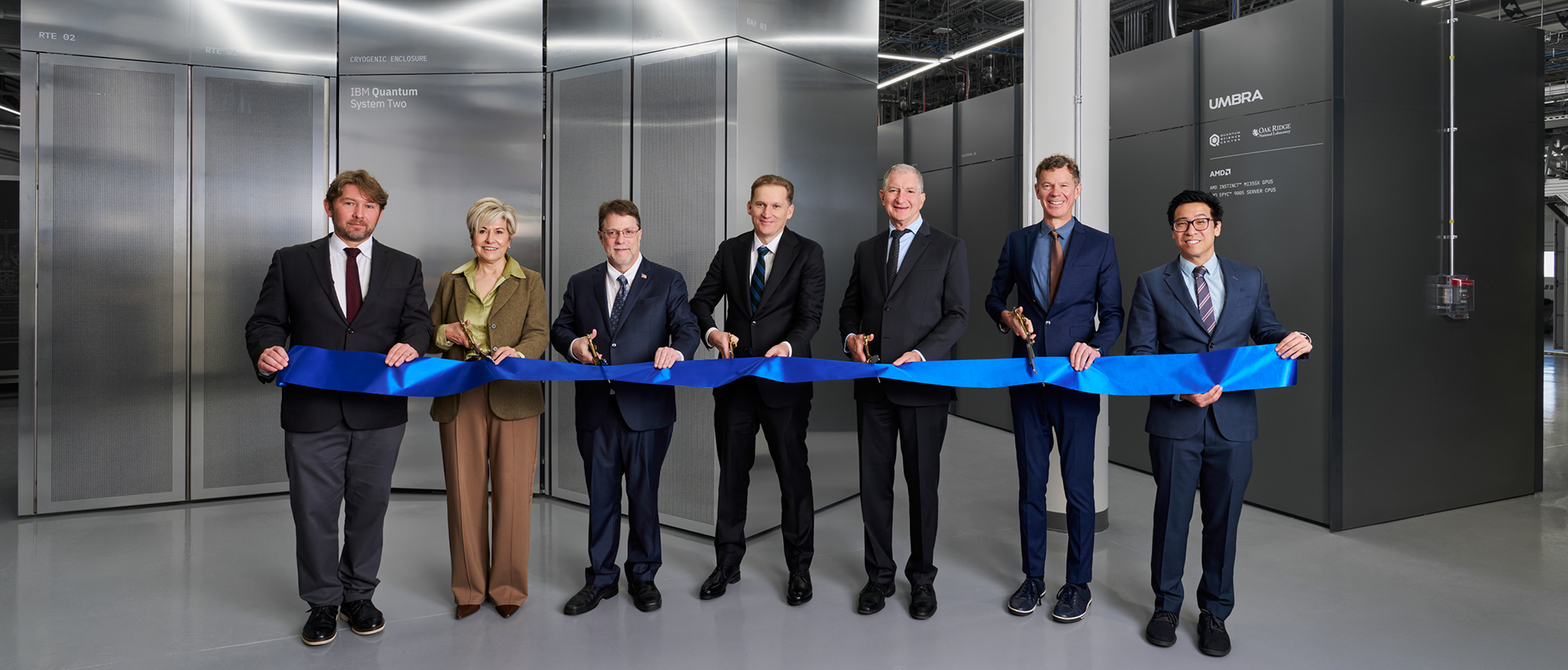
Hardware and supercomputing leaders IBM (NYSE: IBM), the Quantum Science Center (QSC) at Oak Ridge National Laboratory (ORNL), and AMD (NASDAQ: AMD) have launched a dedicated quantum error correction (QEC) co-design platform at IBM’s facility in Poughkeepsie, New York. Designed to eliminate network latency bottlenecks between heterogeneous compute tiers, the deployment co-locates IBM’s latest 120-qubit Quantum Nighthawk r2 processor with ORNL’s Umbra high-performance computing (HPC) system, powered by AMD Instinct MI355X accelerators and 5th Gen AMD EPYC CPUs.
IBM, ORNL, and AMD Deploy Co-Located Quantum Error Correction Platform in Poughkeepsie
Hardware and supercomputing leaders IBM (NYSE: IBM), the Quantum Science Center (QSC) at Oak Ridge National Laboratory (ORNL), and AMD (NASDAQ: AMD) have launched a dedicated quantum error correction (QEC) co-design platform at IBM’s…
Quantum Computing Report
Publisher
Nov 6, 2026 at 12:53 AM UTC · Updated vor 8 Stunden · 2 Min. Lesezeit
Market Impact
Total MCap-4.32%
Last Updated
vor 8 Stunden
Übersetzung…
| IBM / ORNL / AMD QEC Co-Design Platform Specifications | ||
|---|---|---|
| Architecture Pillar | Hardware & Infrastructure Profile | Technical & Operational Function |
| Quantum Compute Tier | IBM Quantum Nighthawk r2 | 120 programmable qubits in a square lattice with dynamic mid-circuit measurement and fast reset. |
| Classical Accelerator Tier | ORNL Umbra HPC System | AMD Instinct MI355X GPUs and 5th Gen AMD EPYC CPUs providing hardware-level decoding acceleration. |
| Interconnect Architecture | On-premises co-location (Poughkeepsie) | Enables sub-millisecond round-trip feedback loops required for real-time syndrome processing. |
| National Mission Alignment | DOE Quantum Genesis Mission (Q Competition) | Targets scaling from 70 logical qubits (438 operations) to 100 logical qubits across 100,000 operations by 2028. |
Fault-tolerant quantum computing requires continuous syndrome-extraction cycles where classical decoding engines process error signals fast enough to prevent physical noise accumulation from overwhelming the logical register. In traditional cloud workflows, transferring syndrome telemetry across public networks introduces transmission delays that preclude real-time conditional branching. By physically placing the Umbra cluster adjacent to the dilution refrigerator infrastructure in Poughkeepsie, the consortium establishes a high-throughput, low-latency datapath, enabling GPU-accelerated decoders to execute in step with the QPU’s 100,000 circuits-per-second repetition rates.
Market Context
Total Market Cap$2.55T-4.32%
24H Volume$329.6B
BTC Dominance59.4%
ETH Dominance10.7%
Updated vor 10 Minuten
View All MarketsArticle Intelligence
Sponsored
Ad
NewsLayerLearn more
NewsLayer Premium
Unlock deeper intelligence.
Ad-free reading, exclusive research, and real-time onchain insights.
Go Premium