
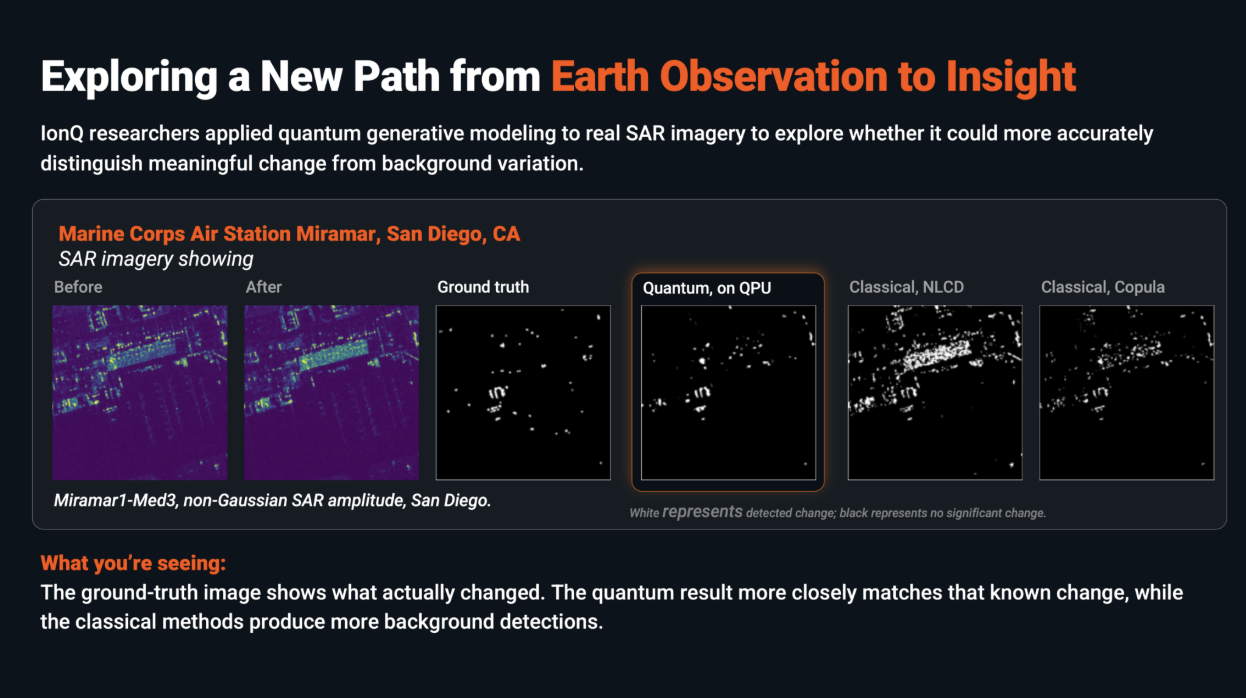
Quantum computing platform developer IonQ, Inc. (NYSE: IONQ) has published breakthrough research demonstrating that quantum generative machine learning models can outperform classical statistical baselines in detecting ground-level changes from satellite-based Synthetic Aperture Radar (SAR) and Interferometric SAR (InSAR) imagery. Published on arXiv (arXiv:2609.05313), the study validates that Quantum Circuit Born Machines (QCBMs) executed on IonQ trapped-ion quantum processing units achieve superior change-detection accuracy under conditions where high-resolution radar data produces sparse or non-Gaussian pixel statistics.
IonQ Demonstrates Quantum Generative Modeling Advantage for High-Resolution Satellite Radar Change Detection
Quantum computing platform developer IonQ, Inc. (NYSE: IONQ) has published breakthrough research demonstrating that quantum generative machine learning models can outperform classical statistical baselines in detecting ground-level…
Quantum Computing Report
Publisher
Sep 25, 2026 at 5:38 AM UTC · Updated vor einer Stunde · 2 Min. Lesezeit
Übersetzung…
The research addresses a fundamental bottleneck in satellite Earth Observation (EO). While SAR provides persistent, all-weather, day-and-night imaging by measuring microwave backscatter, sub-meter high-resolution acquisitions generate heavy-tailed, non-Gaussian pixel distributions. Traditional classical background estimators (such as Non-Linear Change Detection, NLCD) rely on joint histogram lookup tables, which degrade when pixel statistics are sparsely populated. By encoding bi-temporal satellite image pairs in Copula space using a 20-qubit to 24-qubit QCBM architecture, IonQ’s quantum model generates synthetic reference samples to construct accurate background expectations without requiring spatial smoothing or sacrificing fine resolution detail.
Article Intelligence
Related Coverage
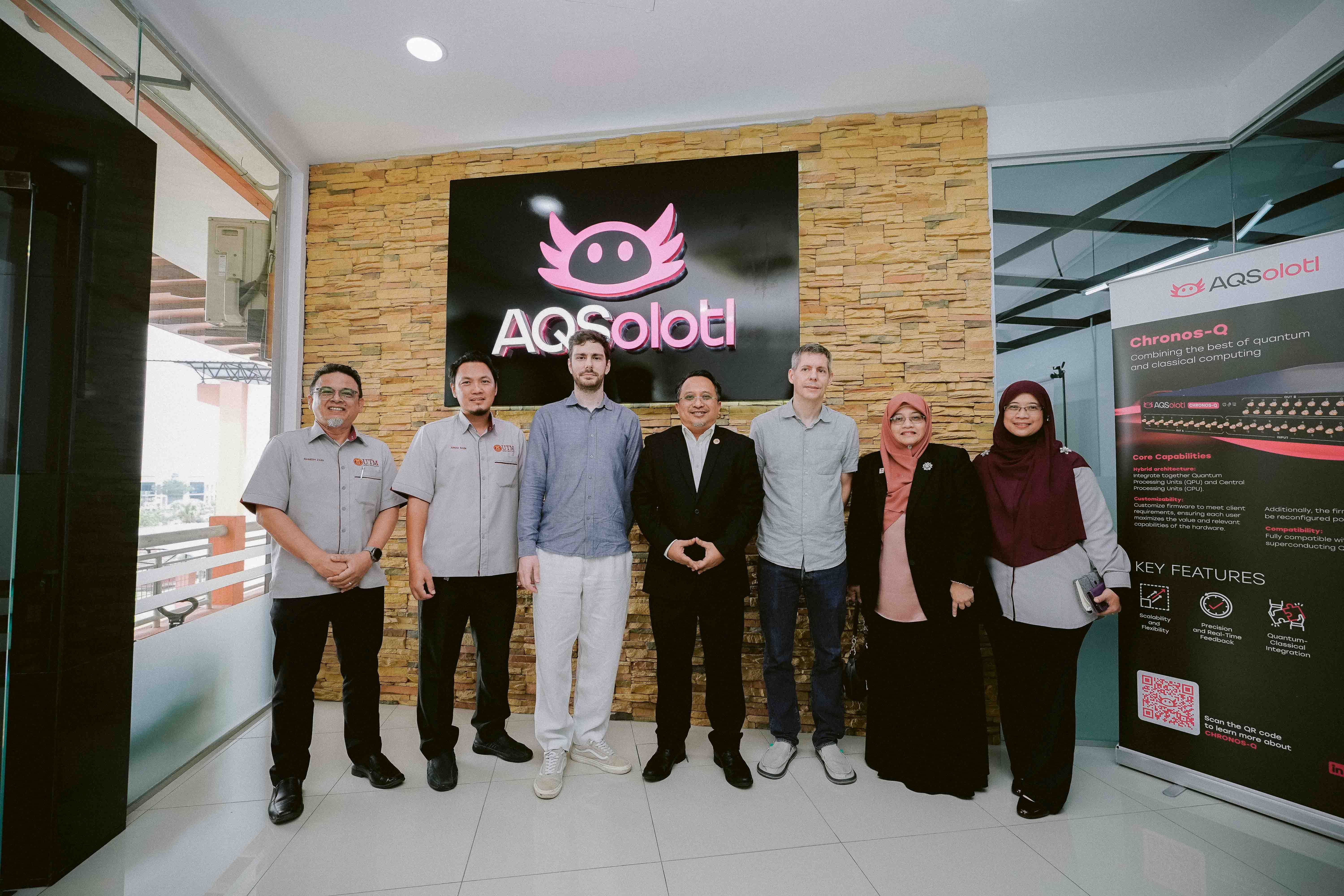 QuantumUTM Becomes Base For Malaysia’s First Quantum Computing Hardware Companyvor 5 Stunden · 3 min read
 Quantum256-qubit quantum computer to power research at Florida universityvor 13 Stunden · 2 min read
Sponsored
Ad
NewsLayerLearn more
NewsLayer Premium
Unlock deeper intelligence.
Ad-free reading, exclusive research, and real-time onchain insights.
Go Premium