

This website uses cookies
We use cookies to personalise content and ads, to provide social media features and to analyse our traffic. We also share information about your use of our site with our social media, advertising and analytics partners who may combine it with other information that you’ve provided to them or that they’ve collected from your use of their services.
Consent Selection
Details
  • Necessary cookies help make a website usable by enabling basic functions like page navigation and access to secure areas of the website. The website cannot function properly without these cookies.
  • Preference cookies enable a website to remember information that changes the way the website behaves or looks, like your preferred language or the region that you are in.
    • We do not use cookies of this type.

  • Statistic cookies help website owners to understand how visitors interact with websites by collecting and reporting information anonymously.
    • We do not use cookies of this type.

  • Marketing cookies are used to track visitors across websites. The intention is to display ads that are relevant and engaging for the individual user and thereby more valuable for publishers and third party advertisers.
    • We do not use cookies of this type.

  • Unclassified cookies are cookies that we are in the process of classifying, together with the providers of individual cookies.
    • __emg_sidPending
      Maximum Storage Duration: 1 dayType: HTTP Cookie
      __emg_vidPending
      Maximum Storage Duration: 1 yearType: HTTP Cookie
      nl-read-countPending
      Maximum Storage Duration: PersistentType: HTML Local Storage
Cookie declaration last updated on 8/12/26 by Cookiebot
[#IABV2_TITLE#]
[#IABV2_BODY_INTRO#]
[#IABV2_BODY_LEGITIMATE_INTEREST_INTRO#]
[#IABV2_BODY_PREFERENCE_INTRO#]
[#IABV2_BODY_PURPOSES_INTRO#]
[#IABV2_BODY_PURPOSES#]
[#IABV2_BODY_FEATURES_INTRO#]
[#IABV2_BODY_FEATURES#]
[#IABV2_BODY_PARTNERS_INTRO#]
[#IABV2_BODY_PARTNERS#]
About
Cookies are small text files that can be used by websites to make a user's experience more efficient.

The law states that we can store cookies on your device if they are strictly necessary for the operation of this site. For all other types of cookies we need your permission.

This site uses different types of cookies. Some cookies are placed by third party services that appear on our pages.

You can at any time change or withdraw your consent from the Cookie Declaration on our website.

Learn more about who we are, how you can contact us and how we process personal data in our Privacy Policy.

Please state your consent ID and date when you contact us regarding your consent.
NewsLayer

Install NewsLayer

Get the app experience — one tap from your home screen, instant loads and breaking-news alerts.

NewsLayer.com
NewsLayer PulseLIVEBTC$79,951+3.65%ETH$2,526+3.58%SOL$97.46+2.22%XRP$1.53+2.13%DOGE$0.0927+0.29%ADA$0.2265+0.87%Total Cap$2.70T+0.62%Layer Index71 Greed

Kyungpook Team Defines Qubit Path Ambiguity With Monopole Connection

A computable method now determines geometric phases along open paths; previously, infinitely many geodesics could close such paths leading to ambiguous calculations. It resolves this ambiguity by defining how displacing a system’s…

Quantum Zeitgeist

Publisher

Aug 24, 2026 at 12:23 PM UTC · Updated vor 25 Minuten · 3 Min. Lesezeit
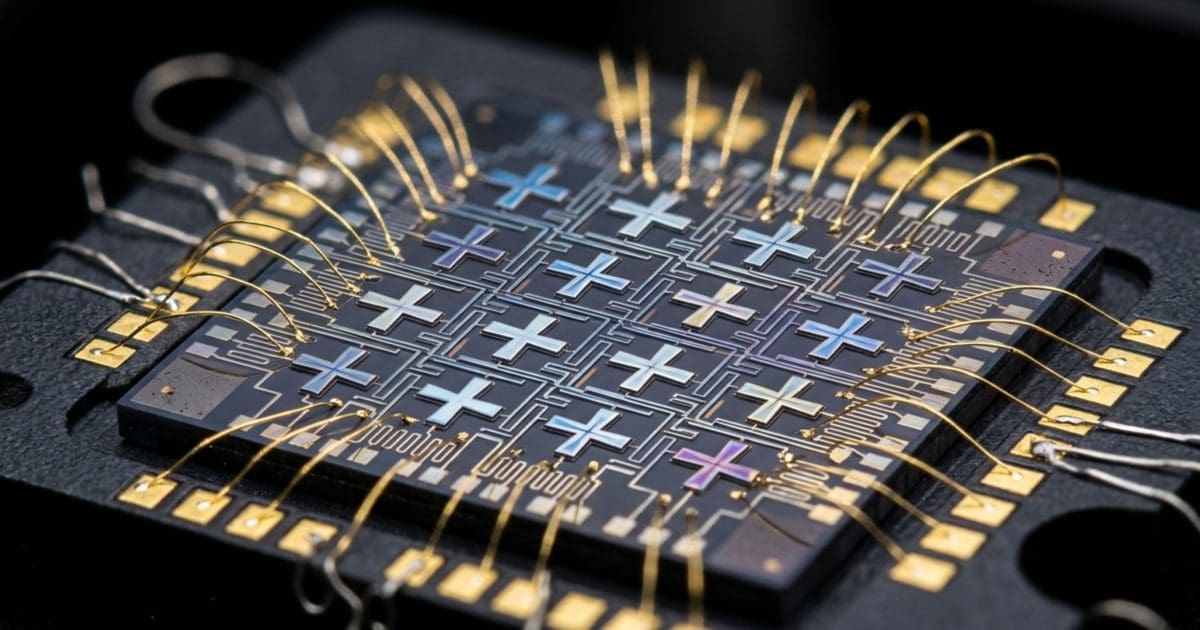
Kyungpook Team Defines Qubit Path Ambiguity With Monopole Connection
Image via Quantum Zeitgeist

A computable method now determines geometric phases along open paths; previously, infinitely many geodesics could close such paths leading to ambiguous calculations. It resolves this ambiguity by defining how displacing a system’s degeneracy closes the path with a predictable solid angle dependent on its curvature at that point. A precise method for calculating geometric phases, fundamental properties influencing quantum systems such as qubits and spin particles, defines these phases.

Previously, calculations relied upon experimentally confirmed approximations; these are now grounded in rigorous mathematics. This offers improved control over manipulation within areas like qubit technology and studies of polarization. An accurate calculation of geometric phases, intrinsic properties influencing quantum systems like qubits and spin particles, achieves resolution of long-standing ambiguities in open path calculations. Previously, determining these phases relied upon approximations; they are now established with rigorous mathematics offering greater control over manipulation within technologies such as qubit engineering and polarization studies.

Understanding how paths close when endpoints meet at opposite points on what’s known as a Bloch sphere, a visual tool for representing qubit states similar to using latitude and longitude on Earth, has been particularly challenging. The team’s approach defines the solid angle of an open curve without relying on choosing arbitrary coordinates, much like calculating distance travelled regardless of whether it is measured in miles or kilometres. But can this method consistently select the correct closing geodesic from infinitely many possibilities, ensuring accurate phase calculations.

Article Intelligence

Sponsored

Ad

House — Advertise on NewsLayer
NewsLayerLearn more

NewsLayer Premium

Unlock deeper intelligence.

Ad-free reading, exclusive research, and real-time onchain insights.

Go Premium