
Global technology services firm LTM (a Larsen & Toubro Group company) has deployed its proprietary AI-QEM (AI-powered Quantum Error Mitigation) software in the IBM Quantum Functions Catalog, becoming the first global systems integrator to publish a circuit function on the platform. Available to IBM Quantum Premium, Flex, and On-Prem Plan users via the ltm/ai-qem interface, the function integrates into Qiskit Estimator workflows to suppress hardware noise through classical deep-learning inference.
LTM Becomes First Global Systems Integrator to Launch Function in IBM Quantum Functions Catalog with AI-QEM
Global technology services firm LTM (a Larsen & Toubro Group company) has deployed its proprietary AI-QEM (AI-powered Quantum Error Mitigation) software in the IBM Quantum Functions Catalog, becoming the first global systems…
Quantum Computing Report
Publisher
Nov 13, 2026 at 4:37 AM UTC · Updated vor einer Stunde · 2 Min. Lesezeit

| LTM AI-QEM Circuit Function Specifications & Benchmarks | ||
|---|---|---|
| System Dimension | Technical Specification | Measured Benchmark / Platform Impact |
| Model Architecture | Graph Convolutional Network (GCN)-Transformer | Predicts per-Pauli correction factors (ζi) from circuit structure, backend topology, and qubit calibrations. |
| Hardware Overhead | Zero additional QPU runtime, circuit repetitions, or ancilla qubits | Matches native IBM EstimatorV2 QPU times (12 s commuting / 23 s non-commuting on ibm_kingston). |
| Hardware Benchmarks | Up to 100 qubits on IBM Heron r2 processors | Achieved 95.06% accuracy on 100-qubit Clifford circuits (depth 45) and 90.29% on 96-qubit 2D Ising runs. |
| Current Scope & Limits | IBM Heron processor family; applied when |⟨O⟩noisy| ≥ 0.1 | Targets non-trivial expectation values while avoiding noise amplification near zero. |
Physical quantum processors remain constrained by gate errors and environmental decoherence that bias expectation values as circuit depth and qubit counts increase. Conventional error-mitigation protocols such as zero-noise extrapolation (ZNE) and probabilistic error cancellation (PEC) compensate for noise by executing ensembles of modified circuits, introducing exponential sampling overheads that inflate quantum runtime costs.
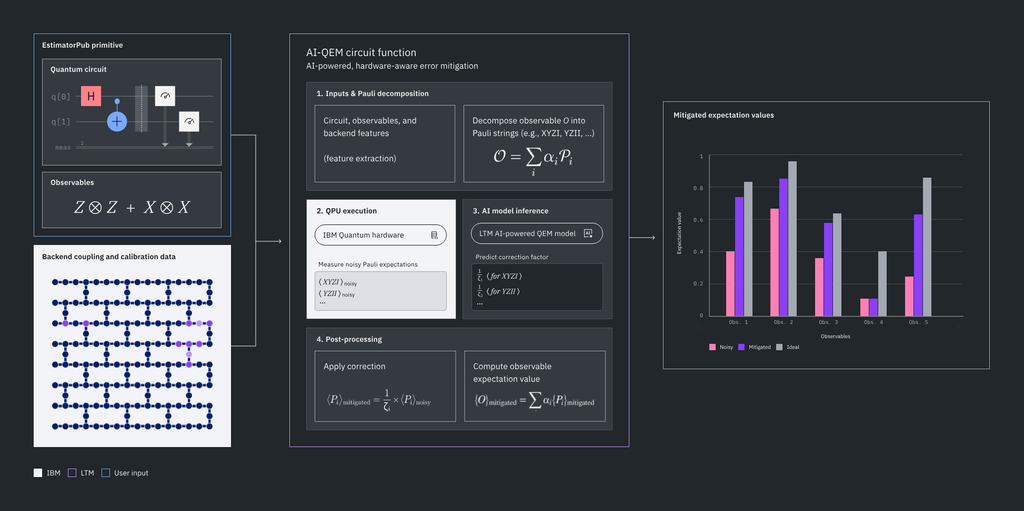
LTM’s circuit-agnostic approach bypasses additional quantum sampling by decomposing observables into Pauli operators and applying trained classical neural networks to rescale each noisy expectation value (⟨Pi⟩mitigated = ⟨Pi⟩noisy / ζi). Across 80- to 150-qubit validation suites, the GCN-Transformer architecture recorded a mean absolute error (MAE) of 0.343, outperforming random-forest mitigation baselines. The launch is accompanied by an IBM Quantum tutorial covering Trotterized time evolution of the 2D tilted-field Ising model.
Article Intelligence
Related Coverage
 QuantumKipu Quantum Launches Rimay Quantum Feature Extraction in IBM Quantum Functions Catalogvor 7 Stunden · 2 min read
 QuantumCleveland Clinic, RIKEN, and IBM Cross 12,000-Atom Barrier in Heterogeneous Quantum-Classical Drug Binding Simulationsvor 6 Stunden · 3 min read
 QuantumPsiQuantum and AMD Expand Partnership with Equity Investment to Co-Design Utility-Scale Quantum Infrastructurevor 7 Stunden · 2 min read
Sponsored
Ad
NewsLayerLearn more
NewsLayer Premium
Unlock deeper intelligence.
Ad-free reading, exclusive research, and real-time onchain insights.
Go Premium