

So, investors should be aware of three things — where returns come from, how they fit inside a portfolio, and how crypto has grown far beyond Bitcoin.
Rethinking crypto risk — Here’s why ONE factor doesn’t tell the whole story
So, investors should be aware of three things — where returns come from, how they fit inside a portfolio, and how crypto has grown far beyond Bitcoin.
Cryptonews.net
Publisher
Nov 23, 2026 at 3:21 AM UTC · 3 Min. Lesezeit

Market Impact
BTC+3.37%$61,180
Last Updated
vor einer Minute
Übersetzung…
Big swings work both ways
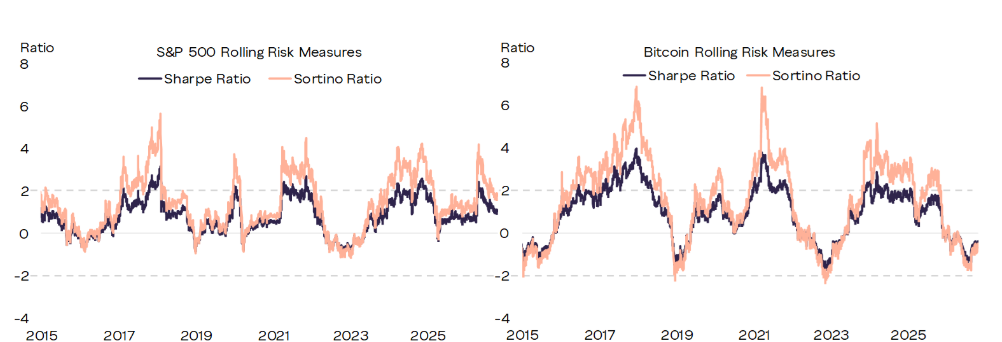
The standard risk tools like the standard deviation or the Sharpe ratio don’t care how much money you make or lose. That leaves a blind spot for Bitcoin as most of its long-term gains come from just a handful of trading days.
Bitcoin has averaged 60% per year over the last three years. If you take away its ten best days, that number drops to 7%. If you take away its ten worst days, the number jumps to 197%. That’s because big drops are often followed by big rebounds, so investors who try to avoid bad days can easily miss the best ones.
Momentum counts as well. Bitcoin’s gains tend to pile on top of each other, and Bitcoin runs far better after months of winning than months of losing. During strong rallies, the Sortino ratio can rise well above normal risk scores. Mostly because it only measures returns against downside volatility, not upside volatility.
Notably, Bitcoin has dropped by 50% or more seven times since 2011. But when you include the volatility of starting, Bitcoin’s falls look more like stocks and bonds.
Market Context
Bitcoin
BTC
$61,201
+3.41% (24H)
Market Cap
$1.23T
24H Volume
$19.7B
24H High
$61,886
Article Intelligence
Topics
Sponsored
Ad
NewsLayerLearn more
NewsLayer Premium
Unlock deeper intelligence.
Ad-free reading, exclusive research, and real-time onchain insights.
Go Premium