
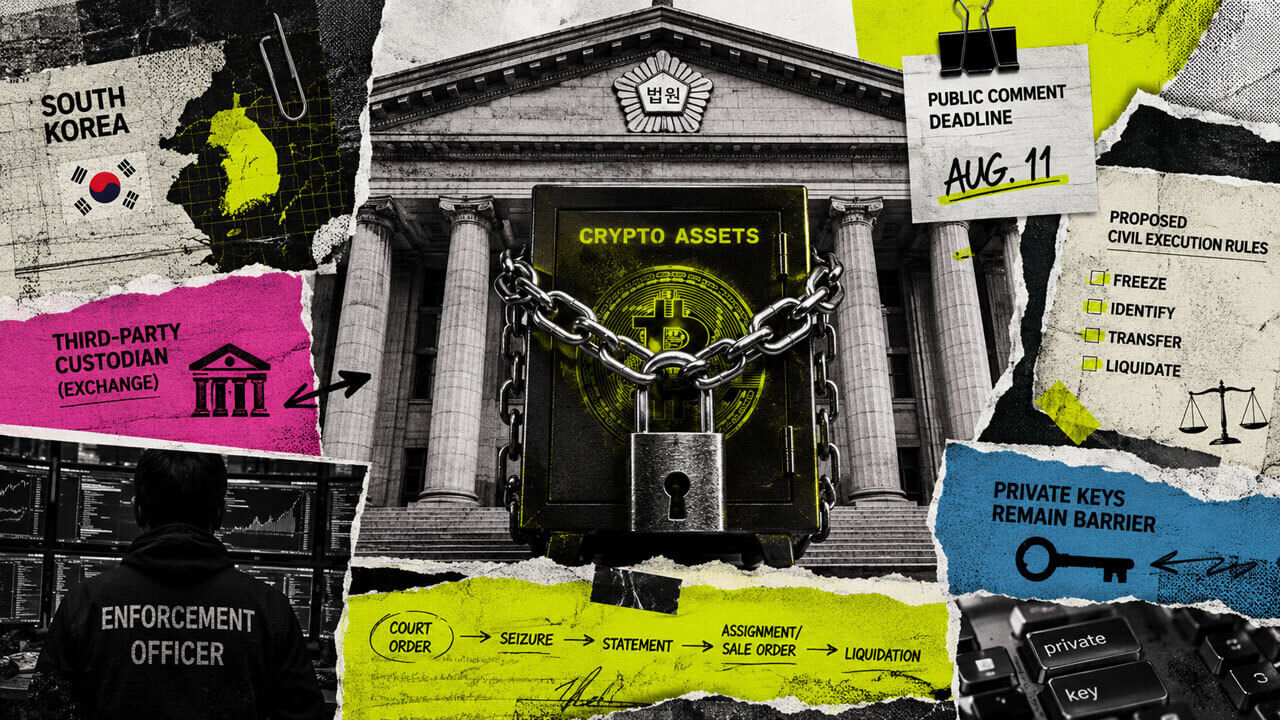
South Korea is nearing an Aug. 11 deadline for public comments on proposed crypto seizure rules that could give exchanges just seven days to disclose customer holdings once served with a court order.
South Korea puts crypto exchanges on a seven-day clock under new seizure rules
South Korea is nearing an Aug. 11 deadline for public comments on proposed crypto seizure rules that could give exchanges just seven days to disclose customer holdings once served with a court order.
CryptoSlate
Publisher
Aug 10, 2026 at 10:30 PM UTC · 2 Min. Lesezeit
Key Signal
16.29M Accounts at top exchanges
Last Updated
vor 2 Monaten
Übersetzung…
The Supreme Court’s proposed amendments to the Civil Execution Rules would create a standardized process for creditors to freeze, identify and liquidate virtual assets held by debtors. If finalized on the current timetable, the rules are expected to take effect Oct. 1.
That would leave exchanges and other virtual asset service providers roughly seven weeks after the consultation closes to prepare for a more formal role in civil debt enforcement.
For crypto held through a custodian, a court could attach the debtor’s right to receive the assets rather than initially seizing the coins themselves. Once served, the provider would be barred from transferring the corresponding assets to the debtor, who would also lose the ability to dispose of the claim.
Creditors could then ask the court to require the provider to disclose what it holds. The exchange would have one week to state whether it recognizes the debtor’s claim, identify the type and quantity of assets, and disclose competing seizures, provisional orders, or priority rights.
Article Intelligence
Topics
Sponsored
Ad
NewsLayerLearn more
NewsLayer Premium
Unlock deeper intelligence.
Ad-free reading, exclusive research, and real-time onchain insights.
Go Premium