
This website uses cookies
We use cookies to personalise content and ads, to provide social media features and to analyse our traffic. We also share information about your use of our site with our social media, advertising and analytics partners who may combine it with other information that you’ve provided to them or that they’ve collected from your use of their services.
Consent Selection
Details
  • Necessary cookies help make a website usable by enabling basic functions like page navigation and access to secure areas of the website. The website cannot function properly without these cookies.
  • Preference cookies enable a website to remember information that changes the way the website behaves or looks, like your preferred language or the region that you are in.
    • We do not use cookies of this type.

  • Statistic cookies help website owners to understand how visitors interact with websites by collecting and reporting information anonymously.
    • We do not use cookies of this type.

  • Marketing cookies are used to track visitors across websites. The intention is to display ads that are relevant and engaging for the individual user and thereby more valuable for publishers and third party advertisers.
    • We do not use cookies of this type.

  • Unclassified cookies are cookies that we are in the process of classifying, together with the providers of individual cookies.
    • __emg_sidPending
      Maximum Storage Duration: 1 dayType: HTTP Cookie
      __emg_vidPending
      Maximum Storage Duration: 1 yearType: HTTP Cookie
      nl-read-countPending
      Maximum Storage Duration: PersistentType: HTML Local Storage
Cookie declaration last updated on 8/12/26 by Cookiebot
[#IABV2_TITLE#]
[#IABV2_BODY_INTRO#]
[#IABV2_BODY_LEGITIMATE_INTEREST_INTRO#]
[#IABV2_BODY_PREFERENCE_INTRO#]
[#IABV2_BODY_PURPOSES_INTRO#]
[#IABV2_BODY_PURPOSES#]
[#IABV2_BODY_FEATURES_INTRO#]
[#IABV2_BODY_FEATURES#]
[#IABV2_BODY_PARTNERS_INTRO#]
[#IABV2_BODY_PARTNERS#]
About
Cookies are small text files that can be used by websites to make a user's experience more efficient.

The law states that we can store cookies on your device if they are strictly necessary for the operation of this site. For all other types of cookies we need your permission.

This site uses different types of cookies. Some cookies are placed by third party services that appear on our pages.

You can at any time change or withdraw your consent from the Cookie Declaration on our website.

Learn more about who we are, how you can contact us and how we process personal data in our Privacy Policy.

Please state your consent ID and date when you contact us regarding your consent.
NewsLayer.com
NewsLayer PulseLIVEBTC$77,326+0.53%ETH$2,438+1.04%SOL$94.18+0.51%XRP$1.48+0.32%DOGE$0.0916+0.53%ADA$0.2194+0.01%Total Cap$2.74T+0.62%Layer Index56 Neutral

Studie vertieft Verständnis des Quantentransports in topologischen Materialien

Insider Brief PRESSEMITTEILUNG — Im Mai wurde in Nature Communications eine Studie veröffentlicht, die ein ungewöhnliches Regime von Quantenoszillationen in einem dreidimensionalen topologischen Isolator identifizierte. Die Ergebnisse zeigen, dass Elektronen im Material Zirconiumpentatellurid (ZrTe₅), wenn sie Temperaturen nahe dem absoluten Nullpunkt und extremen Magnetfeldern ausgesetzt sind, ein Verhalten aufweisen, das von dem durch konventionelle […] vorhergesagten Muster abweicht.

Matt Swayne

Publisher The Quantum Insider

Aug 17, 2026 at 7:26 AM UTC · Updated vor 6 Tagen · 6 Min. Lesezeit
Studie vertieft Verständnis des Quantentransports in topologischen Materialien
NewsLayer editorial artwork

Key Signal

60 tesla Maximum magnetic field

Last Updated

vor 6 Tagen

Insider-Kurzbericht

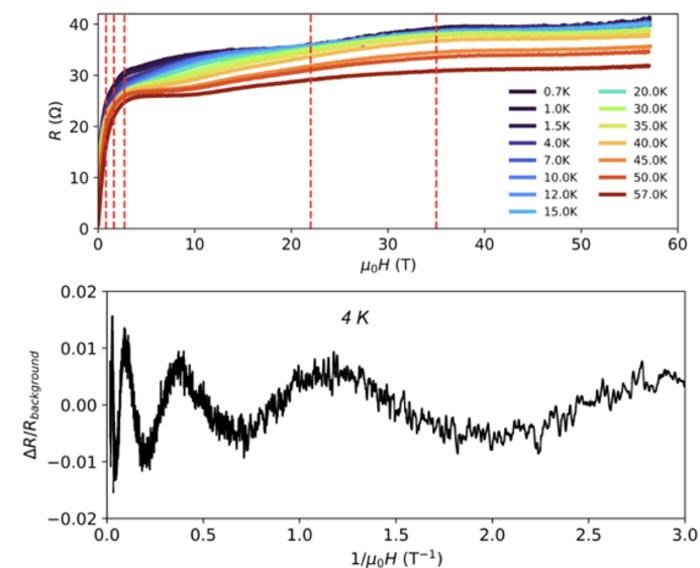
  • Forscher beobachteten ungewöhnliche Quantenoszillationen im topologischen Isolator ZrTe₅, die unter extremen Magnetfeldern und Temperaturen nahe dem absoluten Nullpunkt über das Quantenlimit hinaus bestehen bleiben.
  • Die Studie führt das Verhalten auf reentrante Landau-Niveaus zurück, die durch das Zusammenspiel von Elektronenspin, Orbitalbewegung und starker Spin-Bahn-Kopplung anstatt durch Vielteilchen-Wechselwirkungen verursacht werden.
  • Die Ergebnisse legen nahe, dass zuvor berichtete Unterschiede in den ZrTe₅-Oszillationen aus derselben zugrunde liegenden Dirac-Elektronenstruktur resultieren könnten, wobei die Ladungsträgerdichte und die Größe der Fermi-Fläche das beobachtete Verhalten bestimmen.
  • Bild: Elektrischer Widerstand des topologischen Isolators ZrTe₅ unter extremen Magnetfeldern und bei tiefen Temperaturen; (b) Nicht-periodische oder anomale Quantenoszillationen, die im Hochfeldbereich beobachtet wurden. (Cauê Kaufmann Ribeiro)

PRESSEMITTEILUNG — Im Mai wurde eine Studie in Nature Communications veröffentlicht, die ein ungewöhnliches Regime von Quantenoszillationen in einem dreidimensionalen topologischen Isolator identifizierte. Die Ergebnisse zeigen, dass Elektronen im Material Zirconiumpentatellurid (ZrTe₅), wenn sie Temperaturen nahe dem absoluten Nullpunkt und extremen Magnetfeldern ausgesetzt werden, ein Verhalten zeigen, das von dem durch die herkömmliche Theorie vorhergesagten Muster abweicht.

Article Intelligence

Sponsored

Ad

House — Advertise on NewsLayer
NewsLayerLearn more

NewsLayer Premium

Unlock deeper intelligence.

Ad-free reading, exclusive research, and real-time onchain insights.

Go Premium