
The Missing Runtime for Long-Running AI Agents
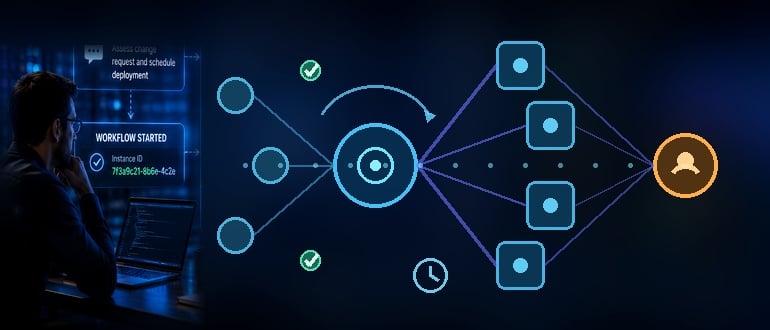
Enterprise AI agents need more than stronger models. They need durable execution environments that can coordinate multi-step workflows, survive failures, pause for human review and resume reliably after disconnects or delays.
DevOps.com
Publisher
Aug 26, 2026 at 9:06 AM UTC · Updated vor 21 Minuten · 10 Min. Lesezeit
Übersetzung…
- Production agents need durable execution, not just better models. Long-running workflows require state, retries, checkpoints and recovery.
- The workflow becomes the application, with an orchestrator coordinating specialized agents and parallel tasks.
- Human review and governance belong inside the workflow, alongside scoped permissions, observability and auditable evidence.
Enterprise AI agents need more than stronger models. They need durable execution environments that can coordinate multi-step workflows, survive failures, pause for human review and resume reliably after disconnects or delays.
AI Agents Have Moved Beyond Chat Demos
AI agents work beautifully in demos. A user asks a question, a large language model generates a response and everyone sees possibility. Production systems are different.
Consider what these systems are now asked to do. An agent assessing a change request may pull deployment history, evaluate blast radius, check freeze-window policy, wait for a release manager’s sign-off and then schedule the rollout. An agent adjudicating an insurance claim may extract fields from submitted documents, cross-check them against prior claims, apply underwriting rules and route anything unusual to a human adjuster. An agent triaging a security alert may enrich indicators, correlate against past incidents, assess asset criticality and hold containment until an analyst approves it.
Article Intelligence
Topics
Sponsored
Ad
NewsLayerLearn more
NewsLayer Premium
Unlock deeper intelligence.
Ad-free reading, exclusive research, and real-time onchain insights.
Go Premium