
Insider Brief
University at Buffalo Study Decodes Quantum Material’s ‘Optical Dingerprints’
Insider Brief PRESS RELEASE — The tiny atomic defects so important for future quantum technologies can be difficult to spot. Fortunately, they leave behind some clues The defects can alter how a material responds to light, producing a…
Matt Swayne
Publisher The Quantum Insider
Nov 13, 2026 at 8:48 AM UTC · Updated vor 13 Stunden · 3 Min. Lesezeit
Übersetzung…
- A University at Buffalo-led team predicted optical fingerprints for 10 atomic defects in hexagonal boron nitride, potentially helping scientists identify defects useful for quantum technologies.
- The simulations showed that defect composition and atomic arrangement can produce distinct responses in the intensity and polarization of light emitted at double or triple the incoming laser’s frequency.
- The findings could guide experimental identification and engineering of defects that emit single photons for future quantum communication and sensing applications.
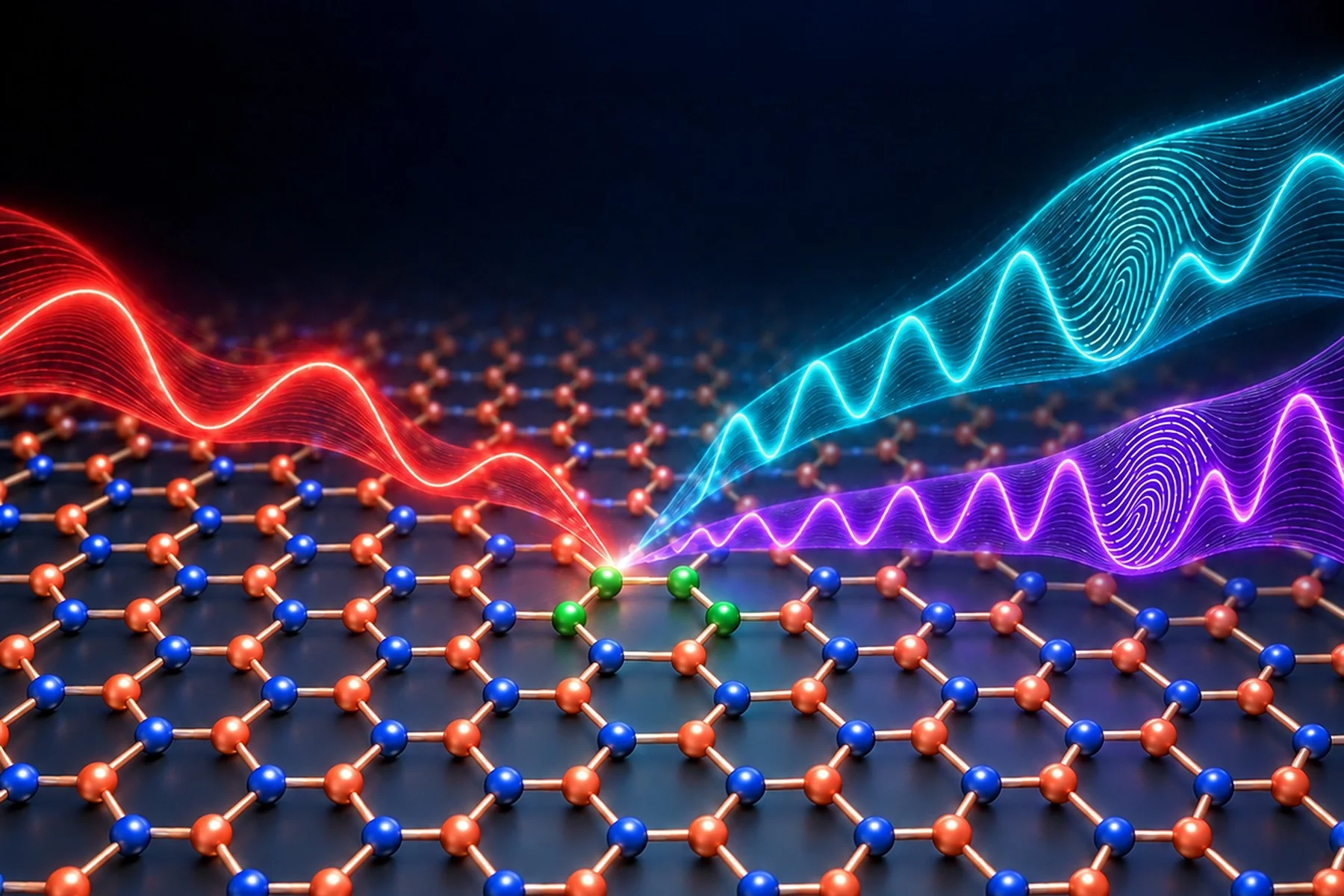
- Image: An illustration of atomic defects within hexagonal boron nitride alerting light, creating an optical fingerprint. A UB-led study predicted the optical fingerprints for 10 known defects within this material, which could have applications for quantum technologies. (Vasili Perebeinos)
PRESS RELEASE — The tiny atomic defects so important for future quantum technologies can be difficult to spot. Fortunately, they leave behind some clues
The defects can alter how a material responds to light, producing a distinctive optical fingerprint that scientists can measure.
The challenge is figuring out which fingerprints belong to which defects.
Article Intelligence
Related Coverage
 ResearchClassical Light Dynamics Could Help Simulate Quantum Interactionsvor 14 Stunden · 3 min read
 QuantumNtt Research Builds Virtual Quantum Computer From Untrusted Serversvor 8 Stunden · 4 min read
 QuantumResearchers Map Qubit States To Probability Distributions In Phase Spacevor 11 Stunden · 6 min read
Sponsored
Ad
NewsLayerLearn more
NewsLayer Premium
Unlock deeper intelligence.
Ad-free reading, exclusive research, and real-time onchain insights.
Go Premium