
This website uses cookies
We use cookies to personalise content and ads, to provide social media features and to analyse our traffic. We also share information about your use of our site with our social media, advertising and analytics partners who may combine it with other information that you’ve provided to them or that they’ve collected from your use of their services.
Consent Selection
Details
  • Necessary cookies help make a website usable by enabling basic functions like page navigation and access to secure areas of the website. The website cannot function properly without these cookies.
  • Preference cookies enable a website to remember information that changes the way the website behaves or looks, like your preferred language or the region that you are in.
    • We do not use cookies of this type.

  • Statistic cookies help website owners to understand how visitors interact with websites by collecting and reporting information anonymously.
    • We do not use cookies of this type.

  • Marketing cookies are used to track visitors across websites. The intention is to display ads that are relevant and engaging for the individual user and thereby more valuable for publishers and third party advertisers.
    • We do not use cookies of this type.

  • Unclassified cookies are cookies that we are in the process of classifying, together with the providers of individual cookies.
    • __emg_sidPending
      Maximum Storage Duration: 1 dayType: HTTP Cookie
      __emg_vidPending
      Maximum Storage Duration: 1 yearType: HTTP Cookie
      nl-read-countPending
      Maximum Storage Duration: PersistentType: HTML Local Storage
Cookie declaration last updated on 8/12/26 by Cookiebot
[#IABV2_TITLE#]
[#IABV2_BODY_INTRO#]
[#IABV2_BODY_LEGITIMATE_INTEREST_INTRO#]
[#IABV2_BODY_PREFERENCE_INTRO#]
[#IABV2_BODY_PURPOSES_INTRO#]
[#IABV2_BODY_PURPOSES#]
[#IABV2_BODY_FEATURES_INTRO#]
[#IABV2_BODY_FEATURES#]
[#IABV2_BODY_PARTNERS_INTRO#]
[#IABV2_BODY_PARTNERS#]
About
Cookies are small text files that can be used by websites to make a user's experience more efficient.

The law states that we can store cookies on your device if they are strictly necessary for the operation of this site. For all other types of cookies we need your permission.

This site uses different types of cookies. Some cookies are placed by third party services that appear on our pages.

You can at any time change or withdraw your consent from the Cookie Declaration on our website.

Learn more about who we are, how you can contact us and how we process personal data in our Privacy Policy.

Please state your consent ID and date when you contact us regarding your consent.
NewsLayer.com
NewsLayer PulseLIVEBTC$77,457+6.37%ETH$2,408+2.76%SOL$91.58+4.35%XRP$1.4+6.19%DOGE$0.0848+1.80%ADA$0.219+9.82%Total Cap$2.71T+4.81%Layer Index73 Greed

Admin Keys, Phishing, and DNS: The New Front Line of Crypto Security

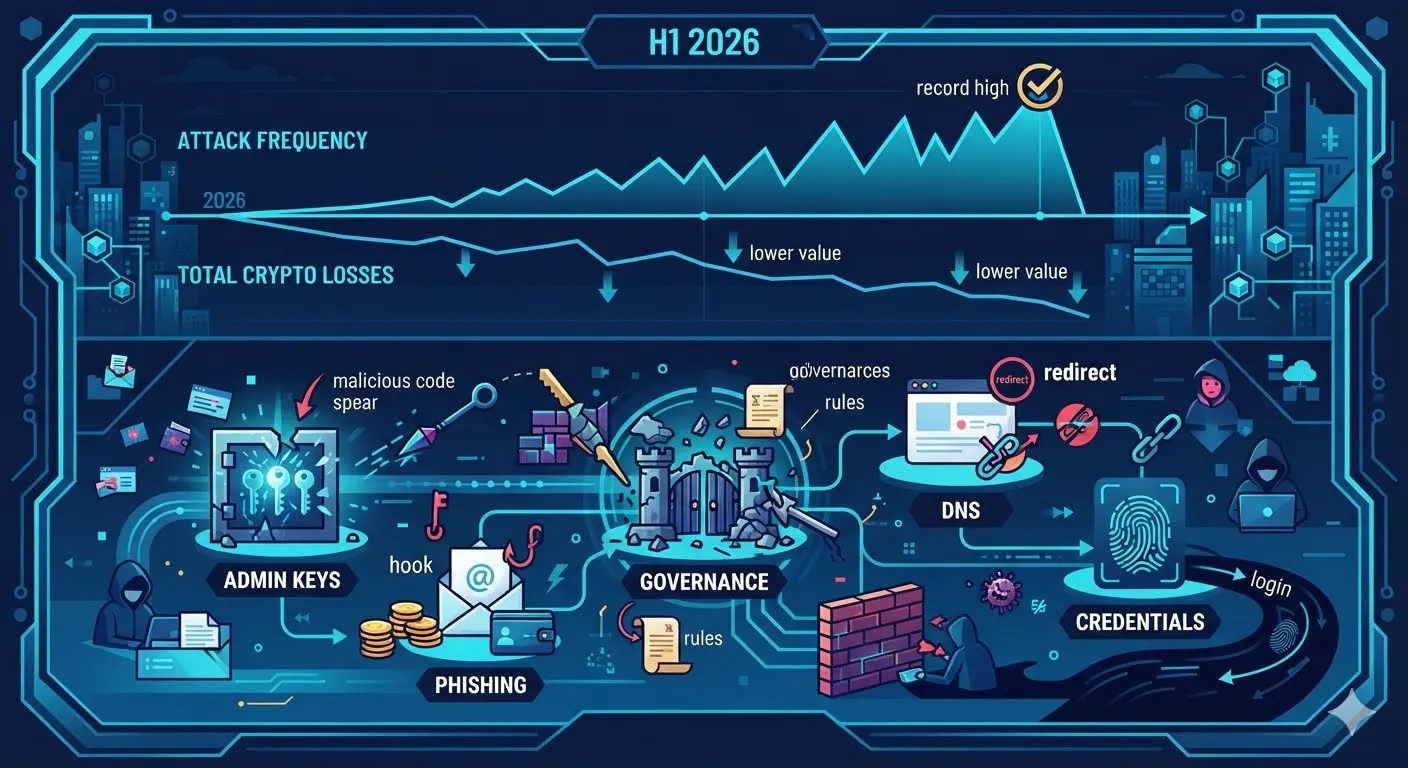
Roughly $972 million was lost across 207 incidents in the first half of 2026, less than half the total of the same period a year earlier, while the incident count more than doubled from 83 and set a record.

HackerNoon

Publisher

Aug 21, 2026 at 9:01 AM UTC · 4 min de lectura
Admin Keys, Phishing, and DNS: The New Front Line of Crypto Security
Image via HackerNoon
Traduciendo…

Roughly$972 million was lost across 207 incidents in the first half of 2026, less than half the total of the same period a year earlier, while the incident count more than doubled from 83 and set a record.

Attacks became more frequent and less profitable at the same time. That is a change in where the money leaves, not in whether protocols get attacked.

Losses Fell. Attacks Did Not.

For most of the past five years the industry's working model of crypto risk began and ended with a contract bug. The apparatus built around that model changed the economics of attacking the code well enough that breaking a contract is no longer the only route to a major loss . Verification got formal, audits got repeated, bounty programs became standing rather than occasional.

None of it reduced the capital sitting inside those protocols. Immunefi, which operates bug-bounty infrastructure for the sector and has an interest in the answer, puts DeFi exploit losses 74% below their 2022 peak of $2.62 billion, at $680.3 million across full-year 2025, with the median loss per exploit falling 75% over the same stretch. TRM Labs, measuring the same period on a different axis, found that infrastructure and operational compromises made up roughly 15% of incidents but about 76% of the value stolen.

Article Intelligence

Related Coverage

View all related

Sponsored

Ad

House — Advertise on NewsLayer
NewsLayerLearn more

NewsLayer Premium

Unlock deeper intelligence.

Ad-free reading, exclusive research, and real-time onchain insights.

Go Premium