
Bitcoin supera los $69K con bajo volumen, según informa Glassnode
Bitcoin supera los $69K con bajo volumen, informa Glassnode en Yellow.com
Yellow.com
Publisher
Aug 17, 2026 at 1:03 AM UTC · Updated hace 2 meses · 2 min de lectura

Key Signal
$5.3B Exchange spot volume
Entities
bitcoin
Market Impact
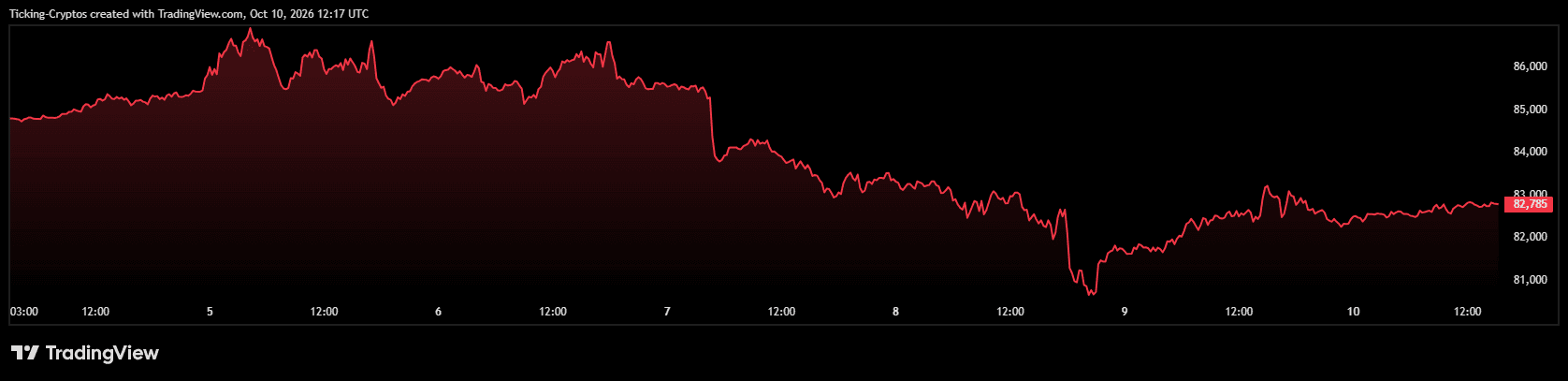
BTC+0.29%$82,791
Last Updated
hace 2 meses
Bitcoin (BTC) recuperó el nivel de los $69,000, pero un informe semanal de Glassnode publicado el 6 de abr. muestra que el volumen de intercambio al contado, la actividad on-chain y el comercio de ETF disminuyeron, incluso cuando el impulso de los precios y el posicionamiento de futuros mejoraron drásticamente.
Detalles del informe de Glassnode
El pulso semanal del mercado de la firma de análisis calificó los indicadores de contado, futuros, opciones y ETF como crecientes con una intensidad moderada, mientras que las métricas fundamentales on-chain y de flujo de capital estaban disminuyendo.
En el lado del contado, el RSI de 14 días saltó un 62% de 30.3 a 49.1, y el CVD al contado pasó de un saldo negativo de $47.8 millones a uno positivo de $27.9 millones. Ambas lecturas apuntan a una renovada presión de compra.
Pero el volumen de los intercambios centralizados cayó un 13% de $6.1 mil millones a $5.3 mil millones, una señal de que menos participantes están respaldando el movimiento al alza.
En derivados, el interés abierto de futuros bajó un 2% a $29.7 mil millones y las tasas de financiación cayeron un 13.1%, lo que sugiere un apalancamiento reducido. El CVD perpetuo se revirtió bruscamente de un saldo negativo de $412 millones a uno positivo de $460.7 millones, un cambio del 211.8% que señala una entrada agresiva del lado comprador en los mercados de futuros.
Market Context
Bitcoin
BTC
$82,791
+0.29% (24H)
Market Cap
$1.66T
24H Volume
$15.3B
24H High
$83,229
Article Intelligence
Key Entities
Topics
Related Coverage
 CryptoAerodrome rallies 48% in four weeks, outpacing Bitcoin and Etherhace 4 horas · 2 min read
 CryptoBitcoin dips 3.6% weekly but rebounds above $83K; NEAR and Monero show resilience amid volatile crypto market.hace 40 minutos · 1 min read
 CryptoCrypto ETF Outflows Pass $1 Billion in October: Is Wall Street Dumping Bitcoin and Ethereum?hace una hora · 3 min read
Sponsored
Ad
NewsLayer Premium
Unlock deeper intelligence.
Ad-free reading, exclusive research, and real-time onchain insights.
Go Premium