
Insider Brief
Crystal Material’s Spiral Structure Could Lead to New Electronics And Computer Memory
Insider Brief PRESS RELEASE — A University of Texas at Dallas scientist and her colleagues have discovered an unusual atomic pattern in a uranium-based material that gives it a rare combination of magnetic properties, a finding that…
Matt Swayne
Publisher The Quantum Insider
Oct 8, 2026 at 7:52 AM UTC · 4 min de lectura
Traduciendo…
- Researchers discovered a repeating, twisted atomic structure in uranium oxytelluride that combines ferromagnetic and antiferromagnetic properties, potentially informing the design of advanced electronics and computer memory.
- High-resolution microscopy and additional measurements showed that the previously unrecognized structure helps govern how electrons move through the material, with potential applications in faster memory more resistant to external magnetic fields.
- Computational analyses suggest hundreds of related compounds could contain similar structures, providing a new approach to finding materials with unusual magnetic properties.
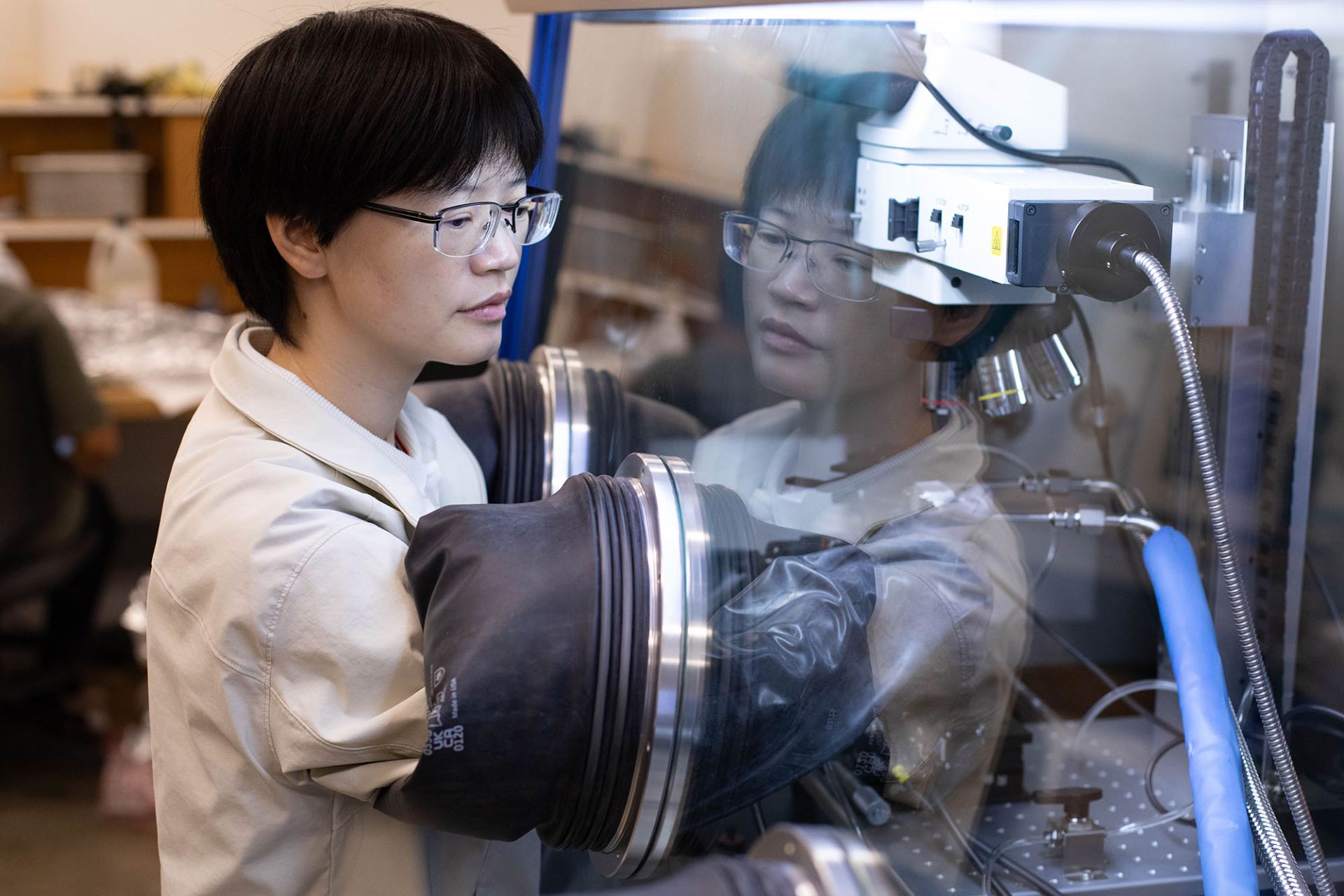
- Image: Dr. Mengke Liu, assistant professor of physics at The University of Texas at Dallas, operates a two-dimensional transfer stage inside a glove box to fabricate atomically thin quantum devices. (University of Texas)
PRESS RELEASE — A University of Texas at Dallas scientist and her colleagues have discovered an unusual atomic pattern in a uranium-based material that gives it a rare combination of magnetic properties, a finding that could open new pathways for designing advanced electronic and computer memory devices.
Dr. Mengke Liu, an assistant professor of physics in the School of Natural Sciences and Mathematics, and her collaborators found a previously unrecognized chiral superlattice in a crystal of uranium oxytelluride (UOTe). Liu is a corresponding author of a study detailing the research published online Oct. 7 in the journal Nature.
Article Intelligence
Topics
Sponsored
Ad
NewsLayerLearn more
NewsLayer Premium
Unlock deeper intelligence.
Ad-free reading, exclusive research, and real-time onchain insights.
Go Premium