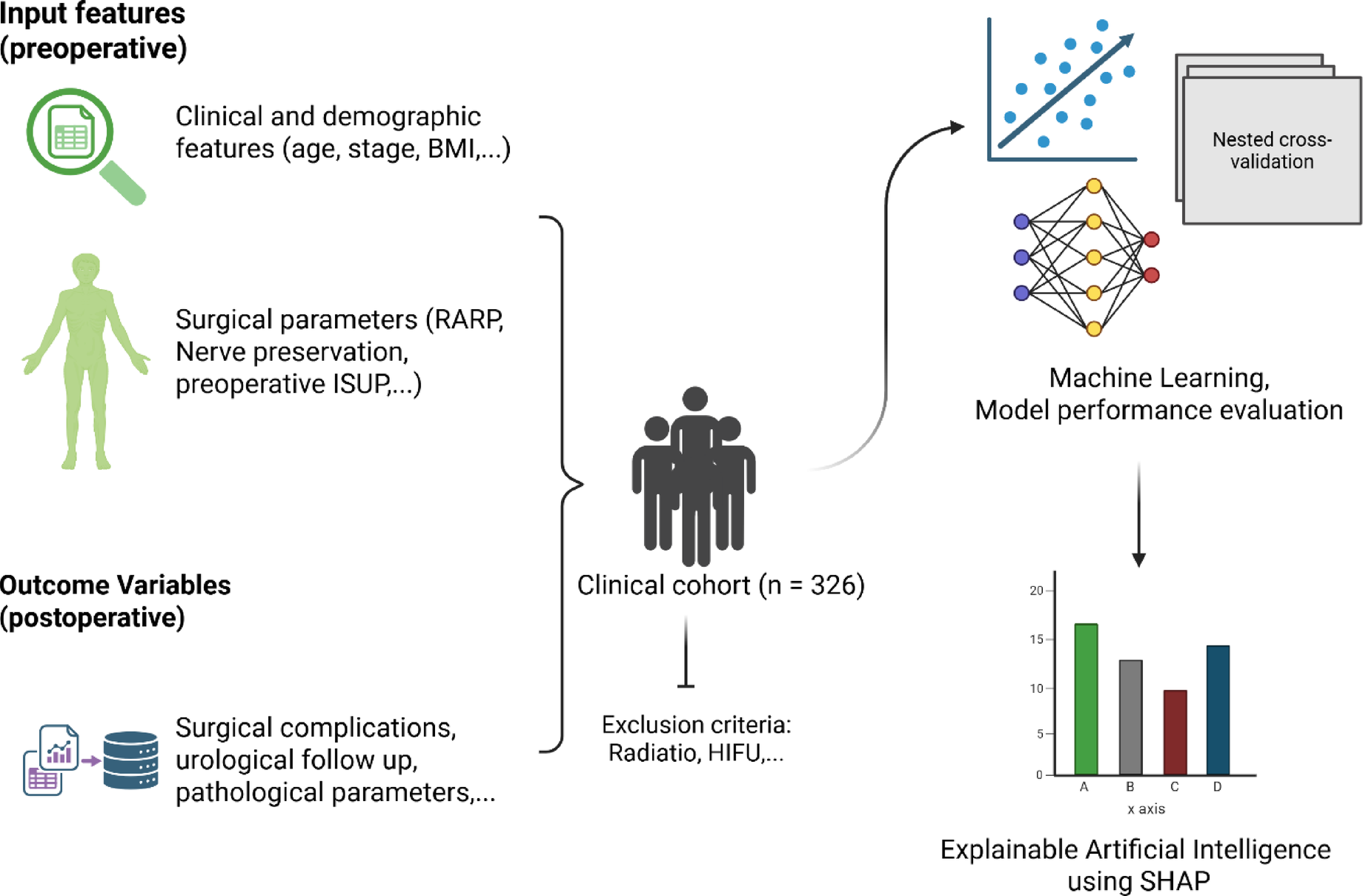
Preoperative risk stratification for radical prostatectomy is crucial, yet predicting the wide range of postoperative outcomes remains a significant challenge. While machine learning (ML) shows promise, “black box” models limit clinical translatability. This study aimed to predict postoperative parameters using ML and employ explainable AI (XAI) to identify their key clinical drivers. In a retrospective study of 326 patients (224 robot-assisted [RARP], 102 open [ORP]), we developed predictive models for twelve outcomes, including length of stay and pathological ISUP grade. Four ML algorithms (Random Forest, Gradient Boosting, SVM, Neural Network) were evaluated via nested 5-fold cross-validation. A custom permutation-based Shapley sampling framework SHAP (SHapley Additive exPlanations) was applied to the best-performing models to quantify the predictive importance of preoperative features. ML models outperformed baseline heuristics for a subset of the prespecified outcomes, with strongest performance for postoperative hemoglobin (R2 up to 0.57) and the decision to perform frozen sections (AUC up to 0.89). Not all outcomes proved equally amenable to prediction, consistent with the heterogeneous nature of postoperative recovery. SHAP analysis revealed a clear dichotomy: procedural parameters, such as catheter dwell time and hospital stay, were almost exclusively predicted by the surgical approach (RARP vs. ORP). In contrast, pathological outcomes like ISUP grade were predominantly driven by preoperative tumor characteristics. Preoperative hemoglobin was identified as a strong predictive feature for postoperative anemia within this dataset, ranking above non-modifiable factors such as age. Explainable AI can deconstruct the complex interplay of factors influencing surgical success, providing a data-driven basis for hypothesis generation and clinical pathway optimization. As a single-centre proof-of-concept study without external validation, these findings require prospective confirmation in independent multi-centre cohorts before clinical translation can be considered.
Explainable artificial intelligence reveals key surgical parameters in robot-assisted and open radical prostatectomy
Preoperative risk stratification for radical prostatectomy is crucial, yet predicting the wide range of postoperative outcomes remains a significant challenge. While machine learning (ML) shows promise, “black box” models limit clinical…
nature.com
Publisher
Aug 26, 2026 at 2:52 AM UTC · 1 min de lectura
Traduciendo…
Sourced by
Originally reported by nature.com
NewsLayer coverage based on externally reported material.
The Daily Brief
The onchain economy, before your day starts.
Curated markets, onchain insights, and key headlines — delivered every weekday morning.
Weekdays · Free · ~5 minute read
0
Applause
Was this article helpful?
Article Intelligence
Topics
Sponsored
Ad
NewsLayerLearn more
NewsLayer Premium
Unlock deeper intelligence.
Ad-free reading, exclusive research, and real-time onchain insights.
Go Premium