
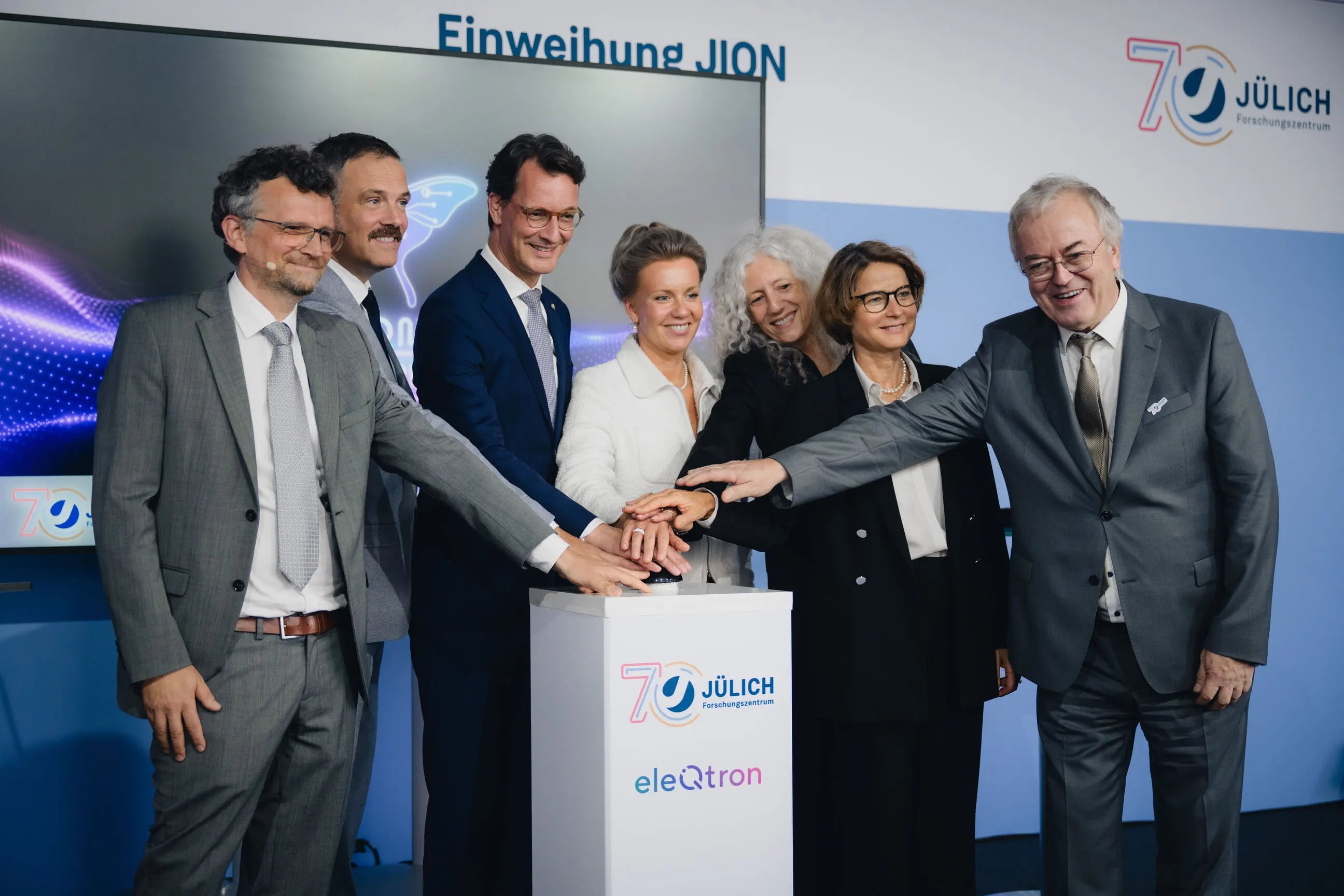
Research center Forschungszentrum Jülich and University of Siegen spin-off eleQtron GmbH have officially brought the JION (Jülich trapped-ION) quantum computer into operation at the Jülich Supercomputing Centre (JSC). Integrated into the JUNIQ (Jülich UNified Infrastructure for Quantum computing) platform, the gate-based trapped-ion processor is linked directly to JSC’s High-Performance Computing (HPC) supercomputing cluster—including the JUPITER exascale system—to enable hybrid quantum-classical workloads across transport optimization, materials science, and chemical simulation.
Forschungszentrum Jülich Operates eleQtron’s JION Trapped-Ion QPU via JUNIQ Infrastructure
Research center Forschungszentrum Jülich and University of Siegen spin-off eleQtron GmbH have officially brought the JION (Jülich trapped-ION) quantum computer into operation at the Jülich Supercomputing Centre (JSC). Integrated into…
Quantum Computing Report
Publisher
Sep 4, 2026 at 11:34 AM UTC · Updated hace 2 días · 2 min de lectura
Traduciendo…
| [ JION Hardware Architecture & NRW Funding Framework ] | ||
|---|---|---|
| Hardware & Control Stack | Project & Integration Platform | State & EU Funding Allocations |
| • Trapped Ytterbium (171Yb+) Atomic Qubits | • EPIQ Partnership (FZJ & eleQtron) | • EPIQ Project: €21M (NRW Science Ministry) |
| • MAGIC Control (Microwave & Magnetic Gradients) | • JUNIQ User Infrastructure (JSC) | • SQALING Project: ~€25M (EU ERDF/JTF Funding) |
| • Room-Temperature Trap Operation (RF Paul Trap) | • HPC Offloading via Modular Supercomputing | • Q-STAR.NRW Project: ~€35M (InvKG Coal Region Fund) |
MAGIC Microwave Control and Room-Temperature Qubit Trapping
Unlike conventional trapped-ion architectures that rely on complex, multi-laser optical setups for individual qubit addressing, JION employs eleQtron’s proprietary MAGIC (Magnetic Gradient Induced Coupling) technology:
- Microwave Control Fields: Replaces individual laser beams with static magnetic field gradients and globally applied microwave pulses, allowing precise single-qubit addressing and multi-qubit gate operations through radio-frequency (RF) signals.
- Reduced Thermal Constraints: Operating trapped Ytterbium ions inside electromagnetic fields eliminates the need for dilution refrigerators required by superconducting QPUs, allowing the core trap assembly to operate at room temperature.
- All-to-All Qubit Connectivity: Long-range magnetic gradient coupling enables direct gate operations between non-adjacent ions within the trap array, minimizing compiler SWAP gate overhead during circuit synthesis.
Article Intelligence
Related Coverage
 QuantumResearchers Detect Entanglement Patterns In 100-Qubit Systemshace un día · 4 min read
 QuantumBrian Gaucher (ERVA): Why engineering, not physics, now limits quantum progresshace un día · 15 min read
Sponsored
Ad
NewsLayerLearn more
NewsLayer Premium
Unlock deeper intelligence.
Ad-free reading, exclusive research, and real-time onchain insights.
Go Premium