Summary
Cryptocurrency provides sanctioned and terrorist organizations with new ways to transfer value, but public blockchains also create persistent records that investigators can analyze retrospectively. Crypto forensics can connect wallets, identify infrastructure, expose financial relationships, and support sanctions or asset freezes. Centralized stablecoin issuers and exchanges create particularly important intervention points where authorities may disrupt access to funds. As evasion techniques become more sophisticated, effective enforcement will increasingly combine blockchain analytics, AI, conventional investigative methods, legal powers, and international cooperation.
Key Takeaways
- Blockchain transparency can work against illicit finance. Public, immutable transaction records allow investigators to trace historical activity, connect related wallets, and uncover financial networks that might be harder to reconstruct through traditional banking systems.
- Enforcement increasingly targets entire financial ecosystems. Wallet freezes, exchange sanctions, stablecoin blacklisting, and investigations of brokers and infrastructure providers can disrupt the gateways that connect digital assets with real-world money and resources.
- Crypto forensics is becoming a strategic counterterrorism capability. Its effectiveness depends not only on blockchain analytics, but also on appropriate legal authority, private-sector cooperation, international coordination, and increasingly AI-assisted detection.
The Islamic Revolutionary Guard Corps (IRGC) has long operated as a central architect of international terrorism and illicit finance, sustaining a vast clandestine financial network that supports proxy militias, destabilizes the Middle East, and circumvents global sanctions.
For decades, this shadow economy relied on a labyrinthine network of hawala brokers, bulk cash smuggling, and front companies embedded within the traditional banking sector, exploiting regulatory blind spots and jurisdictional arbitrage to move billions of dollars beyond the reach of Western intelligence.
As the United States and its allies tightened the financial noose, however—expelling Iranian institutions from the SWIFT network and intensifying secondary sanctions—the IRGC and its elite Quds Force were forced to adapt. Increasingly, they pivoted toward the decentralized, borderless realm of digital assets to sustain their operations.
Yet this strategic migration to cryptocurrency, initially perceived by illicit actors as a financial haven shielded from sovereign governments, has inadvertently handed global law enforcement agencies one of the most powerful intelligence-gathering and disruption tools in the history of counterterrorism.
Blockchain’s Forensic Advantage
The inherent nature of blockchain technology—an immutable, transparent, and publicly accessible digital ledger—stands in stark contrast to the opaque, siloed databases of the legacy financial system. This difference is fundamentally transforming the battlefield of illicit finance.
In traditional banking, tracing dirty money can require investigators to navigate mutual legal assistance treaties, subpoenas, and reluctant foreign jurisdictions, often reaching dead ends when funds disappear into offshore havens or non-cooperative states. A blockchain, by contrast, records transactions in perpetuity, cryptographically preserving the network’s financial history for investigators equipped with the appropriate analytical tools.
The moment a terrorist operative moves funds on-chain, an enduring digital trail can be created.
This paradigm shift has given rise to the specialized field of crypto forensics, an increasingly indispensable discipline that enables law enforcement agencies to penetrate the pseudonymous veil of digital wallets, map complex financial networks, and dismantle the economic infrastructure supporting organizations such as the IRGC.
Using sophisticated blockchain analytics platforms provided by companies including Chainalysis, TRM Labs, and Elliptic, financial investigators can conduct cluster analysis, heuristic tracing, and behavioral profiling. These techniques allow them to associate seemingly unrelated cryptocurrency addresses through shared transactional patterns, common funding sources, and overlapping withdrawal behavior.
This capability changes the nature of financial policing by making previously hidden relationships visible. It also gives investigators something particularly valuable: the ability to look backward.
When a new illicit wallet is identified, investigators can reconstruct its historical transaction network, potentially exposing years of previously undetected financial activity and revealing the broader shadow-banking mechanisms facilitating the movement of capital.
Israel’s Wallet Seizures and Blacklisting Campaign
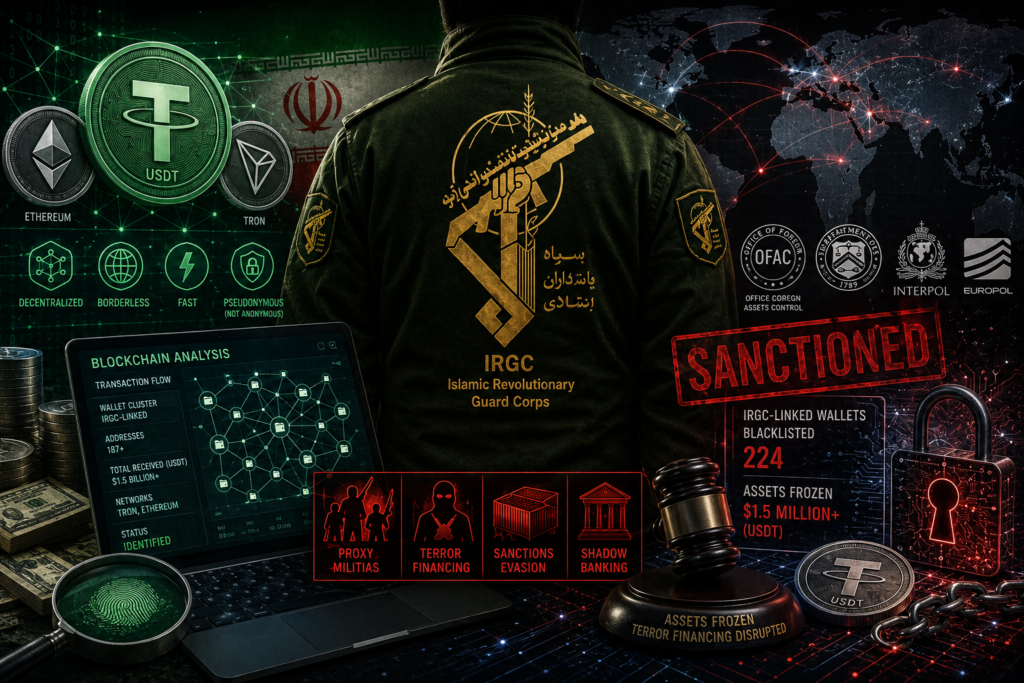
A striking example occurred in September 2025, when Israel’s National Bureau for Counter Terror Financing (NBCTF) ordered the seizure of 187 cryptocurrency wallets linked to the IRGC after blockchain analysis indicated that the addresses had received approximately $1.5 billion worth of Tether (USDT), the dollar-pegged stablecoin.
The operation resulted in the blacklisting of 39 wallets and the freezing of approximately $1.5 million in digital assets by the stablecoin issuer. It underscored the importance of public-private partnerships in modern financial enforcement: when authorities can translate forensic intelligence into actionable identifiers, private-sector actors can help rapidly disrupt terrorist financing channels.
The campaign against the IRGC’s digital financial infrastructure continued. In July 2026, an additional Israeli operation sanctioned 37 digital wallets associated with an international shadow-banking network responsible for moving tens of millions of dollars over several years.
The IRGC had sought to exploit high-liquidity blockchains such as Ethereum and Tron to bypass conventional monitoring frameworks. But once the relevant digital identifiers were blacklisted and cross-referenced against customer databases by compliance teams, the ability to integrate those funds into the mainstream financial system became significantly more difficult.
Exposing the IRGC’s Crypto Infrastructure
Crypto forensics also offers intelligence far beyond individual seizures. At scale, blockchain analysis can provide authorities with insights into the geopolitical strategies and systemic vulnerabilities of hostile state actors.
Investigative reporting by TRM Labs, for example, exposed how the IRGC allegedly embedded itself within crypto-financial infrastructure, using two United Kingdom-registered cryptocurrency exchanges as corporate fronts to process more than a billion dollars in stablecoin transactions.
The investigation also identified direct transfers exceeding $10 million from this infrastructure to Sa’id Ahmad Muhammad al-Jamal, a designated terrorist financier associated with a smuggling network generating revenue for the Houthi rebels in Yemen.
Such findings illustrate an important evolution in the threat landscape: hostile entities are no longer simply abusing existing cryptocurrency infrastructure. They can also seek to build or control elements of that infrastructure themselves in order to evade sanctions.
Sanctioning Iran’s Crypto Gateways
Armed with blockchain evidence, regulatory bodies and law enforcement agencies can respond at a systemic level. On June 2, 2026, the U.S. Department of the Treasury’s Office of Foreign Assets Control (OFAC) imposed sanctions on four major Iranian cryptocurrency exchanges—Nobitex, Bitpin, Ramzinex, and Wallex—for their alleged roles in facilitating sanctions evasion and terrorist financing.
The action followed on-chain analysis indicating that IRGC-associated addresses accounted for more than 50 percent of the total value received by Iran’s $7.78 billion cryptocurrency ecosystem in late 2025.
Nobitex alone reportedly processed more than half of Iranian digital-asset inflows. By bringing such exchanges within the reach of secondary sanctions, authorities can target the on-ramps and off-ramps through which sanctioned actors connect digital assets to the broader global economy.
Blockchain Evidence as an Enforcement Tool
One of crypto forensics’ greatest strategic advantages is the evidentiary nature of blockchain data. Human intelligence can be incomplete, subjective, contested, or difficult to disclose because of national-security classifications. Blockchain records, by contrast, provide a persistent transactional record that can be independently analyzed and used alongside other evidence to support sanctions designations, asset forfeitures, and criminal investigations.
Technological capabilities, however, must be accompanied by appropriate legal authorities.
Building a Legal Framework for Digital Asset Freezes
The United Kingdom’s amendment of the Proceeds of Crime Act 2002 to introduce specialized Crypto Wallet Freezing Orders (CWFOs) illustrates this evolution. The framework gives British authorities mechanisms to freeze certain digital assets when there are grounds to suspect that they constitute criminal property or are intended for unlawful conduct.
Such legal instruments are increasingly important because the speed of digital-asset transfers means that identifying illicit funds is only part of the challenge. Authorities must also be capable of acting before those assets are transferred elsewhere.
How Heuristic Clustering Reconstructs Hidden Networks
To understand the revolutionary potential of crypto forensics, it is also necessary to examine the mechanics of heuristic clustering and behavioral analysis.
Criminal actors once assumed that generating thousands of unique, single-use cryptocurrency addresses would fragment their financial activity into countless untraceable pieces. Modern forensic platforms, however, can ingest enormous quantities of blockchain data and apply heuristics designed to identify the underlying control structures connecting apparently separate wallets.
If, for example, a terrorist financier consolidates funds from numerous addresses into a single transaction to pay a supplier, forensic software may identify relationships among those addresses and begin reconstructing the larger financial network.
This allows investigators to shift their focus from individual transactions toward the command-and-control nodes of illicit financial systems.