
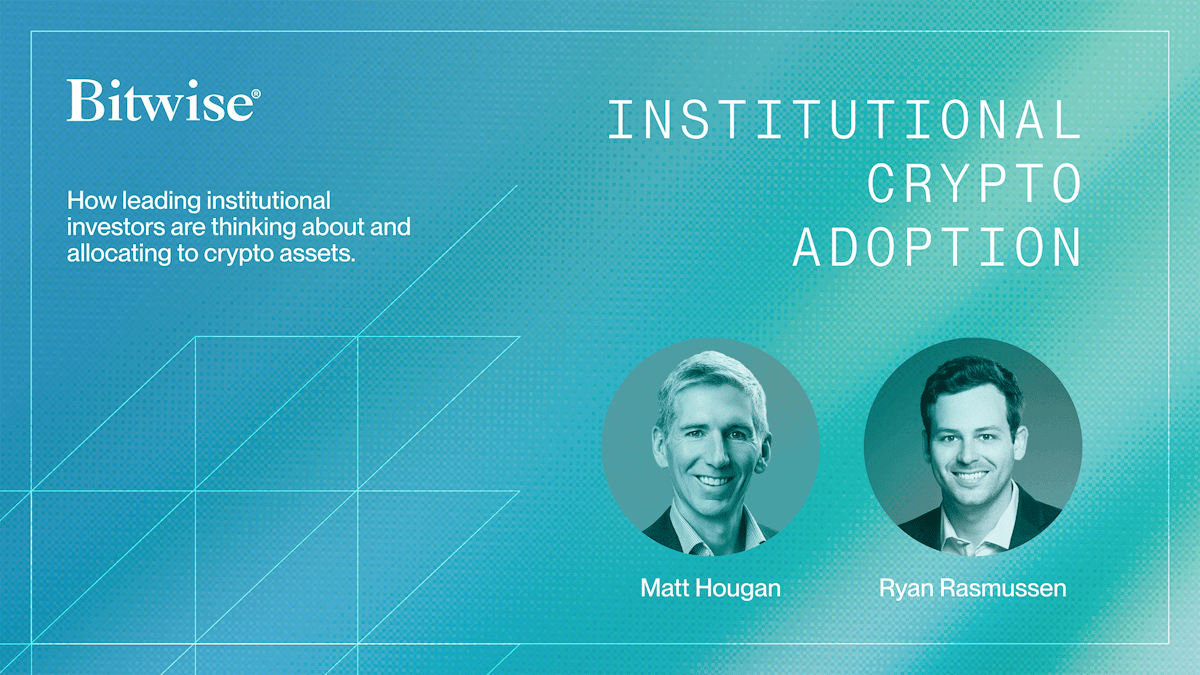
Bitwise Asset Management, a global crypto asset manager with $9 billion in client assets, today released Institutional Crypto Adoption, a study drawn from in-depth interviews with the senior investment professionals responsible for crypto allocation decisions at 15 of the world's largest institutions, including endowments, foundations, public pension funds, sovereign wealth funds, multi-family offices, investment consultants, and public companies.
How the World's Largest Institutions Are Investing in Crypto
Bitwise Asset Management, a global crypto asset manager with $9 billion in client assets, today released Institutional Crypto Adoption, a study drawn from in-depth interviews with the senior investment professionals responsible for…
Bitwise Investments
Publisher
Sep 23, 2026 at 2:06 PM UTC · 5 min de lectura
Market Impact
Total MCap-1.80%
Last Updated
hace un día
Traduciendo…
Institutions rarely disclose their crypto positions, whether for competitive or reputational reasons. This study intends to break through that silence by asking allocators directly what they hold, how much, why, and what would make them sell.
The findings suggest adoption is happening faster and more durably than the general public realizes, and support Bitwise's position that a majority of institutional investors will hold crypto within five years.
Five key findings from the Institutional Crypto Adoption report:
Institutional crypto capital proved sticky through the drawdown. Crypto markets fell roughly 50% between Q4 2025 and Q2 2026. Not one institution interviewed reduced its allocation over that period, and several bought more. No institution named a price decline as a reason it would sell.
Bitcoin is the universal institutional conviction asset. Every institution interviewed that owns crypto owns bitcoin. For almost all of them it was their first, largest, and longest-held crypto asset, most often framed as a store of value and frequently paired explicitly with gold as a fiat debasement hedge.
Ethereum and Solana are held as thesis-dependent bets. Institutions that own these assets hold smaller positions, on shorter horizons, with explicit exit conditions tied to whether value accrues to the underlying token. Several said plainly that if meaningful adoption does not materialize in the next few years, they will sell.
Allocation sizes are small now, but the direction is up. Crypto allocations ranged from 0.5% to 13% of investable assets, with most between 1% and 2%, typically split across ETFs, direct ownership, venture capital, and hedge funds.
Spot ETFs have reshaped institutional access. Almost every institution interviewed either uses spot ETFs or plans to, citing lower all-in cost, lower operational burden, and the fact that ETFs make crypto look more familiar from a back-office perspective. Because some institutions deliberately use vehicles that bypass 13F visibility, estimates of institutional ownership drawn from 13F filings should be read as a floor rather than a ceiling.
Market Context
Bitcoin
BTC
$84,094
-1.96% (24H)
Market Cap
$1.68T
Circulating Supply
20.1M BTC
24H Volume
$43.4B
24H High
$85,918
Article Intelligence
Topics
Sponsored
Ad
NewsLayerLearn more
NewsLayer Premium
Unlock deeper intelligence.
Ad-free reading, exclusive research, and real-time onchain insights.
Go Premium