
Michael Saylor identifica la próxima oportunidad financiera de mil millones de dólares
Michael Saylor identifica la próxima oportunidad financiera de mil millones de dólares Bitcoin News
Bitcoin News
Publisher
Aug 8, 2026 at 11:54 PM UTC · 3 min de lectura

Entities
bitcoin
Last Updated
hace 2 meses
- Michael Saylor identifica el crédito digital como una importante oportunidad financiera.
- Los valores preferentes de Strategy conllevan rendimientos efectivos de dos dígitos.
- El crédito digital convierte las estrategias de capital centradas en bitcoin en productos de ingresos.
Saylor orienta a los inversores hacia una oportunidad financiera de mil millones de dólares
El presidente ejecutivo de Strategy Inc. (Nasdaq: MSTR), Michael Saylor, compartió su visión sobre el próximo negocio de mil millones de dólares en finanzas en una publicación del 7 de agosto en X, orientando a los emprendedores hacia el crédito digital como la categoría financiera que él estudiaría.
Saylor escribió en X:
“Si estuviera buscando el próximo negocio de mil millones de dólares en finanzas, estudiaría el Crédito Digital.”
El gráfico que incluyó en su publicación mostraba los rendimientos efectivos de cuatro valores en la línea de crédito digital de Strategy a las 11:10 a.m. EDT. Stride Preferred Stock (STRD) lideró con un 15.29%, seguido de Stretch Preferred Stock (STRC) con un 12.63%, Strike Preferred Stock (STRK) con un 12.08% y Strife Preferred Stock (STRF) con un 10.38%.
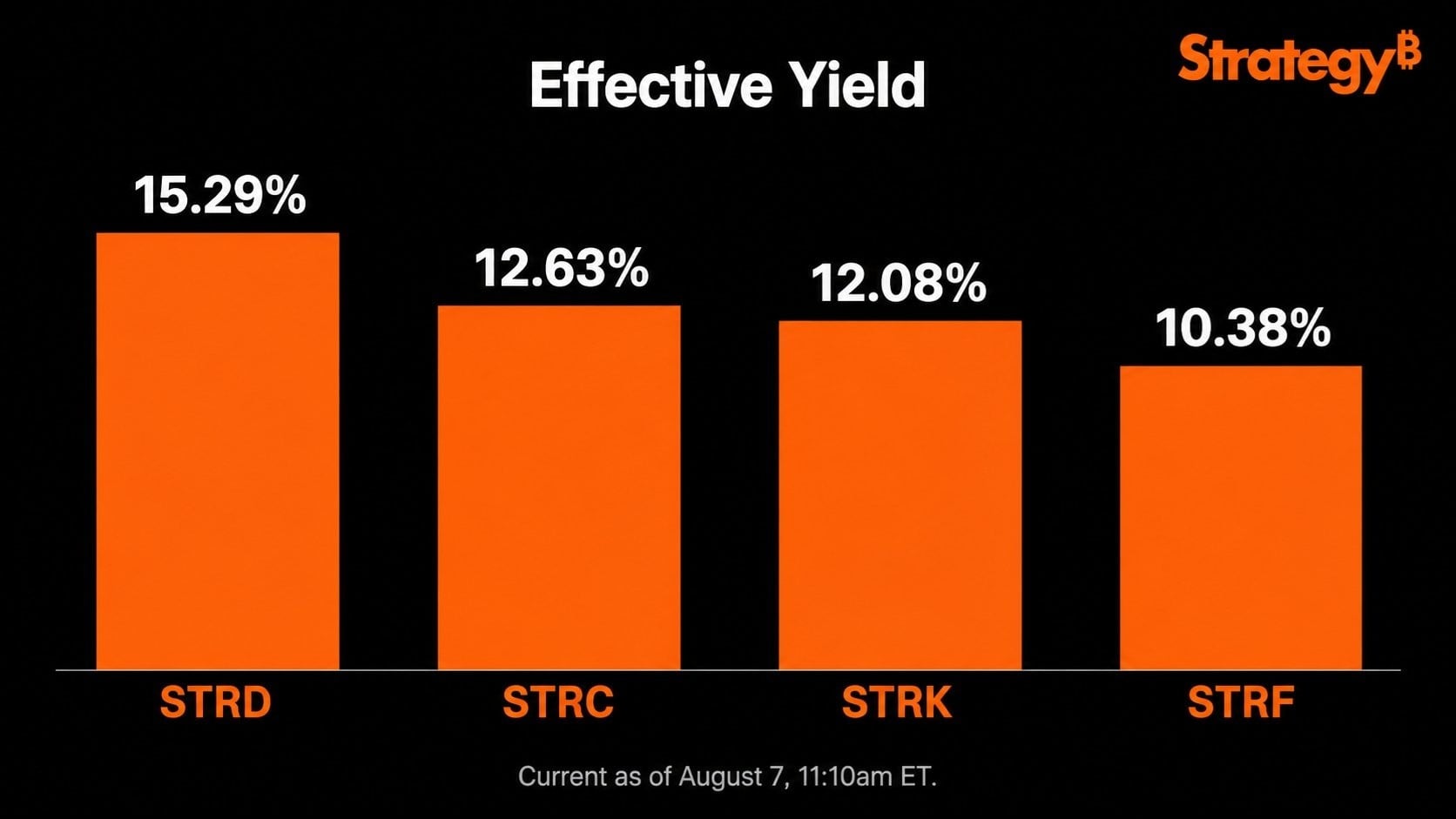
Juntos, los cuatro valores preferentes permiten a Strategy recaudar capital de inversores que buscan ingresos, al tiempo que ofrecen diferentes tasas de dividendos, niveles de riesgo y posiciones en la estructura de capital de la empresa. Los valores amplían las opciones de financiación de Strategy más allá de las acciones ordinarias y la deuda.
Market Context
Bitcoin
BTC
$84,662
+1.23% (24H)
Market Cap
$1.70T
24H Volume
$26.2B
24H High
$85,239
Article Intelligence
Key Entities
Topics
Related Coverage
 CryptoBitcoin Analyst: 'Only Michael Saylor' Can Do Strategy's Treasury Modelhace una hora · 2 min read
 CryptoSEC Proposes New Rule for Investment Advisers to Hold Bitcoin for Clients: Which Coins Will See Over $100 Trillion in Managed Funds First?hace 24 minutos · 3 min read
 CryptoSEC Proposes New Rules On Crypto Custodyhace una hora · 1 min read
Sponsored
Ad
NewsLayerLearn more
NewsLayer Premium
Unlock deeper intelligence.
Ad-free reading, exclusive research, and real-time onchain insights.
Go Premium