
Insider Brief
One Broken Symmetry Opens a Path to Universal Quantum Control
Insider Brief PRESS RELEASE — A new theory identifies what globally driven quantum systems need to become fully controllable. In a Rydberg-atom experiment, optimized pulses also create an interaction involving three atoms at once. The…
Matt Swayne
Publisher The Quantum Insider
Nov 4, 2026 at 8:29 AM UTC · 2 min de lectura
Traduciendo…
- Researchers developed a theory of universal control in globally driven quantum systems and demonstrated an effective three-atom interaction in a Rydberg-atom experiment.
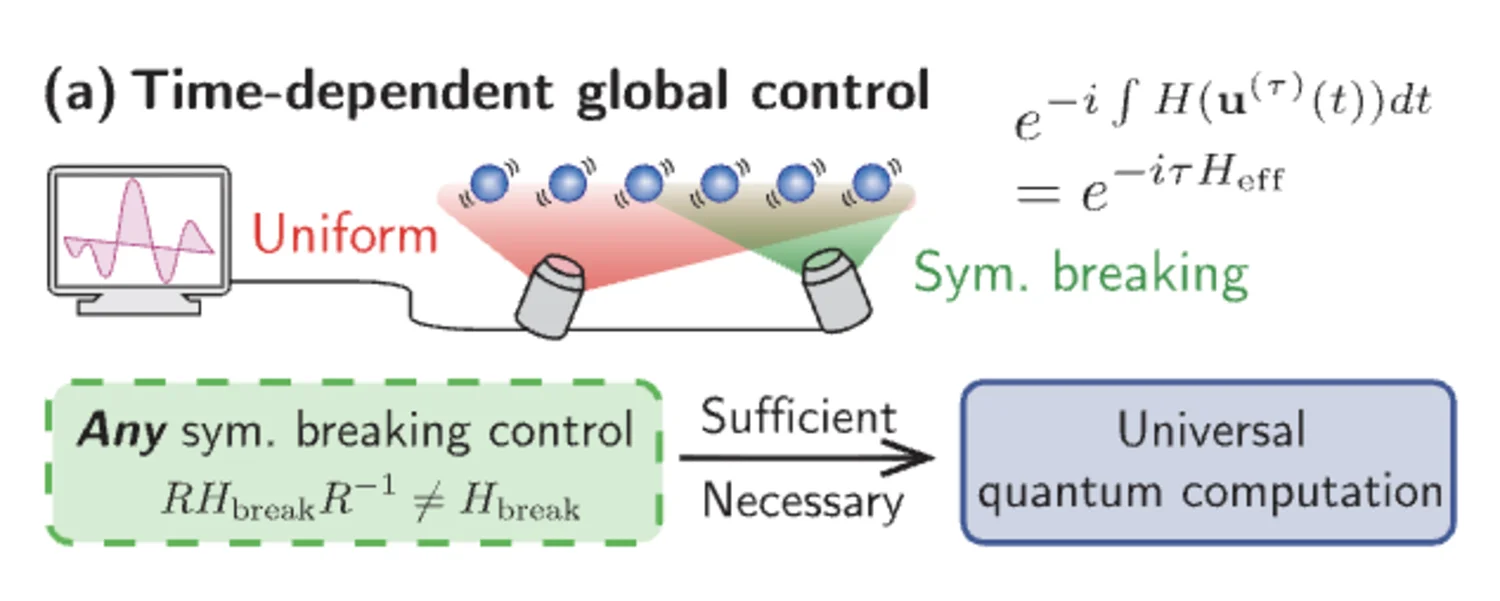
- For a one-dimensional qubit chain with uniform nearest-neighbor interactions and global rotations, adding a controllable field or interaction that breaks mirror symmetry enables universal quantum control.
- Optimized global pulses produced a three-atom ZXZ interaction in an eight-atom chain, with measurements showing signatures of topological edge modes.
PRESS RELEASE — A new theory identifies what globally driven quantum systems need to become fully controllable. In a Rydberg-atom experiment, optimized pulses also create an interaction involving three atoms at once.
The study by Hong-Ye Hu and colleagues is forthcoming in Nature Physics. The linked manuscript is the authors’ preprint.
Many quantum simulators use a small number of laser fields that act on every atom at once. This shared control can make large systems easier to operate, but it raises a basic question: can a device controlled globally perform a full range of quantum operations, or is it limited to the interactions built into its hardware?
For a one-dimensional chain of qubits, the researchers prove a precise rule. With uniform interactions between neighboring qubits and global rotations, the remaining obstacle is mirror symmetry: atoms on opposite sides of the chain are indistinguishable. Add a controllable interaction or field that breaks that symmetry, and universal quantum control becomes possible. The team also extends related results to fermionic and bosonic systems.
Article Intelligence
Sponsored
Ad
NewsLayerLearn more
NewsLayer Premium
Unlock deeper intelligence.
Ad-free reading, exclusive research, and real-time onchain insights.
Go Premium