
This website uses cookies
We use cookies to personalise content and ads, to provide social media features and to analyse our traffic. We also share information about your use of our site with our social media, advertising and analytics partners who may combine it with other information that you’ve provided to them or that they’ve collected from your use of their services.
Consent Selection
Details
  • Necessary cookies help make a website usable by enabling basic functions like page navigation and access to secure areas of the website. The website cannot function properly without these cookies.
  • Preference cookies enable a website to remember information that changes the way the website behaves or looks, like your preferred language or the region that you are in.
    • We do not use cookies of this type.

  • Statistic cookies help website owners to understand how visitors interact with websites by collecting and reporting information anonymously.
    • We do not use cookies of this type.

  • Marketing cookies are used to track visitors across websites. The intention is to display ads that are relevant and engaging for the individual user and thereby more valuable for publishers and third party advertisers.
    • We do not use cookies of this type.

  • Unclassified cookies are cookies that we are in the process of classifying, together with the providers of individual cookies.
    • __emg_sidPending
      Maximum Storage Duration: 1 dayType: HTTP Cookie
      __emg_vidPending
      Maximum Storage Duration: 1 yearType: HTTP Cookie
      nl-read-countPending
      Maximum Storage Duration: PersistentType: HTML Local Storage
Cookie declaration last updated on 8/12/26 by Cookiebot
[#IABV2_TITLE#]
[#IABV2_BODY_INTRO#]
[#IABV2_BODY_LEGITIMATE_INTEREST_INTRO#]
[#IABV2_BODY_PREFERENCE_INTRO#]
[#IABV2_BODY_PURPOSES_INTRO#]
[#IABV2_BODY_PURPOSES#]
[#IABV2_BODY_FEATURES_INTRO#]
[#IABV2_BODY_FEATURES#]
[#IABV2_BODY_PARTNERS_INTRO#]
[#IABV2_BODY_PARTNERS#]
About
Cookies are small text files that can be used by websites to make a user's experience more efficient.

The law states that we can store cookies on your device if they are strictly necessary for the operation of this site. For all other types of cookies we need your permission.

This site uses different types of cookies. Some cookies are placed by third party services that appear on our pages.

You can at any time change or withdraw your consent from the Cookie Declaration on our website.

Learn more about who we are, how you can contact us and how we process personal data in our Privacy Policy.

Please state your consent ID and date when you contact us regarding your consent.
NewsLayer.com
NewsLayer PulseLIVEBTC$72,744+5.38%ETH$2,320+4.61%SOL$87.53+4.59%XRP$1.24+13.22%DOGE$0.08+7.91%ADA$0.1972+6.45%Total Cap$2.58T+6.01%Layer Index74 Greed

La promesa revolucionaria de la computación cuántica está trayendo soluciones al mundo real

La promesa revolucionaria de la computación cuántica está trayendo soluciones al mundo real Newsweek

Newsweek

Publisher

Aug 19, 2026 at 9:00 AM UTC · 17 min de lectura
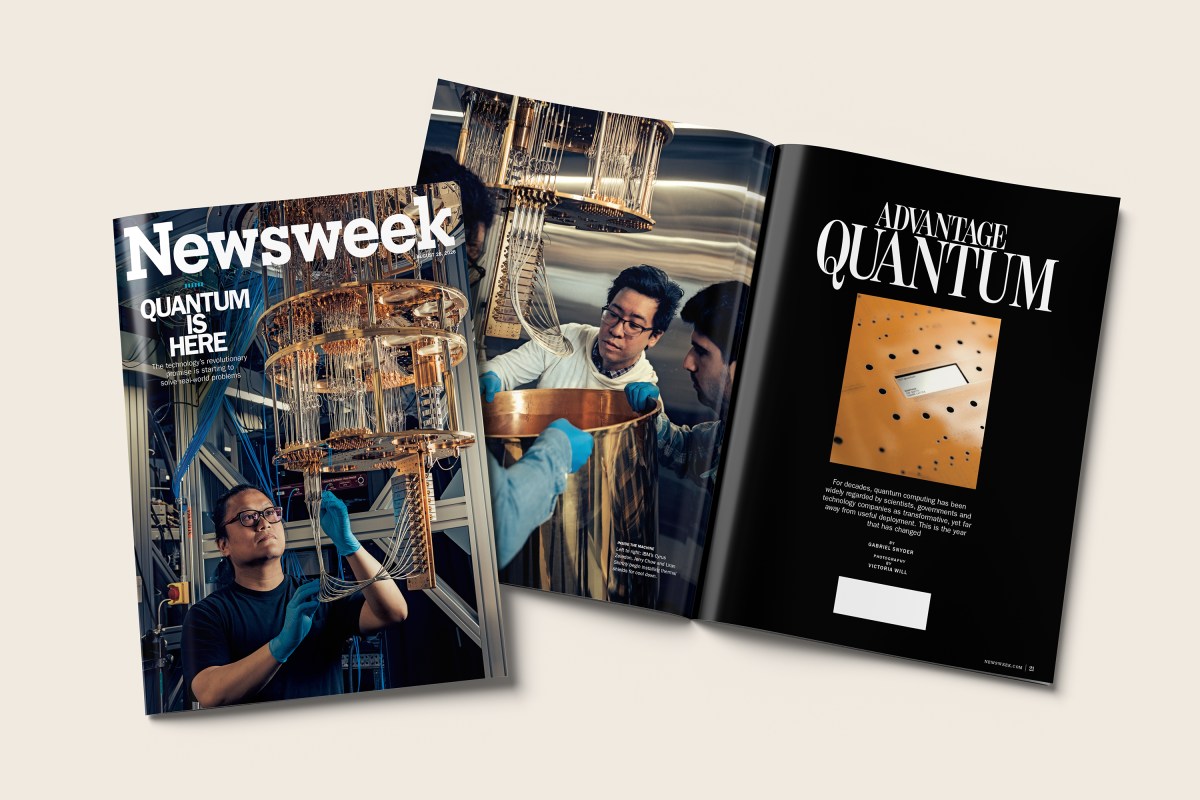
La promesa revolucionaria de la computación cuántica está trayendo soluciones al mundo real
NewsLayer editorial artwork

La idea más difícil de la mecánica cuántica de retener en la cabeza de alguien que no es físico es que una cosa puede estar en dos estados a la vez. No parpadeando entre ellos tan rápido que no se vea, sino en ambos, genuinamente, al mismo tiempo, hasta que alguien mide y se estabiliza en uno. Esa contradicción resulta ser la mejor manera de describir el argumento de décadas sobre el estado de la propia computación cuántica.

Lo cuántico ha sido una tecnología que el Comité Nobel, la Agencia de Seguridad Nacional y la mitad de Silicon Valley coinciden en que reescribirá lo que una computadora puede hacer. También es, simultáneamente, algo tan lejos de estar terminado que ha sido seguro archivarlo junto con la fusión en frío y, hasta hace poco, la inteligencia artificial como maravillas tecnológicas que siempre están al menos a 30 años en el horizonte.

Una computadora ordinaria almacena información en bits, que son interruptores con exactamente dos estados: encendido o apagado, uno o cero. Una computadora cuántica utiliza bits cuánticos, o qubits, que pueden ser ambos a la vez. Encadena suficientes de ellos y el número de estados que pueden mantener simultáneamente crece tan rápido que unos pocos cientos de ellos pueden representar más posibilidades de las que hay átomos en el universo observable. Lo que se podría hacer con una computadora que funciona con qubits ha sido una promesa que la ciencia ha estado persiguiendo durante mucho tiempo.

Article Intelligence

Topics

Sponsored

Ad

House — Advertise on NewsLayer
NewsLayerLearn more

NewsLayer Premium

Unlock deeper intelligence.

Ad-free reading, exclusive research, and real-time onchain insights.

Go Premium