

Insider Brief
RIKEN Team Improves Parallel Control of Silicon Spin Qubits
Insider Brief PRESS RELEASE — Silicon spin qubits are a promising platform for building scalable quantum computers as they are compatible with the semiconductor manufacturing technologies used to produce today’s computer chips. However,…
Matt Swayne
Publisher The Quantum Insider
Oct 19, 2026 at 7:52 AM UTC · Updated hace 13 horas · 3 min de lectura
Traduciendo…
- RIKEN researchers demonstrated high-accuracy parallel control of silicon spin qubits using a shared microwave line and a calibration method that reduces control errors.
- Pairwise phase calibrations helped maintain gate fidelities above 99.99% when operating up to three qubits simultaneously and approximately 99.9% across all five.
- Increased microwave power caused remaining losses in quantum coherence, identifying a limitation that further device improvements could help address.
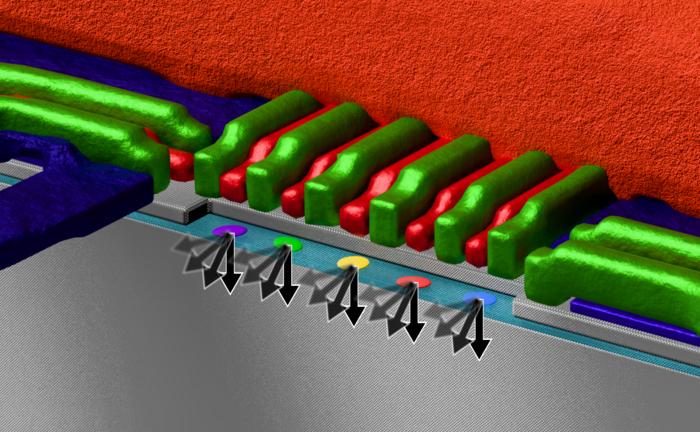
- Image: Rendered illustration of five silicon spin qubits controlled in parallel through a shared microwave line. (RIKEN)
PRESS RELEASE — Silicon spin qubits are a promising platform for building scalable quantum computers as they are compatible with the semiconductor manufacturing technologies used to produce today’s computer chips. However, they have an important weakness: silicon spin qubits typically lose accuracy when several qubits are under parallel control. To be useful, quantum computers will need to operate many qubits simultaneously without compromising the accuracy of their operations.
Now, in a study published in Nature Physics, researchers from the RIKEN Center for Emergent Matter Science and collaborators have addressed this challenge by achieving high-fidelity control of multiple silicon spin qubits operating in parallel. Using a five-qubit silicon array controlled through a single shared microwave line, they identified a key source of errors during the simultaneous operation of qubits and developed a way to mitigate its effects.
Article Intelligence
Key Entities
JustLend
Topics
Sponsored
Ad
NewsLayerLearn more
NewsLayer Premium
Unlock deeper intelligence.
Ad-free reading, exclusive research, and real-time onchain insights.
Go Premium